

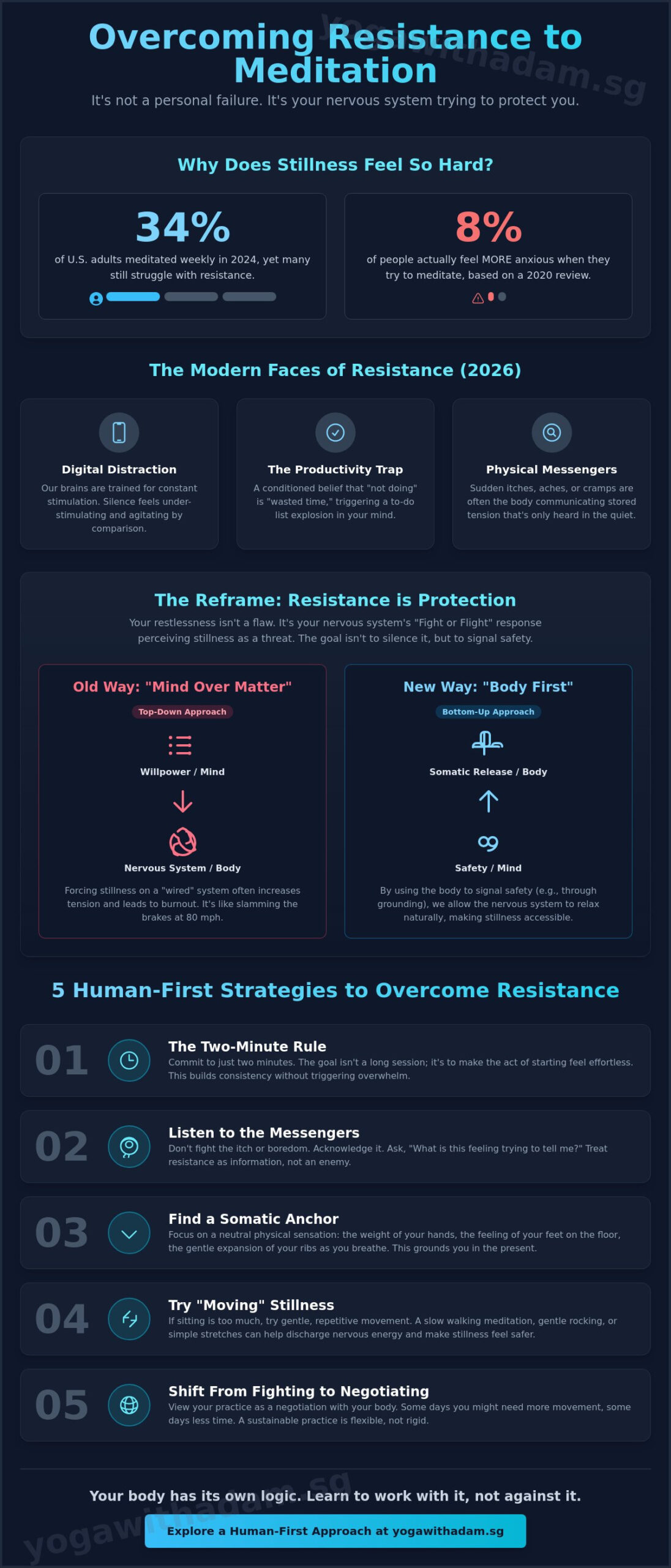
What if the reason you can’t seem to sit still isn’t because you lack discipline, but because your nervous system is doing its job a little too well? We’ve all been there. We set a timer for ten minutes; by minute two, our legs are twitching and our brains are screaming. We feel like failures because we can’t “turn off” our thoughts, even though 34% of U.S. adults managed to meditate weekly in 2024. In reality, a 2020 review of 83 studies found that 8% of people actually feel more anxious when they try to meditate. I’ve found that overcoming resistance to meditation starts with realizing that our restlessness isn’t a flaw; it’s often just a sign of a dysregulated system trying to keep us safe.
I want to help you see that building a practice isn’t about “mind over matter” or forcing yourself to be still. It’s about understanding why your body perceives silence as a threat. In this guide, we’ll look at the science of the “fight or flight” response and explore somatic tools that make your practice feel nourishing rather than punishing. We’ll move away from the pressure of perfection and toward a sustainable way of being that works for your real, human body in 2026.
Key Takeaways
- Learn why your brain creates distractions like sudden boredom or physical itching as a protective shield against the vulnerability of stillness.
- Understand how your nervous system treats silence as a potential threat and how to signal safety to your body instead.
- Explore why a “bottom-up” somatic approach often works better than pure willpower when you’re feeling overstimulated or “tired and wired.”
- Master five human-first strategies for overcoming resistance to meditation, including the “two-minute rule” that makes starting feel effortless.
- Learn to shift your perspective from fighting your internal pushback to negotiating with it for a practice that’s actually sustainable.
What is Resistance to Meditation and Why Does it Happen?
Resistance is that sudden, loud internal “no” that happens the moment you sit down on your cushion. It shows up as a physical itch that wasn’t there two seconds ago, a sudden urgent need to check your email, or a wave of intense boredom. When we look at the foundational concepts of What is Mindfulness, we see it’s about present-moment awareness. But for a brain that’s used to constant stimulation, that awareness can feel like a threat. This pushback isn’t a character flaw or a sign that you’re “bad” at being still. It’s actually your mind trying to solve a problem it perceives as unsafe. In 2026, our systems are primed for action, not stillness. Overcoming resistance to meditation requires us to stop seeing this friction as a barrier and start seeing it as a biological signal. It’s your body’s way of saying it doesn’t feel ready to let its guard down yet.
The ‘Lazy’ Myth: Why Willpower Isn’t the Answer
Many of us fall into the trap of thinking we just need more discipline. We tell ourselves we’re lazy, which triggers a cycle of guilt that eventually makes us abandon the practice entirely. A 2023 survey showed that while 56% of adults over 50 meditate to cope with stress, many struggle to maintain the habit because it feels like another chore on an already long list. Trying to “white-knuckle” your way through a session only increases internal tension. At Yoga with Adam, we practice “Yoga for Humans,” which means we acknowledge that your nervous system has its own logic. If your body feels “wired,” forcing it to be still is like slamming on the brakes of a car going 80 mph. It doesn’t lead to peace; it leads to burnout. Discipline is helpful, but it’s a poor substitute for safety.
Common Faces of Resistance in 2026
Resistance has changed its look in recent years. We aren’t just fighting a simple “monkey mind” anymore; we’re fighting a sophisticated dopamine loop. Here is how it usually shows up:
- Digital Distraction: With AI companions like Headspace’s Ebb exchanging over one million messages with users as of April 2026, we’ve become accustomed to interactive, responsive wellness. Pure silence can feel under-stimulating and even agitating by comparison.
- The Productivity Trap: We’re conditioned to believe that if we aren’t “doing,” we’re failing. This makes the meditative pause feel like wasted time, triggering a “to-do list” explosion in your brain.
- Physical Messengers: That sudden back ache or foot cramp isn’t always an obstacle. It’s often the body’s way of communicating stored tension that only becomes loud enough to hear when the external world goes quiet.
I’ve found that overcoming resistance to meditation becomes much easier when we stop treating these symptoms as enemies. They’re just messengers. When we listen to what the itch or the boredom is trying to tell us, we can start to work with our bodies instead of against them.
The Body’s Defense: Reframing Resistance as Nervous System Protection
I used to think my inability to sit still was a personal failure, but I’ve learned that your body actually has a very good reason for making you feel twitchy. When your nervous system is stuck in a state of high alert, closing your eyes and trying to be quiet can feel less like peace and more like being a sitting duck. This is your “fight or flight” response in action. If your brain perceives the environment as stressful, it won’t let you relax because relaxation feels like a dangerous drop in your defenses. Overcoming resistance to meditation isn’t about fighting these signals. It’s about recognizing that your body is trying to protect you. By understanding common resistances to meditation, like restlessness or sudden anxiety, we can stop judging our physiology and start working with it.
The key player here is your Vagus nerve, which acts as the “brake” for your stress response. If this nerve isn’t sending a strong “all clear” signal, your body stays in a state of chronic dysregulation. This is especially true in 2026, where micro-stressors from digital overload are constant. For anyone who has experienced trauma or even just a very difficult year, traditional stillness can feel threatening. Your brain is essentially saying, “I can’t be still right now; I need to stay ready.” When we approach our practice with this understanding, we move from being “bad meditators” to being humans with protective instincts. If you want to explore how to move your body toward this state of ease, you might enjoy our Yoga for Humans sessions.
When Stillness Feels Scary
For some of us, sitting still triggers a state of hyper-arousal where every small sound feels like a jump-scare. For others, it triggers a “freeze” response, which often manifests as a thick mental fog or a feeling of being completely checked out during your session. These aren’t signs that you’re doing it wrong; they are signs that your system is overwhelmed. Somatic safety is the foundation of any successful meditation practice. Without that feeling of safety in your own skin, your brain will keep throwing up roadblocks to prevent you from dropping into a deep state of presence.
The Role of Cortisol and Adrenaline
When your system is flooded with cortisol and adrenaline, a “monkey mind” isn’t a bug; it’s a physiological necessity. Your brain is scanning for threats and keeping you alert because it believes you are in a high-stakes situation. Forcing yourself to be “calm” when your blood is pumping with stress hormones can actually trigger a secondary stress response, making you feel even more agitated. This is why a broader approach to holistic mental wellness is so vital. We need to address the chemical reality of our bodies before we ask our minds to be quiet. Overcoming resistance to meditation often starts with simple movements or breathwork that helps clear these hormones, rather than just sitting there and hoping the storm passes.
Mental Willpower vs. Somatic Release: Choosing Your Path
Most of us were taught that meditation is a mental game. We sit down, close our eyes, and try to “tame” the mind through sheer force of will. This is what I call a top-down approach. It assumes the brain is in charge and the body will simply follow suit. But if you are already feeling overstimulated, your brain is likely the last part of you that’s going to listen to reason. Overcoming resistance to meditation often requires a shift to a bottom-up approach. Instead of arguing with your thoughts, you use your body to signal to your brain that it’s safe to settle down. It’s much easier to quiet a mind that lives in a relaxed body than one trapped in a buzzing, tense one.
I’ve found that using sound is one of the most effective ways to bridge this gap. When we use meditation and mantra, we give the “monkey mind” a specific job to do. The vibration of the sound actually stimulates the vagus nerve, which we talked about earlier, helping to manually flip the switch from stress to ease. It bypasses the analytical intellect entirely. If you’re struggling, I highly recommend checking out this self-compassionate guide to overcoming resistance. It reminds us that we don’t need to be perfect; we just need to be kind to ourselves as we navigate these internal hurdles.
Active Meditation: The Secret for Restless Minds
On days when sitting still feels like a punishment, active meditation is your best friend. This isn’t “cheating”; it’s a valid on-ramp for a high-resistance nervous system. Practices like Kundalini Yoga are incredibly effective because they combine repetitive movement with specific breathwork patterns. This helps to discharge the restless energy that makes traditional stillness feel impossible. Sometimes, the best way to find silence is to move until your body is ready for it. Simple techniques like “shaking” for two minutes can break up the physical patterns of stress, making overcoming resistance to meditation feel like a natural progression rather than a fight.
TRE®: Shaking Off the Resistance
For many professionals here in Singapore, the baseline of stress is so high that the body forgets how to let go. This is where Tension & Trauma Releasing Exercises (TRE®) come in. TRE® involves a series of simple exercises that assist the body in releasing deep muscular patterns of stress by inducing involuntary tremors. These tremors are a natural “reset” button for the nervous system. By discharging this stored energy before you ever sit down to meditate, you remove the physiological fuel that powers your resistance. It’s a game changer for anyone who feels “tired and wired” and wants a practice that actually feels sustainable for the long haul.
5 Human-First Strategies to Overcome Meditation Resistance
Forget the “just push through it” mentality. That’s advice for robots, not for real humans living in 2026. If you’ve ever felt like a failure because you couldn’t finish a twenty minute session, you aren’t alone. Data from 2024 shows that while 34% of U.S. adults meditate at least weekly, only 14% manage to do it daily. The gap between wanting to meditate and actually doing it is where resistance lives. Overcoming resistance to meditation isn’t about finding more willpower; it’s about making the practice so accessible that your nervous system doesn’t feel the need to rebel. We do this by working with our biology rather than against it.
- Strategy 1: The Two-Minute Rule. We lower the bar until it’s touching the floor. If ten minutes feels like a mountain, do two.
- Strategy 2: Habit Stacking. Link your practice to something you already do and love, like waiting for your morning coffee to brew or sitting in your car after work.
- Strategy 3: Sensory Anchoring. Use a specific scent, a weighted blanket, or a particular song to signal to your brain that it’s time to transition into a “safe” space.
- Strategy 4: The Gentle Inquiry. Instead of telling your resistance to shut up, ask it what it’s trying to protect you from.
- Strategy 5: Community Support. There’s a different energy when we meditate together. In a fast paced city like Singapore, sitting with others can help anchor your own wandering mind.
Lowering the Barrier to Entry
I always tell my students that a “bad” two minute meditation is infinitely better than a “perfect” twenty minute one that never happens. We need to stop treating meditation like a performance. On high stress days, I use a “Meditation Minimum.” This is my non-negotiable tiny slice of time that I can do even when I’m exhausted. It helps maintain the neural pathways of the habit without triggering the “productivity trap” we discussed earlier. Create a space that feels cozy and inviting, not clinical or intimidating. If your cushion makes your back ache, sit in a chair. If closing your eyes feels scary, keep them open with a soft focus. Your comfort is the priority.
The Power of Gentle Inquiry
When the “to-do list” starts exploding in your brain, try treating those thoughts like a guest who arrived too early for a party. You don’t have to kick them out, but you don’t have to stop everything to entertain them either. Compassionate observation is the act of noticing resistance without judgment. When you feel the urge to quit, ask yourself: “What does this restlessness need right now?” Sometimes it needs a deeper breath, and sometimes it just needs to be acknowledged. Overcoming resistance to meditation becomes a lot easier when you stop seeing yourself as the problem. If you’re ready to stop fighting your own mind, explore our beginner friendly sessions where we prioritize your comfort over rigid rules.
Moving Beyond the Barrier: Integrating Practice into Real Life
We’ve spent this guide reframing your internal pushback, moving from a place of battle to a place of conversation. I want you to remember that overcoming resistance to meditation isn’t a one-time event where you finally “win” over your mind. It’s a daily negotiation with your nervous system. Some days your body will feel open and ready for stillness; other days, it will feel like a live wire. Both versions of you are welcome in this practice. The goal isn’t to reach a state of perfect, thoughtless bliss, but to build a relationship with yourself where you don’t have to run away from your own discomfort.
Sustainable brain rewiring depends on consistency rather than intensity. While we often think we need massive blocks of time to change, the nervous system actually responds better to small, frequent signals of safety. In the fast-paced environment of 2026, a five-minute practice you actually do is infinitely more powerful than a thirty-minute session you skip. For many of us, overcoming resistance to meditation becomes easier when we stop trying to be perfect and start being consistent. You’re essentially learning to speak a new language with your body, and like any language, it’s the daily immersion that makes you fluent.
Finding Your Tribe in Singapore
Group practice offers a unique kind of support that’s hard to find in solo sessions. When we sit together, the collective focus acts as a stabilizer for individual restlessness. This shared experience is why corporate wellness programs have become a cornerstone for modern teams. They move mindfulness out of the “spiritual” box and into the practice of human sustainability, making it a normal part of the workday. At Yoga with Adam, we focus on making these moments feel attainable rather than like another high-pressure task on your calendar.
Your Next Steps Toward Stillness
If your solo practice feels like a constant uphill climb, it might be a sign that you need a guide to help you navigate the deeper layers of your resistance. While self-guided tools are great, they can’t always see the blind spots in your own stress patterns. For those deep-seated blocks, private healing sessions offer a tailored, somatic approach that targets exactly where you’re holding tension. These sessions provide the one-on-one mentorship needed to move through the physiological barriers that apps simply can’t reach. Remember, you aren’t broken; you’re just a human learning to navigate a very loud world. Let’s find a version of meditation that actually feels like home.
Start Listening to Your Body’s Wisdom
We’ve moved past the idea that you’re “bad” at being still. As we explored, your restlessness is a biological signal from a nervous system that values your safety above all else. By shifting from mental force to somatic release, you turn a chore into a sustainable habit that actually supports your life in 2026. Whether you use the two-minute rule or discharge tension through shaking, you’re building a practice that respects your human limits.
I’ve spent over 10 years guiding real humans through the unique stresses of life in Singapore. As a certified TRE® Provider and Kundalini Yoga lead, my focus is on providing trauma-informed, sustainable wellness that works for your specific body. My goal is to make overcoming resistance to meditation feel like a natural homecoming rather than a daily battle. You don’t have to do this alone.
Ready to move past the struggle? Book a Kundalini or TRE session with Adam today.
You aren’t broken; you’re just learning a new way to communicate with yourself. I can’t wait to help you find that sense of ease you deserve.
Frequently Asked Questions
Is it normal to feel angry or frustrated when I try to meditate?
It is completely normal and much more common than people realize. A 2020 review of 83 studies found that approximately 8% of participants experienced negative effects like increased anxiety or frustration during meditation. This anger is often just your “fight” response kicking in because your nervous system feels vulnerable in the silence. Instead of judging the feeling, try to see it as a protective energy that simply needs a safe way to move through you.
How long does it take for meditation resistance to go away?
Resistance doesn’t usually disappear forever; it just becomes easier to manage. Most practitioners find that after about 21 to 60 days of consistent, low-pressure practice, the initial “itchiness” begins to subside. This happens because your brain starts to recognize the habit as safe. Overcoming resistance to meditation is a gradual process of building trust with your own body rather than a one-time hurdle you jump over.
Can I meditate while walking if I can’t sit still?
Yes, walking meditation is a valid and highly effective practice for those who find sitting impossible. It provides the rhythmic, bilateral movement that helps regulate a “fight or flight” response. Focus on the physical sensation of your feet hitting the pavement or the floor. This movement-based approach is often the best “on-ramp” for real humans who feel trapped by the traditional requirement of total physical stillness.
What should I do if my mind simply won’t stop racing?
If your mind is racing, stop trying to make it stop. Instead, give it a specific job like counting breaths or repeating a simple mantra. Trying to force a quiet mind often just creates more internal friction and stress. If the thoughts feel overwhelming, try opening your eyes and naming five objects you see in the room. This simple somatic grounding technique can pull you out of a mental loop and back into your body.
Is 5 minutes of meditation actually enough to see benefits?
Five minutes is absolutely enough to trigger positive physiological changes in your system. Even short bursts of intentional breathing can stimulate the vagus nerve and begin to lower cortisol levels. A 2023 study found that consistent, short mindfulness practices were as effective as some medications for managing anxiety disorders. It’s the regularity of the practice that rewired the brain, not the length of any single session.
Why do I get sleepy as soon as I start meditating?
Falling asleep is usually a sign that your body is finally feeling safe enough to relax and is realizing how exhausted it truly is. In 2026, many of us live in a state of “tired and wired” where we only feel our fatigue when we stop moving. If you’re constantly nodding off, try meditating with your eyes slightly open or even standing up. This keeps enough “upward” energy in your system to stay present.
Does everyone experience resistance, even experienced teachers?
I’ve been teaching for over 10 years, and I still have days where I’d rather do anything else than sit still. Resistance is a universal human experience, not a sign that you’re doing it wrong. The difference for experienced practitioners is that we’ve learned to see resistance as a guest rather than an enemy. Overcoming resistance to meditation simply means you keep showing up and negotiating with that internal “no” with a bit more kindness each time.
Can TRE® help if I find traditional meditation too boring?
TRE® is an excellent alternative because it’s a physical, engaging process that doesn’t require you to be quiet or still. It uses involuntary tremors to discharge the built-up energy that often makes sitting feel “boring” or physically painful. By clearing that stored stress first, you might find that stillness eventually feels more natural. It’s a great way to work with your body’s needs instead of fighting against a wandering mind.