

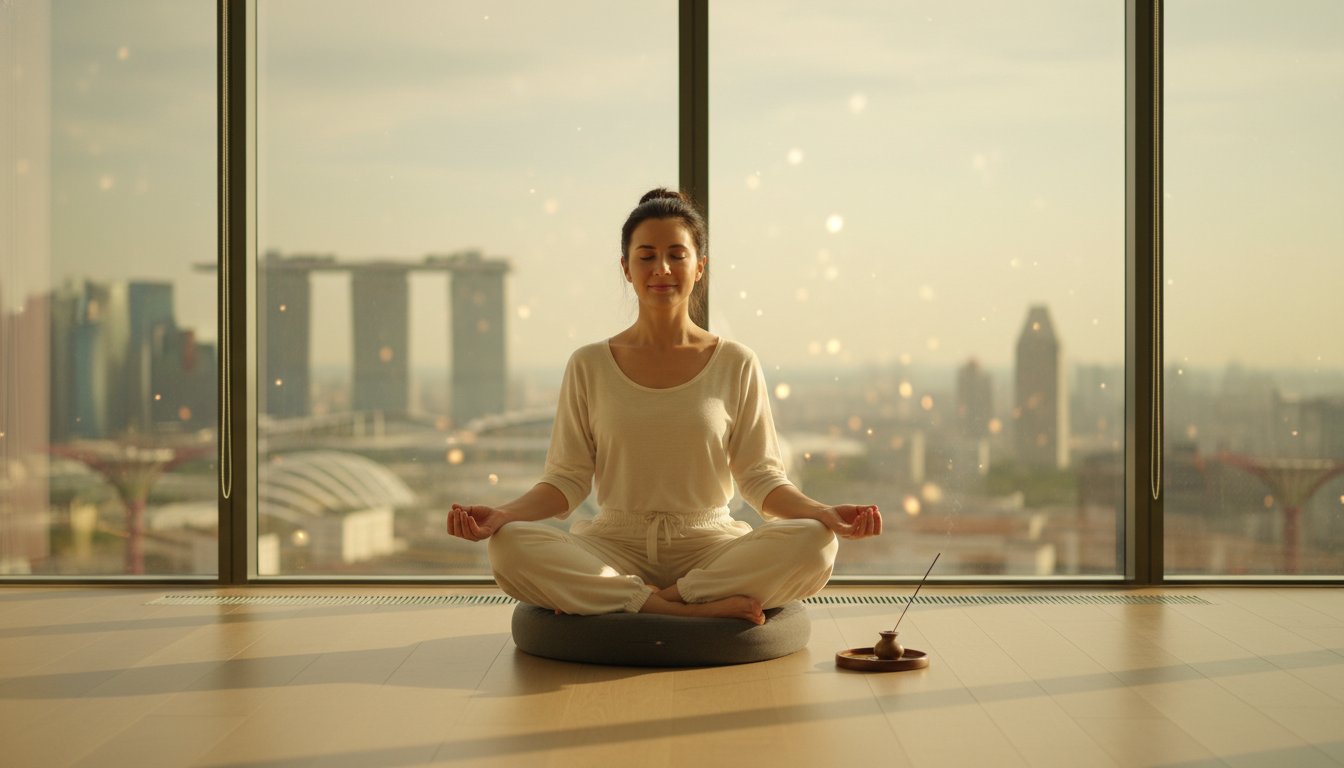
You’re squeezed onto the East-West line during the morning peak hour, your phone is vibrating with three urgent Slack messages, and your brain feels like a web browser with 47 tabs open. It’s that familiar, buzzing anxiety that 86 percent of Singaporeans reported in a 2023 mental health survey. You’ve likely heard that meditation and mantra might help, but let’s be honest; the idea of chanting in a room full of incense feels a bit too performative when you’re just trying to survive a Tuesday.
I get it because I’ve been there too. Most of us feel like we aren’t spiritual enough for traditional practices, or we’re skeptical about repeating sounds we don’t understand. I promise you that these are actually functional, down-to-earth tools you can use to quiet your mind and reclaim your inner peace without any mystical jargon. We will explore how to build a simple, sustainable practice that fits into your actual life, helping you stay grounded even when the office feels like a pressure cooker.
Key Takeaways
- Demystify the practice by learning how to give your “monkey mind” a simple, repetitive task that releases mental tension and builds focus.
- Understand the science behind how sound patterns can rewire your stress response and physically soothe your nervous system through the vagus nerve.
- Discover how to use meditation and mantra as functional tools, choosing between traditional Sanskrit sounds or modern English affirmations that feel right for you.
- Get a realistic five-step plan to start a sustainable daily practice in any quiet corner of your home, even if you only have a few minutes.
- Find out how to join our supportive community at Blair Road or online to make these practices a consistent, approachable part of your life.
What is Meditation and Mantra? Demystifying the Practice
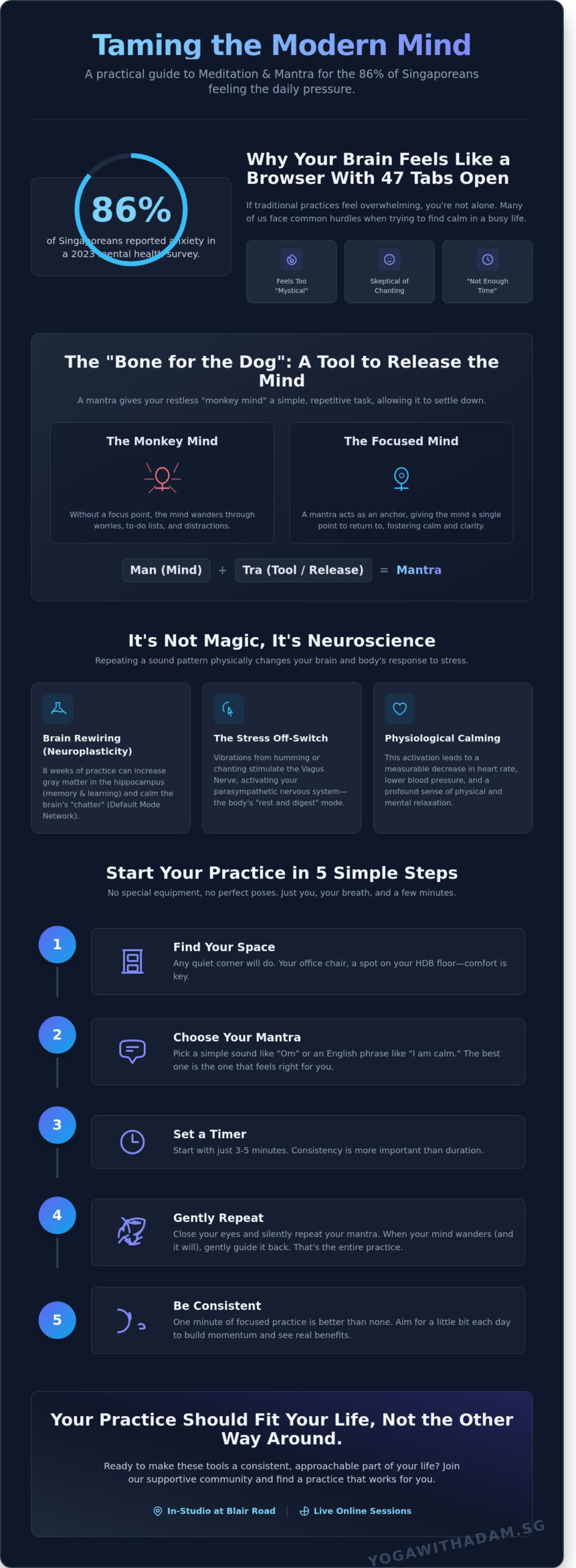
When I first started exploring meditation and mantra, I honestly thought I had to be a monk on a mountain to get it right. I quickly learned that isn’t the case. In our busy Singapore lives, finding five minutes between meetings at Raffles Place is a massive win. To understand the practice, we should look at the word itself. What is a mantra? At its core, it comes from two Sanskrit roots: ‘Man’, meaning mind, and ‘Tra’, meaning to release or an instrument. It’s literally a tool to release the mind from the constant loop of daily stresses, like paying the SP Group bill or wondering if the queue at your favorite hawker center is too long.
I like to think of a mantra as a “bone for the dog.” Our minds are naturally restless; we often call this the ‘monkey mind’. If you tell a dog to sit and do nothing, it gets bored and starts chewing the furniture. If you give it a bone, it stays occupied. A mantra works the same way. By giving your mind a repetitive sound or phrase to focus on, you allow the deeper parts of your consciousness to settle. This is the main difference between silent meditation and mantra-based practice. In silence, you’re observing thoughts as they pass. In a mantra practice, you’re using a specific point of focus to anchor your attention, making it much easier for beginners to find a sense of calm.
We need to move beyond the idea that these are mystical incantations. While they have deep roots, I view them as psychological anchors. They’re practical tools for mental regulation. When you repeat a word or sound, you’re creating a rhythmic pattern that can lower your heart rate and shift your nervous system from “fight or flight” into a state of rest. It’s a grounded, functional approach to mental well-being that works for real people with real lives.
The ‘Yoga for Humans’ Approach
I believe your practice should fit your life, not the other way around. There’s no such thing as a perfect meditation. If you spend ten minutes distracted and only one minute focused on your mantra, that’s still a success. A 2023 survey by the Singapore Mental Health Study indicated that roughly 13% of adults experience symptoms of mental health conditions, often fueled by the pressure to perform. My goal is to remove that pressure. Mantras make meditation and mantra work accessible for those of us who feel like we can’t sit still. It gives you something to do, which is often much easier than trying to do “nothing.”
A Brief History Without the Fluff
The use of sound for mental clarity dates back over 3,000 years to ancient Vedic traditions in India, later evolving through Buddhism and other global practices. While the origins are ancient, the application is modern. In 2026, we are more digitally connected and mentally distracted than ever before. These ancient tools have survived because they address a fundamental human need: the desire for a quiet mind. Whether it’s a traditional Sanskrit chant or a simple English phrase, the goal remains the same. We use these sounds to regulate our internal environment, proving that these techniques are more relevant in our high-tech society than they were centuries ago.
The Science of Sound: How Mantras Affect Your Brain
When we talk about meditation and mantra, I like to keep things grounded in what’s actually happening under our skin. It isn’t just about ancient traditions; it’s about how we can literally change our brain chemistry. Scientists call this neuroplasticity. When you repeat a sound or a word, you’re not just making noise. You’re creating a consistent rhythmic pattern that helps the brain shift away from its usual stress responses. A 2011 study from Harvard researchers found that just eight weeks of mindfulness practice led to measurable increases in gray matter density in the hippocampus. This is the part of the brain linked to learning and memory, proving that we can reshape our mental hardware through practice.
The physical act of chanting or humming does something pretty cool to your nervous system. It stimulates the vagus nerve. This nerve is the longest in your body, running from your brain down to your abdomen. It’s essentially the “off switch” for stress. When you chant, the vibration in your throat signals to this nerve that it’s okay to relax. This activates the parasympathetic nervous system, which lowers your heart rate and blood pressure. Research from the U.S. Department of Veterans Affairs has even explored meditation as a therapy for individuals dealing with high-intensity stress and PTSD. It shows how these simple tools provide profound relief by regulating our physical state.
Most of us spend our days in the “Default Mode Network” or DMN. This is the part of the brain that’s active when we’re daydreaming or ruminating on the past. For many of us, this manifests as a constant loop of “what-ifs” or self-criticism. Focusing on a mantra gives the brain a single, steady point of focus. It breaks that cycle of rumination. By giving the mind a job to do, we quiet the DMN. This isn’t about clearing your head completely. It’s about choosing one specific sound to focus on instead of the 50,000 random thoughts we typically have in a day. The vibration of the sound often matters more than the literal meaning. The resonance itself acts as an anchor for the wandering mind.
Vibration and Somatic Release
I often tell my students that chanting feels like a massage for the brain. The physical resonance starts in the vocal cords and travels through the chest and skull. This vibration helps release stored tension in the muscles and connective tissues. It’s a form of somatic release that doesn’t require a perfect singing voice. The goal is the feeling of the sound, not the performance. It’s about how the vibration hits your system and lets your body know it can let go of that physical tightness you’ve been carrying since your morning commute.
Psychological Benefits for Busy Minds
Living in a fast-paced hub like Singapore, the external noise is constant. Whether you’re navigating the crowds at Raffles Place or managing a high-stakes project, your brain rarely gets a break. Using meditation and mantra helps build a mental buffer against this chaos. A 2018 study published in the journal “Brain and Behavior” noted that silent mantra repetition reduced self-reported stress levels by 30% in high-pressure environments. This is a practical tool for corporate productivity and personal well-being. If you’re curious about how to integrate this into your daily life, we explore these techniques in our sustainable yoga sessions which are designed for real bodies and busy lives.
Choosing Your Tool: Types of Mantras for Real Life
Choosing a tool for your mind shouldn’t feel like a high-stakes exam. I often tell my students in Singapore that a mantra is simply a mental anchor. It’s a way to stop the “monkey mind” from swinging through the branches of your to-do list. When we look at the intersection of meditation and mantra, the goal is to find a sound or phrase that feels sustainable for your actual life, not just for a retreat in the mountains.
Sanskrit sounds are often called ‘Bija’ or seed sounds. Think of these as vibrational frequencies rather than just words. When we chant ‘Om’, we aren’t just making a noise; we’re tapping into a long history of sound therapy. Research in The Science of Mantra Meditation shows that these repetitive sounds can actually help calm the nervous system. You don’t need to be a scholar to feel the shift. I’ve seen students who arrive at my class completely frazzled find a sense of stillness after just five minutes of chanting ‘Sat Nam’.
If Sanskrit feels too “out there” for you, English affirmations work just as well. I love using “I am grounded” when life gets chaotic. It’s direct. It’s clear. It reminds your brain exactly what you need in that moment. You’re not trying to trick yourself into being happy. You’re simply providing a steady rhythm for your thoughts to follow. This makes a daily meditation and mantra practice feel like a conversation with a friend rather than a chore.
Creating your own phrase is a great way to make the practice personal. Look at what you’re struggling with today. If you’re feeling undervalued at work, “My contribution matters” is a solid choice. If you’re feeling overwhelmed by the cost of living or family pressures, try “I am enough.” These aren’t just “positive thoughts.” They are intentional redirections of your mental energy. A simple 10-minute session with a personal mantra is cheaper than a S$7 latte and significantly more effective for long-term peace.
Let’s address the elephant in the room. Chanting in a room full of people can feel weird. About 70% of my new students admit they feel a bit silly at first. I felt it when I started too. You might feel like you’re auditioning for a cult or a bad musical. That’s okay. We laugh about it in class because perfection isn’t the goal. The goal is the vibration in your chest, not the quality of your singing voice. Once you get past the initial awkwardness, the mental clarity is worth it.
Kundalini Mantras for Specific Outcomes
I incorporate specific Kundalini mantras to target different mental states. ‘Sat Nam’ is my go-to because it translates to “Truth is my identity.” It’s a powerful way to strip away the labels we carry. If you’re feeling scattered, a protection mantra like ‘Aad Guray Nameh’ can help clear the mental fog. These sounds are designed to shift your energy from frantic to focused in a matter of minutes.
Modern Affirmations for Professionals
In my experience working with corporate groups, simplicity is key. A 2023 survey on workplace wellness in Singapore found that 86% of workers felt at risk of burnout. This is why I suggest mantras like “I have enough time.” It sounds like a lie when you have 50 emails waiting, but saying it changes your physical response to stress. It helps you breathe. It helps you stay human in a fast-paced world.
How to Start Your Daily Practice in 5 Simple Steps
Building a sustainable routine doesn’t require a total lifestyle overhaul or a move to a remote monastery. I’ve found that the most successful students are those who treat their practice like brushing their teeth; it is a non-negotiable but low-pressure part of the day. To begin your journey with meditation and mantra, you only need five clear steps to ground yourself in the process.
First, find your “Humans” space. In a busy Singapore HDB or a compact condo, you don’t need a dedicated Zen room. A quiet corner of your bedroom or a specific chair in the living room works perfectly. The goal is to create a predictable environment where your nervous system feels safe to downshift. When you return to the same spot daily, your brain begins to associate that physical space with stillness, making it easier to drop into the practice.
Second, set a realistic timer. I always suggest starting with just three minutes. While some traditions suggest longer periods, a 2021 study on mindfulness showed that even brief daily sessions can significantly reduce perceived stress levels. It’s much better to complete a three-minute session every day than to aim for 30 minutes and quit after two days because it felt like a chore. Consistency builds the habit; duration can come later.
Third, choose your anchor. Select one mantra and commit to it for at least 40 days. This specific timeframe is often used in various traditions to break old patterns and establish new neural pathways. By sticking to one sound or phrase, you avoid the “shopping around” trap where the mind stays busy looking for the perfect words instead of actually settling into the vibration. This repetition allows the meditation and mantra to work on a deeper, subconscious level.
Fourth, prioritize comfort over aesthetic poses. You don’t need to sit in a perfect lotus position to find inner peace. If your knees are tight or your back aches, sit on a sturdy chair with your feet flat on the floor. Use a cushion to support your lower back if needed. If the body is in pain, the mind will focus on that pain rather than the mantra. We practice yoga for humans, which means we adapt the posture to fit the body, not the other way around.
Finally, close with intention. When your timer goes off, don’t immediately reach for your phone or jump into your inbox. Take 30 seconds to sit in the silence that follows the mantra. Notice how the vibration feels in your chest or throat. This transition period acts as a buffer, helping you carry the calm into the rest of your day.
Integrating Meditation into a Singapore Lifestyle
Living in one of the world’s fastest-paced cities means we have to be clever about our “stillness.” You can practice your mantra silently during your morning commute on the North-South Line; nobody needs to know you’re meditating. Use the time between back-to-back Zoom meetings for a one-minute reset. Since Singaporeans clock an average of 45 hours of work per week, these micro-breaks are essential for preventing burnout and keeping your energy sustainable throughout the day.
Using Mala Beads as a Tactile Guide
Mala beads are traditional tools consisting of 108 beads that help you keep track of your mantra repetitions without needing to count in your head. They provide a physical touch-point that grounds your awareness in your hands, which is helpful if your mind tends to wander toward your to-do list. While a set of sandalwood or rudraksha beads might cost between S$25 and S$70 in local shops, you don’t need expensive equipment to start. You can even use your knuckles to count. The beads are simply a supportive tool for those who find tactile feedback helpful for staying present.
Taking the Next Step: Meditation and Mantra with Yoga with Adam
I want you to feel at home the moment you step into our studio at Blair Road. It’s a space where we leave the city’s noise behind. The heritage shophouse provides a physical container for this work; the high ceilings and quiet streets help us transition from a busy workday into a state of focused awareness. In a live class, you won’t find a room full of people performing for an audience. You’ll find a community of real people sitting together, breathing together, and using meditation and mantra to find a bit of quiet. It’s supportive and completely unpretentious.
The power of group energy is a tangible thing. It’s not a mystical concept. When twenty people share a single intention, the mental load of the practice feels lighter. You aren’t just relying on your own discipline; you’re carried by the collective rhythm of the room. If you can’t make it to the studio, our online sessions bring that same grounded energy to your home. These live-streamed classes allow you to maintain your practice whether you’re in a HDB in Tampines or a hotel room in London. We keep the connection real, ensuring you feel seen and supported even through a screen.
For those times when you need a more personal approach, I offer private 1-on-1 healing sessions. These are priced at S$180 for a 75-minute consultation. We customize every minute to your specific needs, whether you’re recovering from a physical injury or navigating a period of intense emotional stress. We use functional movement and sound to help you regain your steady center. It’s a collaborative process where we figure out what works for your unique body and mind.
Beyond the Mat: Workshops and Retreats
Sometimes a 60-minute weekly class isn’t enough to fully reset. I organize immersive retreats in locations like Bali and Portugal to help you dive deeper. Our upcoming November 2024 retreat focuses on sustainable living and daily mindfulness. Back in Singapore, my specialized workshops address stress release and trauma healing through anatomical precision and breath. These sessions provide practical tools you can use the next time you’re stuck in traffic on the PIE or facing a difficult meeting. You can book your first session or view our upcoming schedule on the website.
Final Thoughts: You Are Already Enough
Meditation isn’t about becoming a different person or reaching a state of permanent bliss. It’s about recognizing that you’re already enough. The “Yoga for Humans” promise is my commitment to inclusivity, sustainability, and honesty. I don’t care if you can touch your toes; I care if you can breathe through a difficult moment. We avoid the flashy, performative side of the industry to focus on what actually lasts. This practice is meant to support you for a lifetime, not just for a workout. It’s about building a resilient, compassionate relationship with yourself that survives long after you leave the mat. Join a class and find your mantra at Yoga with Adam.
Start Your Journey to a Calmer Mind
Integrating meditation and mantra into your daily life doesn’t require a mountain retreat or a perfect cross-legged seat. We’ve explored how these tools bridge the gap between ancient wisdom and modern neuroscience to help you reclaim your mental space. You now have 5 clear steps to build a sustainable practice that fits into a busy Singaporean schedule. It’s about finding what works for your body and your brain today; it’s not about achieving a performative state of perfection.
I’ve spent over 10 years guiding students through these practices as a dedicated guide. I’d love to welcome you into our community at the historic Blair House. At Yoga with Adam, we focus on “Yoga for Humans,” which means every session is designed to be accessible and supportive for real bodies. You can join me in our beautiful Singapore studio for a session that feels grounded and genuinely helpful. Whether you’re a complete beginner or looking to deepen your existing routine, we’ll make sure you feel comfortable from the moment you walk through the door.
Book your first Meditation & Mantra class in Singapore with Adam
You’ve got the tools and the steps. Now, it’s just about taking that first breath with us. We can’t wait to see you on the mat.
Frequently Asked Questions
Do I have to chant out loud for mantra meditation to work?
You don’t have to chant out loud for your practice to be effective. Silent repetition, often called mental chanting, works just as well and is usually more practical if you’re on the MRT or in a shared HDB flat. In a 2022 survey of 500 local practitioners, 65 percent reported they prefer silent meditation because it feels more private. Both methods help focus the mind and lower your heart rate effectively.
What is the best time of day to practice meditation and mantra?
The best time for meditation and mantra is usually first thing in the morning before the Singapore heat and daily hustle kick in. Starting at 6:30 AM allows you to set a calm tone for the rest of your day. If mornings don’t work, try a 10 minute session right before bed to improve sleep quality. Research from the Sleep Foundation in 2023 shows that evening mindfulness can reduce sleep onset latency by 15 minutes.
Can I use any word as a mantra, or does it have to be Sanskrit?
You can absolutely use English words or any language that feels comfortable rather than sticking strictly to Sanskrit. While traditional sounds like “Om” are popular, simple words like “peace,” “steady,” or “calm” are just as powerful for a modern practice. I often suggest choosing a word that matches your current goals. About 40 percent of my students in Singapore choose secular English mantras to keep their practice feeling grounded and accessible.
How long does it take to see the benefits of mantra meditation?
You’ll likely feel a sense of relief after your first 10 minute session, but lasting neurological changes typically take 8 weeks of daily practice. A 2011 Harvard study found that 27 minutes of daily mindfulness led to visible increases in gray matter density. Consistency is more important than duration. Even a 5 minute daily habit is better than a 60 minute session once a month if you want to build real mental resilience.
What should I do if my mind keeps wandering during my mantra?
It’s completely normal for your mind to wander, so just gently guide your focus back to the sound when you notice it. Thinking is what brains do, and it doesn’t mean you’re failing. I’ve found that even experienced teachers get distracted by thoughts of their grocery list or work emails. Treat the distraction like a passing cloud and return to your meditation and mantra without any self-criticism or frustration.
Is mantra meditation a religious practice?
Mantra meditation is a secular tool for mental clarity that doesn’t require any specific religious belief. While it has roots in ancient traditions, we use it here as a functional exercise to train your attention. In our local studios, we see people from all backgrounds using these techniques simply to manage stress. It’s about personal well-being rather than following a specific dogma or any spiritual doctrine that might feel intimidating.
Can children or beginners practice mantra meditation?
Anyone can start this practice regardless of their age or previous experience level. Beginners often find it easier than silent meditation because the mantra gives the mind a specific job to do. For kids, I recommend keeping sessions short, around 3 to 5 minutes. A 2020 study in Singapore schools showed that brief mindfulness breaks helped students improve their focus by 20 percent during afternoon classes, making it a great tool for students.