

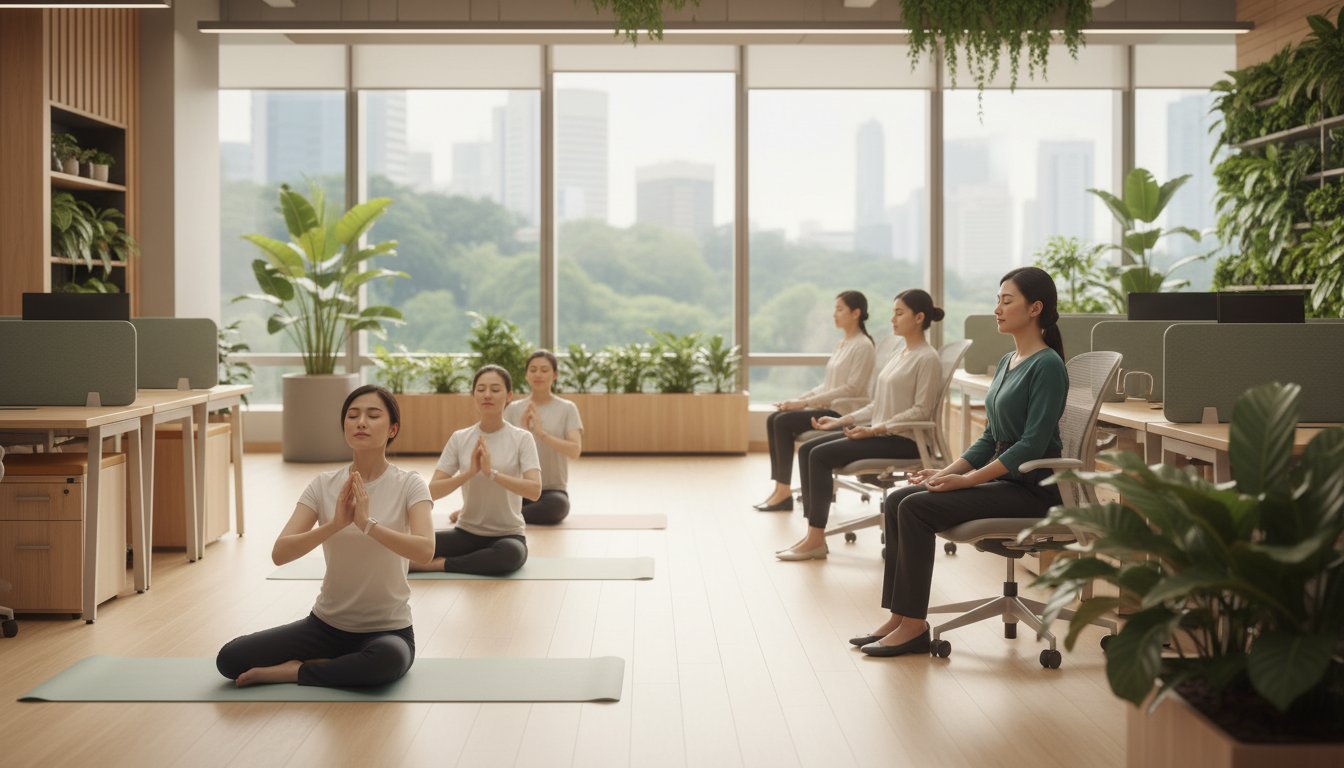
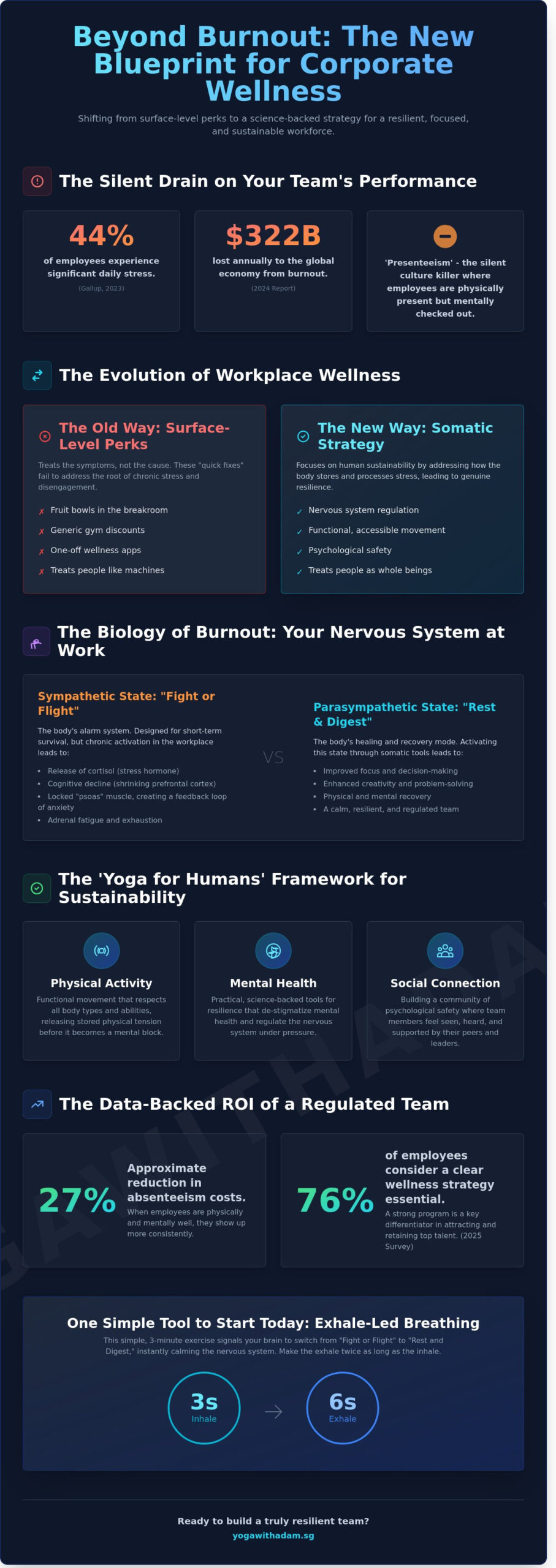
What if the reason your team feels drained isn’t a lack of perks, but a nervous system that’s perpetually stuck in survival mode? We’ve seen the 2023 Gallup data showing that 44% of employees experience significant daily stress; it’s a heavy weight that leads to quiet quitting and high turnover. You’ve likely noticed that traditional corporate wellness programs often fall flat because they treat people like machines that just need a quick oil change rather than living, breathing humans. I agree that the current cycle of burnout and disengagement feels unsustainable for everyone involved.
In this guide, I’ll show you how to move beyond generic office perks to build a high-performance culture through nervous system regulation and somatic wellness. We’re going to explore how focusing on the body’s physical response to stress can lower absenteeism costs by roughly 27% and help you cultivate a team that’s genuinely focused, calm, and resilient. It’s time to shift from checking boxes to actually supporting the humans who make your business possible.
Key Takeaways
- Learn why modern workplace health is shifting toward human sustainability and somatic support rather than just basic insurance or generic perks.
- Understand the science of the nervous system to identify how chronic “fight or flight” states are secretly draining your team’s cognitive performance.
- Discover how to design corporate wellness programs that last by conducting a specific “Wellness Audit” to uncover your organization’s real pain points.
- Explore how to integrate functional movement and psychological safety through a down-to-earth approach that makes wellness accessible for every human on your team.
- Get a roadmap for securing leadership buy-in by demonstrating the clear, data-backed link between nervous system regulation and sustainable productivity.
What Are Corporate Wellness Programs in 2026?
We’ve moved past the era where a bowl of fruit in the breakroom or a discounted gym pass counted as health support. By 2026, corporate wellness programs have evolved into a strategic framework for human sustainability. These are no longer just “nice-to-haves” tucked away in an HR manual. They’re a strategic set of health promotion strategies implemented directly at the workplace to keep our teams whole. Historically, workplace wellness programs focused on basic insurance and safety; today, the focus is on the human behind the desk.
I call this the ‘Yoga for Humans’ approach. It’s a gold standard that treats people as whole beings rather than just productivity units. We prioritize how a person feels in their body over how they look in a performative pose. This philosophy integrates three core components to ensure nobody gets left behind:
- Physical activity: Functional movement that respects different body types and abilities.
- Mental health: Tools for resilience that de-stigmatize the daily pressure of modern work.
- Social connection: Building a community where people feel seen and supported by their peers.
In a 2025 industry survey, 76% of employees stated they wouldn’t consider a new role without a clear wellness strategy. We’re seeing a shift where sustainability is the new currency of the workplace.
The Shift from Perks to Somatic Strategy
Cheap perks don’t fix a nervous system that’s stuck in a “fight or flight” response. Modern teams are tired of surface-level solutions that don’t address the root cause of their fatigue. This is why somatic wellness is rising to the top of corporate agendas. It’s about addressing stress where the body actually stores it, like in a tight jaw or hunched shoulders. Somatic wellness is the bridge between physical movement and mental clarity. By focusing on alignment and breath, we help employees release physical tension before it turns into a mental block.
Identifying the Need for Workplace Wellness
How do you know if your team is reaching a breaking point? The signs are usually there if we’re willing to look. High turnover is an obvious red flag, but ‘presenteeism’ is the silent killer of culture. This happens when people are physically at their desks but aren’t productive because they’re mentally checked out or physically exhausted. A 2024 report showed that burnout costs the global economy $322 billion annually in lost productivity. Corporate wellness programs act as a preventative measure; we don’t wait for the engine to smoke before we decide to maintain it. It’s about long-term organizational health, ensuring our people can show up as their best selves for years to come.
The Science of Stress: Why Your Team is Burning Out
Stress isn’t just a busy calendar or a full inbox. It is a physiological state that takes over the body. When your team faces a tight deadline, their nervous systems often shift into a “Fight or Flight” response. This sympathetic state was designed to help us escape predators, but in a modern office, it becomes a permanent setting. Chronic exposure to cortisol leads to adrenal fatigue and measurable cognitive decline. Research from 2019 indicates that prolonged stress can actually shrink the prefrontal cortex. This is the part of the brain responsible for executive function and decision-making. When we talk about corporate wellness programs, we have to address this biological reality first.
The body stores this tension in specific places, most notably the psoas muscle. This deep core muscle is often called the “fight or flight” muscle because it’s the first to contract when we feel threatened. If your team spends eight hours a day sitting in a state of high alert, their psoas stays locked. This creates a feedback loop of anxiety that no amount of “positive thinking” can fix. We need somatic tools to break the cycle.
Nervous System Regulation in the Boardroom
Stress is contagious. Thanks to mirror neurons, a dysregulated leader can unintentionally trigger anxiety across an entire department. If you’ve ever felt the energy in a room shift during a tense meeting, you’ve experienced this firsthand. You can interrupt this “co-dysregulation” with simple, science-backed tools. Taking three minutes for an exhale-led breath, where the exhale is twice as long as the inhale, signals the brain to switch to the “Rest and Digest” state. While critics often question the effectiveness of wellness programs that only offer surface-level perks, integrating somatic practices like sound healing or mantra can physically rewire neural pathways to improve collective focus.
TRE® (Tension & Trauma Releasing Exercises) for Professionals
TRE is a revolutionary approach for the corporate world because it doesn’t require anyone to “talk through” their stress. It is a series of exercises that assist the body in releasing deep muscular patterns of stress and tension. The “science of shaking” is at the heart of this. Just as animals shake after a stressful event to reset their systems, humans have a natural neurogenic tremor. TRE safely activates this tremor to release the psoas and reset the nervous system. This is a core pillar of our corporate wellness programs because it prioritizes the long-term sustainability of the person. You can learn more about how TRE calms the nervous system and why it is so effective for busy professionals.
If you’re ready to move beyond generic perks and build a truly resilient team, I’d love to help you explore a sustainable approach to movement that works for real bodies in the real world.
Evaluating Different Types of Corporate Wellness Programs
We’ve seen corporate wellness programs evolve from simple gym discounts into complex ecosystems. To build something that actually lasts, we need to look at three distinct pillars: physical, mental, and somatic wellness. Physical support involves functional movement that offsets the “office chair hunch.” Mental wellness moves beyond basic meditation into psychological safety workshops. Somatic wellness is the missing link. It uses breathwork and nervous system mapping to help your team manage stress in real time.
A 2023 Deloitte study revealed that 77% of employees have experienced burnout at their current roles. This statistic highlights why we must address the challenges of corporate wellness with more than just a generic app subscription. While “off-the-shelf” digital tools are convenient, they often feel performative. Bespoke sessions with a mentor provide the human connection necessary for true growth. We’re not just looking for a workout; we’re looking for a way to feel more human at work.
Traditional Yoga vs. Kundalini for the Workplace
Vinyasa is wonderful for building strength, but Kundalini is often more effective for the modern office. It targets mental clarity through specific breath sequences and energy work that clears brain fog in minutes. Our “Yoga for Humans” philosophy ensures these movements are accessible to every body type. You don’t need to be flexible to find focus. If you’re curious about the technical differences, read our comparison: Kundalini vs. Vinyasa: Which is right for your team?
Online vs. In-Person Program Delivery
As of 2023, roughly 12.7% of full-time employees work from home, making digital delivery essential for hybrid teams. Online sessions keep everyone in the loop, regardless of their zip code. Still, we can’t ignore the power of being in the same room. Physical studio sessions build a level of communal trust that pixels just can’t replicate. The most sustainable corporate wellness programs use a hybrid model. This approach balances the ease of remote access with the deep, grounded connection of in-person practice.
How to Build a Sustainable Wellness Strategy That Sticks
I’ve seen too many corporate wellness programs fizzle out because they were built on assumptions rather than real human needs. To make yours stick, we have to move past the “one-size-fits-all” mentality. It starts with five clear steps.
- Step 1: Conduct a Wellness Audit. I recommend using anonymous surveys to identify exactly where your team is struggling. A 2023 Gallup report found that 67% of employees experience burnout at least some of the time. We need to know if that stress is manifesting as physical back pain or mental exhaustion.
- Step 2: Secure Leadership Buy-in. Show the numbers. A 2022 Deloitte study highlighted that for every $1 spent on mental health, businesses see a $1.50 return in productivity. When leaders participate, the rest of the team feels safe to do the same.
- Step 3: Start Small. Don’t jump into a week-long workshop. Try “Mindfulness Minutes” at the start of your regular Monday meetings. It’s easier to scale up once the habit is there.
- Step 4: Create a Wellness Calendar. Align your sessions with the business cycle. If your team hits peak stress in October, that is when you should schedule the most support.
- Step 5: Measure Success. Look at engagement metrics but prioritize qualitative feedback. If 85% of your staff reports feeling more focused after a session, your strategy is working.
Overcoming the ‘No Time’ Objection
The biggest hurdle I hear is that there just isn’t enough time. That’s why I focus on 15-minute “Micro-Practices” that fit between meetings. We follow the sustainability principle; doing 10 minutes of movement daily is far more effective for your nervous system than a 90-minute session once a month. It’s about making wellness a part of the job, not an extra task on the to-do list. Check out our self-care checklist for busy professionals for simple ways to start.
Fostering a Culture of Radical Inclusivity
I believe in “Yoga for Humans,” which means we ditch the spiritual jargon. We use plain English to describe how movements feel in the body. This makes corporate wellness programs approachable for everyone, regardless of their background or fitness level. I make sure every practice is accessible to all physical abilities. When you appoint a “Wellness Champion” from within your own team, it drives organic adoption. It feels less like a corporate mandate and more like a community effort. We’re in this together, and everyone is invited.
Ready to bring a grounded, human approach to your office? Explore our corporate wellness sessions today.
The Yoga with Adam Approach: Transformative Corporate Workshops
I’ve spent over 15 years discovering that a body under constant pressure cannot sustain high-level performance. When I design corporate wellness programs, I don’t aim for complex poses or “perfect” flexibility. Instead, I focus on the nervous system. We use somatic tools like Tension & Trauma Releasing Exercises (TRE), Kundalini breathwork, and Mantra to help real-world humans find their center. These aren’t just exercises; they are practical techniques for people who spend eight hours a day behind a screen or in high-stakes meetings. My goal is to make the practice feel like a tool for life, not just another item on a to-do list.
- Reset Workshops: A 90-minute deep dive designed to clear mental fog and physical tension after major projects.
- Long-term Contracts: Sustained support through monthly or quarterly sessions that build a lasting culture of human sustainability.
- Somatic Toolkits: Teaching teams how to use breath and movement to regulate stress in real-time, even during a difficult call.
Customizing Your Workplace Wellness Journey
Every company has its own rhythm and its own specific challenges. I work closely with HR leads to design a curriculum that reflects your core values and 2024 sustainability targets. For executive leadership, I offer private 1-on-1 coaching. These sessions focus on how physical regulation improves decision-making and emotional intelligence. Whether your team is a small startup of 12 or a national department of 250, we’ll find a pace that fits your schedule. You can Book a Corporate Wellness Workshop With Adam to start building your custom plan.
Why Choose a Mentor Over a Platform?
Digital platforms offer convenience, but they lack the power of genuine human connection. An app can’t see the tension in a staff member’s shoulders or hear the collective sigh of a team finally letting go of a stressful week. I approach mentorship with transparency and humility. I’m a lifelong student who has faced my own physical and mental hurdles, and I share those experiences openly. This grounded approach makes the practice feel attainable rather than performative. It removes the pressure to be “good” at yoga and replaces it with the freedom to be human. Most corporate wellness programs fail because they feel like another corporate chore. My goal is to make your team look forward to this time as a genuine sanctuary. Start your team’s transformation today.
Building a Resilient Workforce for 2026 and Beyond
Human sustainability isn’t just a buzzword; it’s the foundation of a thriving business. We’ve seen how chronic stress lives in the body, which fuels the burnout trends we’re seeing for 2026. Effective corporate wellness programs must move beyond surface-level perks to address the nervous system directly. I’m Adam Fazlur, and I’ve spent over 10 years as a guide for national corporate clients, using my specialized training in TRE® (Tension and Trauma Releasing Exercises) and Kundalini Yoga to help teams find their center. My approach, Yoga for Humans, focuses on functional movement that supports your body for a lifetime. We don’t do performative poses here; we do work that actually sticks. When your team feels steady and supported, the whole culture shifts from survival mode to genuine connection. I’m ready to help you build a strategy that respects the physical reality of your employees’ lives. Let’s make wellness feel attainable and real for every member of your staff.
Book a consultation to bring ‘Yoga for Humans’ to your workplace
You’ve got this, and I’m here to help you lead the way.
Frequently Asked Questions
What is the typical ROI of a corporate wellness program?
You can expect an average ROI of $3.27 for every dollar spent on corporate wellness programs due to reduced healthcare costs. A 2010 Harvard study also found that absenteeism costs drop by $2.73 for every dollar invested. We focus on these tangible results because they prove that looking after your team’s physical alignment is a smart financial strategy for any sustainable business.
Can wellness programs really help reduce employee burnout?
Yes, targeted wellness initiatives can reduce the risk of employee burnout by 26% according to 2024 workplace health data. I’ve seen how somatic practices help staff process stress before it becomes a chronic issue. By teaching people how to regulate their nervous systems during the workday, we prevent the exhaustion that leads to 63% of employees seeking new roles elsewhere.
How do I choose the right wellness provider for my company?
Choose a provider who prioritizes functional movement and offers a minimum of 3 years of verifiable case studies in your specific industry. It’s important to ask for their NBHWC certification or equivalent anatomical training credentials. We recommend finding a partner who avoids one size fits all templates and instead builds a program around your team’s actual physical desk-bound challenges.
What are the most popular wellness activities for employees in 2026?
In 2026, the most popular activities include 15 minute nervous system resets and VR-guided somatic movement sessions. Data from the Global Wellness Institute suggests that 72% of companies now favor micro-wellness over hour-long classes. Employees prefer these short, accessible bursts of movement because they fit into a busy schedule without requiring a change of clothes or a yoga mat.
Is yoga and meditation too ‘spiritual’ for a traditional corporate office?
We strip away the intimidating jargon to focus entirely on functional movement and nervous system regulation. My approach to corporate wellness programs is grounded in anatomy and physiology rather than mysticism. We talk about spinal decompression and vagus nerve stimulation because these are measurable physical experiences that every human in an office chair can relate to regardless of their personal beliefs.
How much do corporate wellness programs usually cost?
Most companies invest between $150 and $1,200 per employee annually for a comprehensive program. Small startups often start with a $500 monthly retainer for a single weekly somatic session. I believe in transparency; you’re paying for specialized expertise that reduces your long-term insurance premiums and turnover costs, making the initial spend a protective asset for your company’s future growth.
Can somatic exercises like TRE be done in an office setting?
You can absolutely perform somatic exercises like TRE in a standard office cubicle or conference room. These movements are designed to be subtle and don’t require you to get on the floor or sweat through your professional attire. I often lead teams through 10 minute desk-side tremors that release deep muscular tension without disrupting the flow of the workday.
How do we encourage employees to actually participate in the program?
The best way to boost engagement is to have your leadership team participate visibly in the sessions. When managers join our Yoga for Humans classes, participation rates typically jump by 45% compared to email-only invitations. We also suggest using 15 minute wellness blocks on the company calendar so employees feel they have permission to step away from their screens without guilt.