

What if the key to surviving the 2026 hustle isn’t another S$400 weekend retreat, but a simple shift in how you inhabit your own skin? In a city where 86 percent of us report feeling the weight of daily stress, it’s easy to feel like you’re just a floating head moving from one meeting to the next. I’ve been there too; I’ve felt completely disconnected while trying to follow wellness advice that felt more like a full-time job than a relief. We’re often told that holistic mental wellness requires a complete life overhaul or a vocabulary full of mystical terms, but I don’t think it has to be that complicated.
I agree that the pressure to be ‘on’ all the time is draining your battery faster than a faulty charging cable. This guide is my promise to help you find your footing again by integrating your mind and nervous system through movements that actually make sense for your body. We’re going to look at sustainable habits and grounded techniques that will leave you feeling whole and resilient without the fluff.
Key Takeaways
- Understand why moving beyond a compartmentalized approach is essential for achieving true holistic mental wellness in a fast-paced environment like Singapore.
- Discover the “Somatic Secret” and how to address stress where it actually lives-within your physical body and nervous system.
- Learn to identify hidden “energy leaks” in your daily routine and master 3-minute micro-practices designed for the busy boardroom.
- Shift your focus from aesthetic-driven exercise to functional movement that builds lasting resilience and supports your body for the long term.
- Explore how the “Yoga for Humans” philosophy at our Blair Road studio makes sustainable wellness accessible and intimidation-free for every body.
What is Holistic Mental Wellness in the Modern Age?
I’ve spent years teaching yoga in Singapore, and I see the same pattern every week. People walk into the studio with tight shoulders and racing thoughts, trying to fix them as two separate problems. Achieving true holistic mental wellness requires us to stop treating our bodies like separate entities from our minds. It’s the realization that your physical movement, your emotional regulation, and your mental clarity all sit at the same table. If one is struggling, the others inevitably feel the weight.
Most of us grew up with a compartmentalized view of health. Traditional Western medicine often treats the symptom rather than the system. If you have a headache, you take a pill; if you feel burnt out, you talk to a counselor. While these tools are valuable, they frequently miss the connective tissue between our physical state and our mental peace. Understanding What is Wellness? helps us see that health is a proactive, multi-dimensional journey rather than just the absence of a clinical diagnosis.
I created the ‘Yoga for Humans’ philosophy because I was tired of seeing wellness marketed as an elite, mystical club. It’s about making these tools accessible to real, busy people who might be tight, tired, or just plain overwhelmed. You don’t need to spend three hours meditating on a mountain to find balance. You need practical, sustainable ways to integrate your health into a life that includes MRT commutes and back-to-back meetings. We focus on the person you are today, not the perfect version you think you should be.
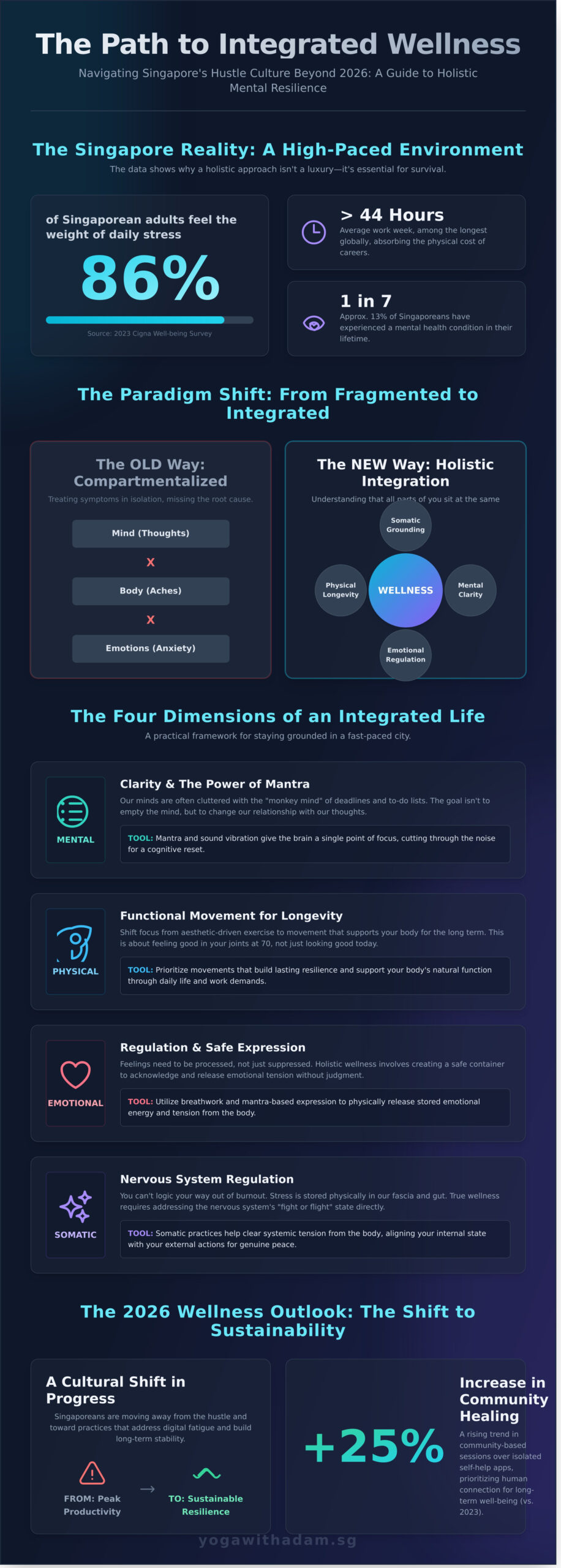
Living in Singapore adds a specific layer of urgency to this integration. With the 2023 Cigna Well-being Survey reporting that 86% of adults here feel stressed, holistic mental wellness isn’t a luxury anymore. It’s a survival tool. We work some of the longest hours globally, often exceeding 44 hours a week. In this high-pressure environment, our bodies physically absorb the cost of our careers. We can’t just think our way out of that kind of systemic tension.
Moving Beyond the ‘Mind-Only’ Fallacy
You can’t always logic your way out of anxiety or burnout. Our nervous systems store stress in the fascia and the gut long after our minds have tried to move on. Holistic wellness is the brave act of aligning your internal state with your external action, ensuring the person you feel like inside matches the life you lead outside. We have to involve the body to truly clear the mind.
The 2026 Perspective on Mental Well-being
Current trends for 2026 show a massive shift toward sustainable resilience over “peak productivity.” Singaporeans are moving away from the hustle and toward somatic practices that address digital fatigue. We’re seeing a 25% increase in community-based healing sessions compared to 2023. This shift prioritizes long-term stability and human connection over the isolated, often lonely world of traditional self-help apps.
The Four Dimensions of an Integrated Life
I believe that living well isn’t about checking boxes or achieving a perfect aesthetic. It’s about how four distinct parts of our human experience work together to create a sense of ease. When I talk about holistic mental wellness, I’m referring to an integrated approach that respects the mind, the body, the emotions, and the nervous system. This isn’t just theory; it’s a practical framework for staying grounded in a fast-paced city like Singapore. A 2023 study by the Institute of Mental Health found that approximately 13% of Singaporeans experienced a mental health condition in their lifetime. This highlights why we need tools that address the whole person rather than just treating symptoms in isolation.
The mental dimension focuses on cultivating clarity. We use meditation not to empty the mind, but to change our relationship with our thoughts. Then, we look at the physical dimension. In my classes, we prioritize functional movement that supports longevity. It’s about making sure your joints feel good when you’re 70, not just how you look in a mirror today. The emotional dimension involves creating a safe container to process feelings, often using mantra-based expression to release tension. Finally, the somatic dimension addresses the nervous system. If your body is stuck in a “fight or flight” state, it’s nearly impossible to feel mentally at peace. By understanding holistic healing for mental health, we can begin to regulate these systems effectively.
Mental Clarity and the Power of Mantra
Singapore’s professional environment is notoriously intense. I often see students come in with what we call the “monkey mind,” where thoughts jump frantically from one deadline to the next. Sound vibration, or mantra, acts as a focused tool to cut through this noise. It gives the brain a single point of focus, which can trigger an immediate cognitive reset. You don’t need an hour; even 300 seconds of intentional chanting or humming can shift your brain waves from high-stress Beta to a more relaxed Alpha state. You can learn more about how I integrate these sounds by exploring the Meditation and Mantra pillar of my practice.
Emotional Resilience and Community Support
Self-care is often marketed as a solo activity, like a long bath or a private walk. I prefer to see it as a communal responsibility. We need inclusive spaces where the pressure to be “perfect” is removed. At my studio on Blair Road, I’ve seen how group classes foster a unique kind of social wellness. When we move together, we realize we aren’t alone in our struggles. This is vital because 1 in 3 adults in Singapore reported feeling socially isolated in a recent 2023 wellness survey. Moving in a community setting helps us reframe our holistic mental wellness as something we build together. It turns a workout into a shared experience of “Yoga for Humans,” where every body is welcome and every emotion is valid.
Why Thinking Isn’t Enough: The Somatic Secret to Wellness
I often hear people say that mental health is “all in your head.” It’s a common misconception that suggests we can simply think our way out of anxiety or logic our way through burnout. The reality is that your body is a giant sponge for your life experiences. When you’re stressed, your muscles don’t wait for a memo from your brain to tighten up; they react instantly. This is why holistic mental wellness requires us to look below the neck. If we ignore the physical sensations, we’re only dealing with half the story. Your nervous system stores what your mind tries to forget, and that storage has a physical limit.
Your Psoas muscle is a prime example of this deep connection. Often called the “muscle of the soul,” this thick band of tissue is the only muscle that connects your spine to your legs. It’s also the primary engine of your fight or flight response. When your brain perceives a threat, the Psoas contracts to pull you into a protective fetal curl. In a 2021 study on physiological stress responses, researchers noted that chronic contraction here can send a constant “danger” signal back to the brain. This creates a feedback loop of high cortisol that feels impossible to break. This is exactly why traditional talk therapy can sometimes hit a wall. You might understand the “why” behind your stress, but your body is still stuck in a defensive physical pattern that won’t let go.
It’s not just our muscles that hold onto this tension. Chronic stress can also manifest in other visible ways, like changes to our skin and hair. For those seeking to address these specific physical signs, the doctor-led team at Terra Medical provides specialized care for hair and scalp conditions as part of a broader wellness journey.
To truly shift these patterns, we need to add practical, body-based tools to our holistic wellness toolkit. By addressing the nervous system directly, we can release tension that the analytical mind cannot even articulate. In a fast-paced environment like Singapore, where the pressure to perform is constant, learning to “speak” the language of the body isn’t just a luxury; it’s a survival skill for your sanity.
Tension & Trauma Releasing Exercises (TRE®)
TRE is a series of simple movements that assist the body in releasing deep muscular patterns of stress. It works by activating a natural reflex mechanism of shaking or vibrating. This isn’t a shiver from being cold; it’s a neurogenic tremor that moves through the tissue to discharge stored adrenaline. I love this practice because it bypasses the analytical mind entirely. You don’t need to talk about your day or relive a difficult memory to find relief. If you’re curious about how this feels in practice, you can explore TRE sessions Singapore to see how we guide this process safely.
Kundalini Yoga: The Technology of Resilience
Many people feel intimidated by Kundalini, but it isn’t about being flexible or performing “perfect” poses. It’s actually a sophisticated system of energy management designed for real people with busy lives. We use specific breathwork, known as Pranayama, to regulate the autonomic nervous system. By changing the rhythm of your breath, you can switch your body from a state of high alert to “rest and digest” in under three minutes. Kundalini functions as a comprehensive nervous system tune-up that builds your internal capacity to handle pressure. It focuses on the internal feeling of the movement rather than the visual outcome, making the practice sustainable for a lifetime.
Building Your Sustainable Wellness Toolkit
I’ve learned through years of teaching in Singapore that a wellness routine only works if it actually fits into your life. We can’t all run away to a mountain for a month. True holistic mental wellness happens in the small gaps between meetings and the quiet moments before bed. According to the 2022 Cigna 360 Well-being Survey, 92% of Singaporean workers are stressed, which means we need a toolkit that’s practical, not just aspirational.
First, audit your energy. I want you to look at your daily commute on the MRT or your hours in the CBD and find the “energy leaks.” These are the habits, like mindlessly scrolling LinkedIn at 11 PM, that drain your battery. Once you spot them, you can swap them for micro-practices. A three-minute box breath in the boardroom isn’t just a “break”; it’s a physiological reset for your nervous system. It lowers your heart rate and clears the mental fog that accumulates by 3 PM.
We also need to shift our mindset from “working out” to “working in.” While a high-intensity session has its place, your body often needs movement that restores rather than drains. This is about choosing functional flows that release tension in your hips and shoulders after a long day at the desk. Finally, set a digital sunset. By 9 PM, I put my phone away. Protecting your mental space from 24/7 connectivity is the only way to ensure your brain actually enters a rest state. If you feel stuck, seek guided support. A teacher or mentor provides the external perspective needed to see patterns you might miss, accelerating your healing journey by months or even years.
A Self-Care Checklist for Busy Professionals
I suggest keeping your mental hygiene simple. Daily, aim for five minutes of intentional movement. Weekly, commit to one 60-minute session where you disconnect entirely. Monthly, consider a deeper reset. Preparing for a wellness retreat involves more than packing a bag; it’s about setting an intention to leave the “hustle” behind. This is vital for addressing adrenal fatigue. A 2023 study by Duke-NUS found that untreated mental health conditions cost Singapore S$15.7 billion annually in lost productivity. Restorative practices aren’t a luxury; they’re a necessity for your long-term health.
Overcoming the Consistency Barrier
Forget about being perfect. In our community, we value “sustainable” over “perfect” every single day. If you can only manage ten minutes on your mat at home using an online session, that’s a win. I often use self-deprecating humor to remind my students that I’m not always “Zen” either. I’ve tripped over my own feet more times than I can count. Laughing at ourselves diffuses the pressure to perform. This approach to holistic mental wellness makes the practice feel like “Yoga for Humans” rather than an elite club. We’re just real people trying to feel a bit better in our bodies.
If you’re ready to build a routine that actually lasts, start your sustainable practice today and join a community that values progress over poses.
Find Your Path with Yoga with Adam
I built Yoga with Adam on a simple premise: yoga is for humans, not for gymnasts or social media influencers. Many people feel intimidated by the complex poses and spiritual jargon often found in modern studios. My “Yoga for Humans” approach strips away that pressure. We focus on how your body feels rather than how it looks. Whether you join us at our sun-drenched Blair Road studio or connect through our global online sessions, you’ll find a space where perfection isn’t the goal. We use a grounded blend of Kundalini, TRE (Tension and Trauma Releasing Exercises), and Mantra to support your holistic mental wellness.
This isn’t just about a workout. It’s about building a sustainable practice that lasts a lifetime. I’ve seen students arrive at Blair Road carrying the weight of 60-hour work weeks and leave feeling lighter, not just physically, but mentally. By integrating breathwork with functional movement, we address the nervous system directly. This helps you move from a state of “fight or flight” into a state of “rest and digest.” It’s a practical, down-to-earth way to manage the demands of life in Singapore without needing to retreat to a mountain cave for months on end.
Private Healing vs. Group Energy
Choosing the right environment depends on your personal goals. If you’re dealing with deep-seated stress or physical blockages, a 1-on-1 private session offers a safe container for personalized trauma work. These sessions often incorporate TRE, a series of exercises that assist the body in releasing deep muscular patterns of stress. Conversely, our group Kundalini classes offer a powerful collective vibe. There’s a unique strength in practicing alongside others, where the shared energy helps you push through mental barriers. For businesses, we bring these tools into the Singapore workplace through corporate wellness programs. With 86% of Singaporean workers reporting burnout in 2023 surveys, bringing holistic health directly to the office isn’t just a perk; it’s a necessity for a sustainable career.
Your Invitation to Transformation
The journey from burnout to integrated wellness doesn’t happen overnight, but it starts with a single, non-judgmental step. I’ve been through the cycle of exhaustion myself, and I know that the hardest part is often showing up. My final note to you is simple: you are already enough. You don’t need to change who you are to start this practice; you just need to be willing to listen to your body. Whether you’re a seasoned practitioner or have never stepped on a mat, you are welcome here. Book your first session at Blair Road or online today and let’s begin this process together. Your path to holistic mental wellness is ready when you are.
Take the Next Step Toward Your Integrated Life
Achieving a balanced life in 2026 requires more than just a positive mindset or a few deep breaths. We’ve explored how somatic practices and the four dimensions of health create a foundation that lasts. Real change happens when we bridge the gap between our busy minds and our physical bodies. I’ve spent over 10 years guiding humans through this process right here in Singapore. Whether we’re working through a Kundalini sequence or using TRE® to release deep-seated tension, the goal is always a sustainable practice that fits your actual life. You don’t need to be perfect or spiritual to start; you just need to show up as you are. I’ve built a welcoming, judgment-free space at 77 Blair Road where we focus on what works for your unique body and nervous system. Your journey toward holistic mental wellness starts with a single, grounded step. I’m here to help you take it without the pressure of performance. Let’s find what feels right for you together.
Start your journey to holistic wellness with Adam; book a session today
Frequently Asked Questions
What does ‘holistic’ actually mean for my mental health?
Holistic mental health means looking at you as a whole human rather than just a single symptom or diagnosis. Instead of focusing only on your thoughts, we look at how your physical movement, sleep patterns, and even your gut health impact your mood. It’s an approach to holistic mental wellness that recognizes your nervous system doesn’t work in isolation. In Singapore, 13.9% of adults experienced a mental health condition in 2022 according to IMH, and a holistic approach helps address those root causes.
Is holistic wellness a replacement for traditional therapy?
No, holistic wellness is a supportive complement to traditional therapy, not a replacement for clinical care. I often work with students who are also seeing psychologists or psychiatrists—or using specialized services like Female Focused Therapy—to manage anxiety or depression. Think of it as a “both/and” approach where we use movement and breathwork to ground the body while you do the talk therapy work. It’s about building a sustainable toolkit for life; one that supports the clinical work you’re already doing.
How often do I need to practice yoga to see mental health benefits?
You’ll start feeling a shift in your stress levels with just two 60-minute sessions per week. A 2019 study in the Journal of Physical Activity and Health found that even 20 minutes of yoga can improve brain function and focus. I recommend starting with two classes at our Singapore studio to build a consistent rhythm. Consistency matters more than intensity when you’re trying to soothe your nervous system, so find a pace that feels sustainable for your schedule.
Can I practice TRE if I’ve never done yoga before?
Yes, you can absolutely practice TRE without any prior yoga experience. TRE is a series of seven simple exercises designed to trigger a natural shaking response in the muscles, which helps release deep chronic tension. It’s a physiological process rather than a “pose-based” practice. I’ve taught beginners who have never stepped on a yoga mat before, and they’ve successfully used these tools to manage daily work stress and improve their sleep quality.
I’m not flexible at all; can I still do Kundalini yoga?
You don’t need to touch your toes to benefit from Kundalini yoga. This practice is more about your breath and internal energy than it is about being a human pretzel. In my classes, we focus on functional movement that supports your real body. I often joke that if you can breathe, you can do yoga. We use chairs or blocks to make every movement accessible for your specific range of motion, keeping the practice safe and effective.
How do I know if I’m suffering from burnout or just ‘normal’ stress?
Burnout is characterized by chronic physical and emotional exhaustion that doesn’t improve after a full weekend of rest. While “normal” stress might peak during a big project, burnout feels like a permanent state of depletion and cynicism. A 2022 survey by Milieu Insight found that 4 in 10 Singaporeans feel burnt out. If you’re feeling detached from your work or constantly fatigued, it’s time to look at your holistic mental wellness strategy and prioritize recovery.
What is the difference between mindfulness and holistic wellness?
Mindfulness is the specific practice of being present in the moment, while holistic wellness is the bigger framework that includes your diet, sleep, and physical activity. Think of mindfulness as one very effective tool in your overall wellness toolkit. My sessions integrate mindfulness into physical movement so you aren’t just sitting still. We focus on how these practices translate into your life in Singapore, from the MRT commute to the high-pressure office environment.
Are your sessions suitable for beginners in Singapore?
My sessions are specifically designed for beginners and real people who might feel intimidated by traditional studios. Around 90% of my new students in Singapore haven’t practiced regularly before joining our community. We keep things down-to-earth and avoid the “performance” aspect of yoga. Single drop-in classes start at S$35, and we offer introductory packages for S$90 that help you get started without any pressure to be perfect or “good” at yoga.