

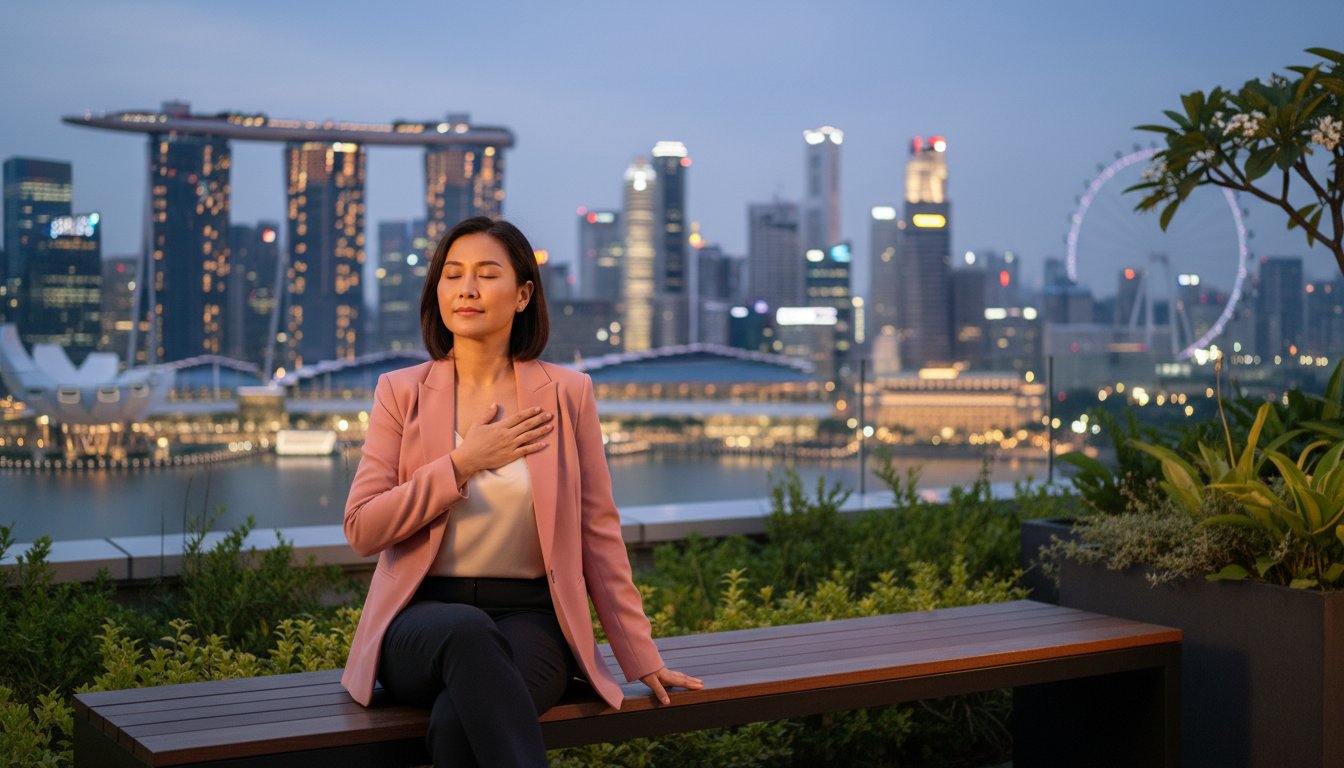
Why is it that the “calm” you find in a typical meditation app disappears the second you step onto a crowded MRT at Raffles Place? If you feel like your brain is constantly running ten tabs at once while your body stays frozen at a desk for nine hours a day, you aren’t alone. In a city where 92% of working adults report feeling stressed, finding an effective mindfulness course singapore can feel like just another task on an endless to-do list. You might be tired of clinical approaches that feel like boring homework, yet skeptical of spiritual tropes that don’t fit your logical mind.
I’m here to show you that there’s a middle ground. My goal is to help you build somatic mental sustainability, moving beyond basic stress reduction into something that actually lasts. You’ll learn practical tools to regulate your nervous system and reclaim a sense of groundedness that doesn’t evaporate the moment you leave the studio. We’ll look at how to integrate “Yoga for Humans” into your high-pressure lifestyle, ensuring your practice is as functional and resilient as you are.
Key Takeaways
- Move beyond the “8-week fix” by understanding how a somatic, body-first approach helps you stay grounded amidst the high-pressure Singaporean lifestyle.
- Explore how the science of the nervous system and tools like TRE can help you select the most effective mindfulness course singapore for your specific needs.
- Learn to integrate simple micro-practices into your daily routine, from your morning commute to the 3 PM office slump, for mental sustainability that lasts.
- Compare traditional clinical programs like MBSR with experiential somatic workshops to identify which path aligns best with your personality and goals.
- Discover the “Yoga for Humans” philosophy of meeting yourself where you are, replacing the pressure of “fixing yourself” with genuine, sustainable self-connection.
Beyond the 8-Week Fix: Why Mindfulness in Singapore Needs a Somatic Approach
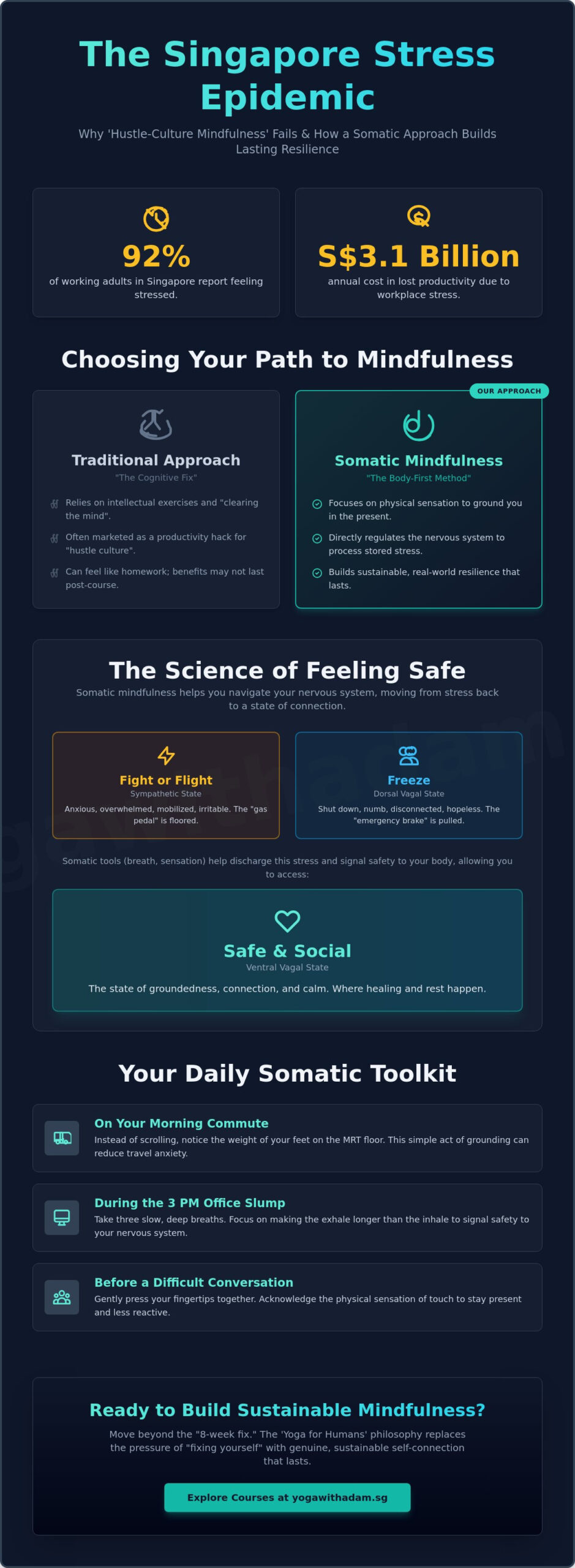
I’ve spent years watching people walk into a mindfulness course singapore looking for a quick escape from the city’s relentless pace. We’re often taught that mindfulness is about “clearing the mind” or reaching a state of Zen-like silence. But let’s be honest; if you live and work in Singapore, your mind is rarely quiet. Between the morning rush at Raffles Place and the late-night pings from work apps, the pressure is constant. A 2022 study by Duke-NUS Medical School and the Institute of Mental Health found that workplace stress and anxiety cost Singapore S$3.1 billion in lost productivity annually. This tells us that the “keep calm and carry on” approach isn’t just failing our health; it’s unsustainable for our society.
While the foundational Mindfulness-Based Stress Reduction (MBSR) program offers a brilliant starting point for many, a purely cognitive approach often hits a ceiling. We can’t just think our way out of stress when our bodies are still vibrating with cortisol. If we only focus on the brain, we miss the signals the rest of us is sending. Real mindfulness isn’t an intellectual exercise; it is a grounded, somatic experience that requires us to reconnect with our physical selves.
The Problem with “Hustle-Culture” Mindfulness
In our local context, we’ve accidentally turned relaxation into a competitive sport. Mindfulness is often marketed as a productivity hack to help us work harder and longer. I see so many students feel like they’re “failing” because they can’t sit still for twenty minutes without their legs falling asleep or their thoughts racing. That’s not a failure; it’s just being a human in a high-pressure environment. We need to move away from performative peace and toward a practice that actually feels grounded in our daily reality. It’s about being present, not being perfect.
What is Somatic Mindfulness?
Somatic mindfulness is awareness rooted in physical sensation. It moves the focus from the stories in our heads to the data in our bodies. Our nervous system processes daily urban stressors long before our conscious mind catches up. At Yoga with Adam, we believe “Yoga for Humans” starts with meeting the body exactly where it is today. We aren’t trying to transcend the body; we’re trying to inhabit it more fully. This is what we call human sustainability. We want to build a practice that supports us for a lifetime, not just until a specific deadline or the end of a workshop.
- Focus on sensation: Noticing the weight of your feet on the floor rather than just “thinking” about being calm.
- Nervous system regulation: Using the breath to signal safety to the body in real-time.
- Sustainable pacing: Learning to recognize the physical signs of burnout before they become medical issues.
Choosing a mindfulness course singapore that prioritizes the body allows us to build resilience that lasts. It’s about creating a toolkit that works when you’re stuck in traffic or facing a difficult performance review, not just when you’re sitting on a cushion in a quiet room.
The Science of Stillness and Shaking: How Somatic Mindfulness Calms the Nervous System
Living in a city like Singapore, our bodies often feel like they are permanently set to “on.” We navigate crowded MRT stations and meet tight deadlines, which keeps our nervous systems in a constant state of high alert. Polyvagal Theory, introduced by Dr. Stephen Porges in 1994, explains this through the lens of the Vagus nerve. Essentially, our bodies toggle between feeling safe and social, being in “fight or flight,” or shutting down into a “freeze” state. Most of us spend our workdays stuck in that middle gear of mobilization. A quality mindfulness course singapore helps us recognize these shifts before we feel completely burnt out.
Research confirms how mindfulness calms the nervous system by actively reducing cortisol levels and slowing the heart rate. However, for many of us, sitting still on a cushion feels impossible when our muscles are tight with the day’s stress. This is why somatic mindfulness is a game changer. It acknowledges that the mind and body are a two way street. If the body is vibrating with stress, we need to address that physical energy before the mind can find any real quiet. Moving from “fight or flight” to “rest and digest” isn’t just a mental choice; it is a physiological shift that we can trigger through specific movements.
Kundalini Yoga: More Than Just Postures
I have noticed that for many modern humans, jumping straight into silent meditation is like trying to stop a freight train with a piece of string. Kundalini Yoga provides a much needed focal point through rhythmic breathwork and mantra. These tools give a busy mind a specific task to focus on. These dynamic movements help us “shake off” the mental tab clutter of the day. If you want to understand the roots of this work, check out this guide on What Is Kundalini Yoga? for a practical perspective.
TRE®: Shaking Off the City Stress
There is a specific “science of shaking” that most people overlook. When animals experience a stressful event, they naturally shake to discharge that energy. Humans have this same mechanism, called neurogenic tremors, but we often suppress it to stay “professional.” In our fast paced local environment, learning to safely access these tremors is essential for long term sustainability. You can find a deep dive into this process in The Ultimate Guide to TRE®. It is a straightforward way to release deep muscular tension without needing to talk through your stressors. If you are ready to see how these practices can support your daily life, you might enjoy exploring the classes at Yoga with Adam.
Choosing Your Path: Secular MBSR vs. Somatic-Based Mindfulness Courses
Finding the right mindfulness course singapore offers can feel like browsing a crowded menu. You’ve basically got two main paths: the clinical, academic route or the somatic, movement-based approach. One isn’t necessarily better than the other, but they serve different parts of your life. It’s about deciding whether you want to study mindfulness like a subject or live it like a habit. If you’re looking for a rigid syllabus, go clinical. If you want something that sticks when life gets messy, go somatic.
When to Choose a Clinical Course
Programs like Mindfulness-Based Stress Reduction (MBSR) or MBCT are the gold standard for data-driven results. They’re often taught in hospitals or university settings across Singapore. These courses are excellent if you’re dealing with specific clinical conditions like chronic pain or severe anxiety. In fact, research studies have shown that these structured interventions can physically change brain regions associated with memory and stress. However, these settings can feel impersonal. It’s often a teacher at a lectern rather than a guide by your side. Choose this if you thrive on homework, theory, and a classroom vibe.
The Case for Experiential, Somatic Learning
Somatic learning flips the script. Instead of reading about calm, we practice feeling it in our bones. We focus on what I call the Tuesday morning test. Will you actually use these tools when your boss sends a late-night email or when the MRT is delayed? Somatic mindfulness focuses on the body’s physical response to stress, teaching you to regulate your nervous system in real-time. This approach is less about “getting it right” and more about being human. Working with a guide through Private Healing Sessions can help you bridge the gap between theory and your actual life, tailoring the practice to your specific physical needs.
- Body Literacy: You learn to spot tension in your shoulders before it becomes a headache.
- Sustainable Habits: Practices are designed to fit into a busy Singaporean lifestyle, not just a quiet retreat.
- Inclusive Spaces: These workshops prioritize your comfort over perfect poses or rigid silence.
Your relationship with your teacher is the secret sauce in this journey. You need someone who feels like a real person, not a perfect statue. In a city as fast-paced as ours, your mindfulness course singapore choice should feel like a relief. It should be a space where you can drop the performance and just be. If a course feels like another chore on your to-do list, it probably won’t last past week three. Look for a guide who values your long-term well-being over academic perfection.
Practical Mindfulness: Integrating Awareness into a Busy Lifestyle
A mindfulness course in Singapore shouldn’t just be about sitting still in a quiet studio in Orchard or Tiong Bahru. Real life happens in the noise, the humidity, and the rush. We need tools that work when the MRT is delayed or when a client sends a “can we talk?” message at 5:55 PM. I’ve found that the most sustainable practices are the ones we can do while waiting for a kopi. Transitioning from the mat to the boardroom isn’t about finding a new personality; it’s about bringing that same somatic awareness into your everyday movements.
I focus on micro-practices because they are human-proof. You don’t need an hour of silence to reset your nervous system. Try these during your day:
- The Commute: Instead of scrolling, feel the weight of your body in the bus seat or the grip of your hand on the grab bar.
- The Queue: While waiting for lunch at the hawker centre, notice your breath without trying to change it. Just acknowledge it’s there.
- The 3 PM Slump: Use Meditation and Mantra as anchors. A simple internal phrase can stop a spiralling thought pattern before it takes over your afternoon.
Mindfulness at Work: Sustainability for Professionals
Work is where our nervous systems often take the biggest hit. In a 2024 Cigna Healthcare study, 86% of Singaporeans reported feeling stressed, with 15% struggling to cope. We often chase the myth of “clearing the inbox,” but the reality is that the inbox is never empty. Clearing your head is the more sustainable goal. Simple breathing techniques, like exhaling for twice as long as you inhale, provide immediate calm before a big presentation. For teams looking to build this into their culture, our Corporate Wellness Programs offer a somatic approach to workplace human sustainability that goes beyond basic fruit baskets.
Creating a Sustainable Home Practice
Forget the hour of silence. Most of us don’t have that, and trying to force it often leads to “meditation guilt.” Five minutes of somatic awareness, checking in with how your feet feel on the floor, beats 60 minutes of “struggling to sit” while your brain lists everything in the fridge. Set up a space that invites you in. It doesn’t need to be an altar; it just needs to be a corner that feels safe. Use inclusive language with yourself. If your mind wanders, that’s okay. You’re a human, not a robot. This grounded approach is exactly what we explore in our mindfulness course singapore, making the practice feel attainable rather than like another chore on your to-do list.
If you’re ready to stop struggling with your practice and start living it, join our community for a more human approach to yoga and mindfulness.
Mindfulness for Humans: How Yoga with Adam Approaches Mental Sustainability
Yoga for Humans is my way of saying that you don’t need to be a gymnast or a monk to find peace. I’ve seen too many people approach wellness as a checklist of things to fix. At Yoga with Adam, I shift the focus from fixing to meeting. We use somatic tools to understand what your body is telling you in real time. This isn’t a performance. If you’re searching for a mindfulness course singapore that prioritizes the human experience over perfection, you’ve landed in the right place. You won’t find high-level spiritual jargon that feels out of reach here. You’ll find a practice that’s grounded, steady, and designed for the life you actually live in 2026.
A Welcoming, Inclusive Environment
I chose the Blair House studio because it feels like a home, not a performance stage. We prioritize functional movement over aesthetic poses. It doesn’t matter if you can touch your toes; it matters if you can regulate your nervous system when life gets heavy. The space is intentionally designed for comfort. We focus on sequencing that supports your joints and breath-work that calms your mind. It’s about making mindfulness accessible to everyone, regardless of their background or fitness level. I’m committed to ensuring that every person who walks through our doors feels seen and supported.
Your Next Steps to Groundedness
Deciding how to start shouldn’t be stressful. I offer three primary ways to engage with the practice:
- Group Classes: Perfect for those who enjoy the energy of a community and want a consistent weekly rhythm.
- Private Sessions: Ideal if you want a practice tailored to specific physical injuries, personal goals, or a busy schedule.
- Corporate Workshops: Designed for Singapore-based teams that need practical tools for stress management and focus.
Choosing this path leads to the long-term benefits of Holistic Mental Wellness. It’s a somatic-first approach that builds resilience from the inside out. This mindfulness course singapore treats you like a person rather than a project. I’ve spent years refining these methods to ensure they work for real bodies in the real world. You don’t have to wait until you’re “ready” or “flexible enough” to begin. Join our community today and start your journey toward a more grounded, sustainable way of living. I’ll be there to guide you every step of the way.
Build a Sustainable Practice for Your Real Life
Finding mental sustainability in a city as fast-paced as Singapore requires more than just a temporary escape. True resilience comes from understanding how your body stores stress and learning the tools to release it effectively. Since 2016, I’ve dedicated my work to “Yoga for Humans,” a practice that strips away the mystical jargon to focus on what actually works for modern professionals. By prioritizing somatic release and nervous system regulation, we move beyond the limitations of standard 8-week programs. We use techniques like Tension & Trauma Releasing Exercises (TRE) to help you physically shake off the day’s tension. This isn’t about achieving a perfect pose or sitting in silence for hours; it’s about building a toolkit that supports your well-being for the long haul. If you’re ready to find a grounded, non-intimidating mindfulness course singapore that fits your busy schedule, I’m here to guide you. My name is Adam Fazlur, and I’ve spent years making these practices accessible for real people with real bodies. You don’t need to be flexible or naturally “zen” to begin. You just need to be yourself. Let’s make your mental health a sustainable part of your everyday routine.
Explore Grounded Mindfulness Courses with Adam
Common Questions About Mindfulness and Somatic Practice
What is the best mindfulness course in Singapore for a complete beginner?
I recommend starting with our Foundations of Somatic Mindfulness course because it’s built specifically for people who’ve never meditated. We skip the confusing jargon and focus on how your body actually feels. About 90% of our new joiners start with zero experience, so you’ll be in good company as we explore these tools together in a low-pressure environment.
Do I need to be flexible or have yoga experience to take a mindfulness course?
You don’t need any flexibility or prior yoga experience to join my sessions. Mindfulness is about training your attention, not performing acrobatic poses. We use chairs or supportive bolsters for 100% of our seated practices to ensure your physical comfort. My goal is to make these tools accessible for every body, regardless of how much you can bend or stretch.
How is somatic mindfulness different from traditional meditation?
Somatic mindfulness focuses on physical sensations within the body rather than just observing your thoughts from a distance. While traditional styles often emphasize sitting still and clearing the mind, we use movement to understand the nervous system. Data from Somatic Experiencing International suggests that body-based awareness can reduce physiological stress markers by 30% more effectively than cognitive-only approaches.
Can mindfulness courses help with professional burnout and work stress?
Our mindfulness course singapore professionals attend is specifically designed to manage the high-pressure demands of the local workforce. We teach practical techniques you can use right at your desk to reset your stress response. A 2023 study by Milieu Insight found that 57% of Singaporeans feel burnt out, and our curriculum provides the exact tools needed to navigate that exhaustion.
Are these mindfulness sessions secular or religious in nature?
Every session I lead is entirely secular and grounded in modern science. We focus on functional anatomy and neuroscience rather than spiritual dogmas or religious traditions. Our curriculum is built on 21st-century evidence-based principles that respect all personal beliefs. I want you to feel comfortable knowing the practice is about your physical and mental well-being, plain and simple.
How long does it take to see the benefits of a mindfulness practice?
You’ll likely feel a shift in your immediate stress levels after your first 60-minute session with us. For long-term changes, consistency is the key ingredient. Research from Harvard University indicates that practicing for 27 minutes daily over 56 days leads to measurable increases in gray matter density in brain regions associated with emotional regulation. It’s a steady process of building mental sustainability.
What should I bring to my first mindfulness or somatic session?
Just bring yourself and wear clothes that allow you to breathe and move easily. I provide all the mats, blocks, and cushions you’ll need at the studio. We keep 25 sets of premium eco-friendly props ready for every class so you don’t have to carry heavy gear on the MRT. A reusable water bottle is the only extra thing I’d suggest for your comfort.
Can I take these mindfulness courses online if I can’t visit the studio?
We offer a flexible hybrid model for our mindfulness course singapore so you can practice from your living room when life gets busy. You’ll get the same personal guidance through our live-streamed sessions as you would in person. Since 2021, we’ve hosted over 500 hours of digital classes, ensuring our community stays connected and supported regardless of their physical location.