


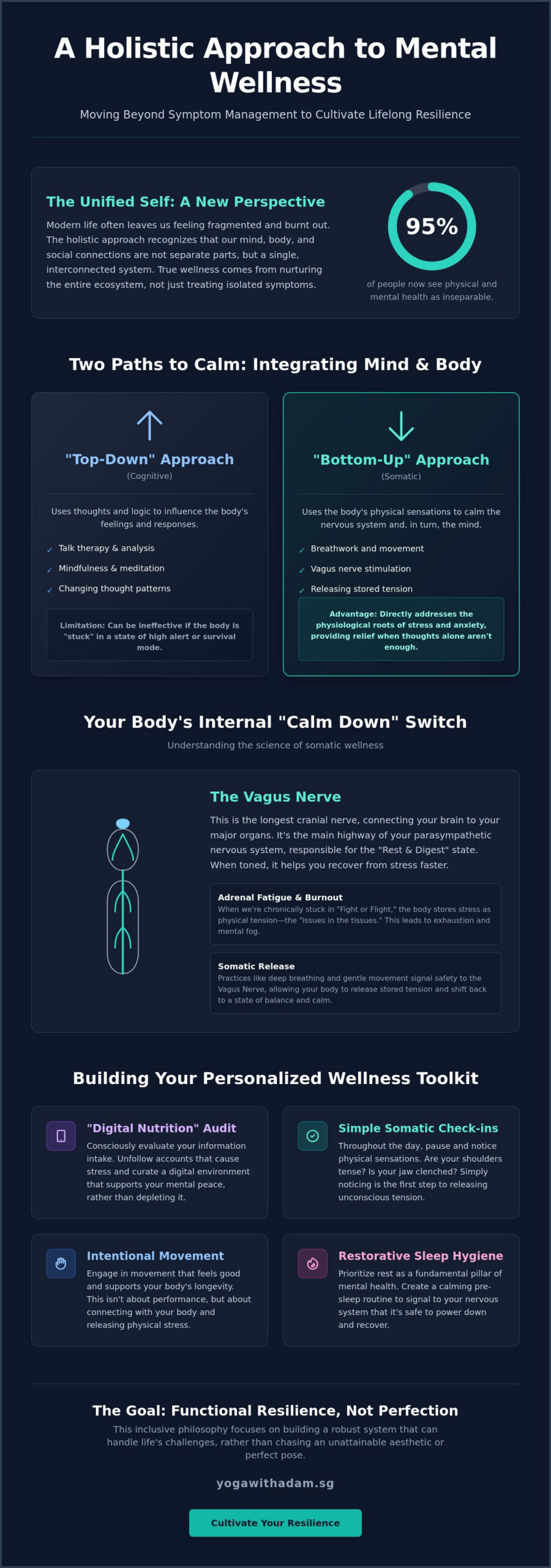
What if the secret to a quieter mind isn’t found in a new thought, but in the way you breathe and move? If you’re feeling the heavy weight of adrenal fatigue or the fuzzy static of constant burnout, you aren’t alone. I’ve been there too, scrolling through endless advice from wellness gurus while feeling completely disconnected from my own skin. A massive 95% of people now recognize that our physical, mental, and social health are all deeply tied together, according to 2025 data from Wellhub. This is why a holistic approach to mental wellness is so vital as we move through 2026. It’s not about perfect aesthetics or chasing a performance. It’s about functional, long-term health that feels attainable for every body.
I understand the frustration of information overload. You want tools that work right now, not more theory that adds to your stress. This guide will show you how to blend somatic practices, mindfulness, and simple lifestyle shifts into your daily life to find immediate calm. We’re going to move past the “band-aid” solutions. Instead, we will build a practical framework for resilience that supports your mind and body for the long haul.
Key Takeaways
- Shift from simply managing symptoms to cultivating an integrated system for long-term health using a holistic approach to mental wellness.
- Discover how the Vagus Nerve serves as your body’s internal “calm down” switch to release stress stored deep within your physical tissues.
- Learn why “bottom-up” somatic practices often provide the relief that traditional “top-down” cognitive approaches might miss.
- Create a personalized toolkit including “digital nutrition” audits and simple somatic check-ins you can use throughout your busy day.
- Explore an unpretentious, inclusive philosophy that focuses on building functional resilience rather than achieving perfect aesthetic poses.
What Is a Holistic Approach to Mental Wellness?
When we discuss a holistic approach to mental wellness, we’re viewing the human experience as a complete ecosystem rather than a collection of isolated symptoms. In previous decades, the focus was often on a reactive model; if you felt anxious, the goal was simply to stop the anxiety. But we aren’t built in silos. Your physical health, your environment, and even your social connections all feed into your mental state. This holistic approach to mental wellness shifts the focus from merely fixing what is “broken” to actively cultivating a state of vibrant, sustainable health that lasts a lifetime.
By 2026, we’ve come to realize that “positive thinking” alone isn’t a sufficient shield against the complexities of modern life. We’re processing more data than ever before, and our nervous systems are often paying the price in the form of burnout and chronic fatigue. This is why we look at the body’s physiological state as the foundation for our thoughts. If your nervous system is stuck in a survival loop, no amount of logic will make you feel truly calm. We have to address the system as a whole to see real, functional change in how we show up every day.
The Five Pillars of the Whole Person
I view wellness as being supported by several essential pillars that keep our internal “house” standing steady. The Physical pillar is about more than just exercise; it includes restorative sleep hygiene and movement that supports your body’s longevity. Then we have the Emotional pillar, which focuses on developing a deep literacy for your feelings without the need to judge them as “right” or “wrong.” Finally, the Social pillar addresses our inherent need for community. Humans are social creatures, and having a supportive network is one of the strongest predictors of long-term mental resilience and brain health.
Why the Biopsychosocial Model Matters
To get a clear picture of our well-being, we use the holistic model of mental health. This framework acknowledges that our biology, our psychology, and our social environments are constantly interacting to create our mental landscape. We’ve moved past the idea that mental health is just a “chemical imbalance” in the brain. Instead, we see it as a systemic reflection of our entire life experience. Using this holistic mental wellness framework allows us to find multiple entry points for healing, making the process feel much more attainable and less like a daunting mountain to climb.
The Mind-Body Connection: The Science of Somatic Wellness
Have you ever noticed how your shoulders creep up toward your ears during a long day at the office? That’s your body keeping a record of your stress. We often think of mental health as something that happens only between our ears, but it’s a full-body experience. This holistic approach to mental wellness focuses on the Vagus Nerve, which acts as your internal “calm down” switch. It’s the longest cranial nerve in your body, running from the brainstem all the way down to the abdomen. When we learn to tone this nerve, we give our system permission to move out of survival mode and back into a state of balance.
Sometimes, talking about our stressors just isn’t enough to clear them from our system. You might understand your anxiety intellectually, yet your chest still feels tight and your breath stays shallow. This happens because the body stores “issues in the tissues,” a form of somatic memory where past tension stays locked in your muscles and fascia. If we don’t address this physical side, we risk falling into adrenal fatigue. This state of chronic exhaustion often comes with a persistent mental fog that makes even simple decisions feel like a mountain to climb. According to data from Wellhub in late 2025, 95% of people now see that physical and mental health are inseparable. Adopting a holistic approach to mental health means we stop ignoring what the body is trying to tell us.
The Role of the Autonomic Nervous System
Our nervous system is constantly toggling between two main states: Fight/Flight and Rest/Digest. In our modern, high-pressure world, many of us get “stuck” in a high alert state. This is largely due to neuroception, which is the body’s subconscious threat detection system that scans for danger before we are even aware of it. When your body constantly senses a threat, your mental health naturally takes a hit. You can’t feel creative or connected when your biology thinks you’re being chased by a predator. Moving into a state of rest is essential for long-term resilience.
Breathwork as a Remote Control for the Brain
Breathwork is one of the most effective ways to override a stressed nervous system. It works like a remote control for your brain. By shifting your breathing patterns, you can actually alter your blood chemistry and heart rate in real time. These techniques help you move from a state of panic to a state of presence in less than three minutes. I find it especially helpful to integrate meditation and mantra into this practice to help steady the mind and improve focus. If you’re ready to see how these practices feel in your own body, our online sessions provide a gentle, unpretentious way to start your somatic journey.
Beyond the Band-Aid: Why Somatic Release Is Essential
I often hear from people who say, “I’ve tried therapy for years, and while I understand why I’m stressed, I still feel it in my gut.” This is a common hurdle. Traditional therapy is often “top-down,” meaning it uses the mind to try and change the body. But when you’re in a state of chronic burnout, your brain’s logic center can go offline. This is where a holistic approach to mental wellness really shines by using “bottom-up” strategies. Instead of just talking about the stress, we work directly with the body to release it from the nervous system.
Think about a gazelle that just escaped a predator. Once the danger passes, it shakes its whole body. It isn’t having a nervous breakdown; it’s discharging the massive amount of survival energy it just used. Humans have this same built-in mechanism, but we’ve learned to suppress it because shaking in public isn’t exactly considered “professional.” Over time, this suppressed energy builds up, leading to the physical and mental exhaustion we recognize as adrenal fatigue. To find true relief, we need to give that energy a way out.
TRE®: The Science of Shaking
This is where Tension & Trauma Releasing Exercises (TRE®) come into play. It’s a series of simple movements that assist the body in releasing deep muscular patterns of stress by inducing a natural, therapeutic shaking response. For busy professionals, it’s a game-changer because it’s a “non-talk” practice. You don’t have to relive your story or analyze your past to clear the tension. During a session, we prioritize your comfort and safety, allowing the body to discharge what it no longer needs to carry. You can expect a sense of immediate calm and a noticeable “lightness” in your body afterward.
Kundalini Yoga: Energy Management for the Modern Human
We also use Kundalini Yoga as a functional tool for daily energy management. I know it can sometimes sound a bit mystical, but our focus is strictly on the functional side. It uses specific movements and rhythmic breathing to balance your glandular system and steady your nerves. The goal isn’t to achieve a perfect, Instagram-worthy pose. It’s about finding a practice that supports your longevity and helps you stay grounded in a chaotic world. This unpretentious, holistic approach to mental wellness ensures you aren’t just putting a band-aid on your symptoms, but actually building a foundation for a balanced life.
Building Your Personalized Mental Wellness Toolkit
Now that we’ve explored why the body holds onto stress, let’s talk about what you can actually do about it on a busy Tuesday morning. Building a holistic approach to mental wellness isn’t about adding twenty new tasks to your already crowded to-do list. It’s about finding small, functional shifts that protect your energy and keep you grounded. I’ve found that the most effective toolkits are built slowly, one manageable piece at a time. This keeps the process from becoming just another source of performance pressure.
The first step is auditing your “digital nutrition.” We often forget that our eyes and ears are gateways to our nervous system. If your morning starts with a flood of stressful headlines or curated perfection on social media, you’re feeding your brain a diet of high-alert signals. Try to be intentional about your sensory input. Second, implement a somatic check-in three times daily. This doesn’t require a yoga mat or a quiet room. Just pause for ten seconds to notice if your jaw is clenched or if your shoulders have hitched up toward your ears. These micro-moments of awareness prevent stress from accumulating until you hit a wall.
Third, we need to prioritize active rest over passive scrolling. While it’s tempting to “zone out” on your phone after work, this often leaves your brain more fatigued because it’s still processing data. Active rest, like a short walk or a few minutes of rhythmic movement, gives your system a genuine chance to reset. Fourth, keep your morning routine low-pressure. You don’t need a two-hour ritual to be successful. Finally, remember that isolation is a significant driver of burnout. Seeking community or professional guidance can help you break the cycle of trying to “fix” everything on your own.
A Daily Self-Care Checklist for Busy Professionals
You don’t need a lot of time to make a big difference in how you feel. Try these micro-practices to stay steady throughout the day:
- The 60-Second Box Breath: During a stressful meeting, inhale for four counts, hold for four, exhale for four, and hold for four. It’s a quick way to signal safety to your brain.
- The “No-Phone” First Hour: Give your dopamine receptors a break by avoiding your screen for the first hour after you wake up.
- The 5-4-3-2-1 Grounding Exercise: If you feel a panic loop starting, name five things you see, four you can touch, three you hear, two you smell, and one you can taste.
Sustaining Your Practice Long-Term
I always tell my students to follow the “1% Rule.” Consistency beats intensity every single time. It’s much better to do five minutes of somatic movement daily than to do a two-hour session once a month and then give up. When you inevitably face a setback, try to avoid the “all-or-nothing” mindset. Just because you missed a day doesn’t mean your progress is gone. It is just part of the rhythmic nature of life. If you feel like you’ve hit a plateau or need more personalized support, you might consider transitioning to private healing sessions to deepen your practice. To start building these habits in a supportive environment, you can join our online sessions and move at your own pace.
Cultivating Resilience with Yoga with Adam
I believe that wellness should be a conversation, not a performance. My goal is to make a holistic approach to mental wellness feel like something you can actually do, even on your most chaotic days. At Yoga with Adam, we strip away the intimidating tropes and high-level jargon often found in modern wellness spaces. Instead, we focus on a grounded, steady, and unpretentious practice that prioritizes your comfort above all else. Whether you are joining me for a private session or a group class, my focus is on how the movement feels from the inside out, not how it looks to an observer. We practice radical inclusivity because everyone deserves a nervous system that feels like home.
Taking the first step from reading about wellness to actually experiencing it can feel like a big jump. I’m here to act as a knowledgeable but humble guide on that journey. We’ve spent this article looking at the science and the toolkit, but the real magic happens when you start to move. We don’t chase aesthetic achievements here. We value your long-term well-being and the integrity of the practice. It’s about building a body and mind that can support you throughout your entire lifetime.
Corporate Wellness for Human Sustainability
We’ve moved past the era where a fruit basket in the breakroom counts as employee support. Real sustainability requires real tools. My corporate wellness programs are designed to address the root causes of burnout by bringing somatic practices directly into the workplace. According to data from Speakwise, the global corporate wellness market is projected to reach $100 billion by 2026. This shift shows that organizations are finally prioritizing the human element of their business. In Singapore, I work with national organizations to customize workshops that help teams reduce stress and improve focus through practical, body-based techniques. These aren’t just “perks”; they are essential strategies for maintaining a healthy, resilient workforce.
Join Our Community
There is a unique power in group practice that you just can’t find alone. When we breathe and move together, we help regulate each other’s collective nervous systems. It creates a sense of communal connection that is vital for our mental health. You can find the format that fits your specific lifestyle through our various offerings:
- Online Sessions: Join our community from the comfort of your own space, wherever you are in the world.
- Private 1-on-1 Sessions: Get personalized guidance tailored to your unique physical and emotional needs.
- Reset-Recharge-Retreats: Step away from the daily grind for a deeper immersion into somatic healing and rest.
Remember that your journey to wellness is a marathon, not a sprint. Grow Therapy reports that 73% of employers now offer access to virtual mental health care, which means more people than ever have the chance to seek support. Don’t feel pressured to get everything right on the first day. Just show up as you are. I’m excited to share these discoveries with you and help you build a life that feels balanced, steady, and deeply human.
Your Path to Lasting Resilience
We’ve covered a lot of ground together. From understanding the Vagus Nerve to building a personalized toolkit, it’s clear that mental health isn’t just about what you think; it’s about how you feel in your skin. By focusing on somatic release and active rest, you can move away from the cycle of burnout and back into a state of balance. This holistic approach to mental wellness is about much more than a quick fix. It is about creating a foundation that supports you for the rest of your life.
I’ve spent over a decade as a guide, and as a Certified TRE® Provider, I’m passionate about making these tools accessible for everyone. My focus is always on your functional, long-term health rather than any aesthetic goals or performative poses. You don’t need to be perfect to start. You just need to be willing to listen to what your body is telling you. I’m here to share what I’ve discovered and help you find the tools that work for your unique life.
Begin your journey to mental clarity; book a session with Adam today
You have everything you need to start building a more resilient, peaceful life. I’m here to support you every step of the way. Let’s take that first breath together.
Frequently Asked Questions
What is the first step in a holistic approach to mental wellness?
The first step is simply noticing how your body feels in this moment. You don’t need a complex plan to start a holistic approach to mental wellness. Just pause and check if your jaw is tight or your breath is shallow. This awareness creates the space needed to choose a supportive action, like a minute of deep breathing or a quick stretch. It is about starting exactly where you are without judgment.
Can a holistic approach replace traditional therapy or medication?
These practices are designed to work alongside traditional medical or therapeutic care, not necessarily replace it. While somatic tools can significantly lower stress and improve your mood, you should always consult with your healthcare provider before making changes to prescribed treatments. I see these tools as part of a larger support system that helps you manage your daily well-being more effectively. It’s about adding more layers of support to your life.
How long does it take to see results from somatic practices like TRE®?
Many people feel a sense of immediate calm or a physical “lightness” after their very first session. However, the goal of a holistic approach to mental wellness is long-term resilience. You’ll likely notice more significant, lasting shifts in your stress levels after three to four weeks of consistent practice. It’s like building a muscle; the more often you signal safety to your nervous system, the stronger that response becomes over time.
Is Kundalini Yoga too intense for someone with high anxiety?
Not at all, because we focus on the functional side of the practice rather than high-intensity performance. If you’re feeling anxious, we can adapt the movements and breathing patterns to meet you where you are. The goal is to steady your nerves and balance your system, not to push you into further overwhelm. We always prioritize your comfort and safety. You’ll find the practice is quite grounding when approached with a steady, gentle energy.
How can I practice holistic wellness if I have a very busy schedule?
You don’t need hours of free time to see a difference in your mental state. I recommend using “micro-practices” throughout your day, like a 60-second box breath between meetings or a quick somatic check-in while you wait for your coffee. These tiny moments of connection prevent stress from building up until you hit a wall. It’s about integrating wellness into your existing life rather than trying to build a whole new one from scratch.
What is the difference between mindfulness and a holistic approach?
Mindfulness is a specific tool that focuses on present-moment awareness, while a holistic approach is the entire system that supports you. A holistic view looks at your sleep, nutrition, social connections, and physical movement alongside your mental state. Mindfulness is a wonderful part of the toolkit, but it’s just one piece of the puzzle. We look at how all these different areas of your life talk to each other to create your overall well-being.
Are these practices suitable for people with no previous yoga experience?
Yes, absolutely. You don’t need any previous experience or a specific level of flexibility to join our sessions. My approach is rooted in radical inclusivity, meaning the movements are designed to be functional for every body. We focus on the internal sensation and the long-term health of your nervous system rather than achieving a perfect visual outcome. You are welcome exactly as you are, regardless of your fitness level or background.
How does corporate wellness improve overall employee mental health?
Effective corporate wellness moves beyond basic perks to provide real, somatic tools that employees can use to manage stress in real time. By teaching teams how to regulate their nervous systems, we reduce the risk of chronic burnout and improve overall focus. This creates a more sustainable work environment where people feel supported as human beings, not just as workers. It leads to better retention and a much healthier office culture for everyone involved.