

What if the goal of meditation isn’t to silence your thoughts, but to finally learn how to coexist with them? Most of us feel like a failure the moment a stray thought about tomorrow’s grocery list pops up, yet the 2022 Cigna Healthcare study found that 86% of Singaporean workers are stressed, making it hard to know how to start a meditation practice that actually sticks. If you’ve tried to sit still only to end up more frustrated, you aren’t doing it wrong; you’re just human.
I want to show you a grounded, no-nonsense approach to building a routine that fits into your real, busy life. We’ll skip the mystical jargon and focus on sustainable techniques that prioritize your comfort and sanity over perfect posture. You’ll discover how to regulate your nervous system and use practical tools for focus that don’t feel like another chore on your to-do list. Let’s look at how we can build a consistent habit together, one breath at a time.
Key Takeaways
- Demystify the practice by viewing it as a practical workout for your nervous system rather than an intimidating or mystical ritual.
- Learn how to start a meditation practice anywhere—from a quiet corner of your HDB to a spare moment at the office—without needing expensive cushions or gear.
- Explore simple, no-nonsense techniques like the Breath Anchor to give your busy mind a productive focus during the day.
- Shift your perspective on distractions by treating the moment you notice a wandering mind as a win for your awareness rather than a failure.
- Discover how to build a sustainable habit that actually sticks by using “habit stacking” to anchor your practice to your existing daily routine.
What is Meditation? (And What It Isn’t for Real People)
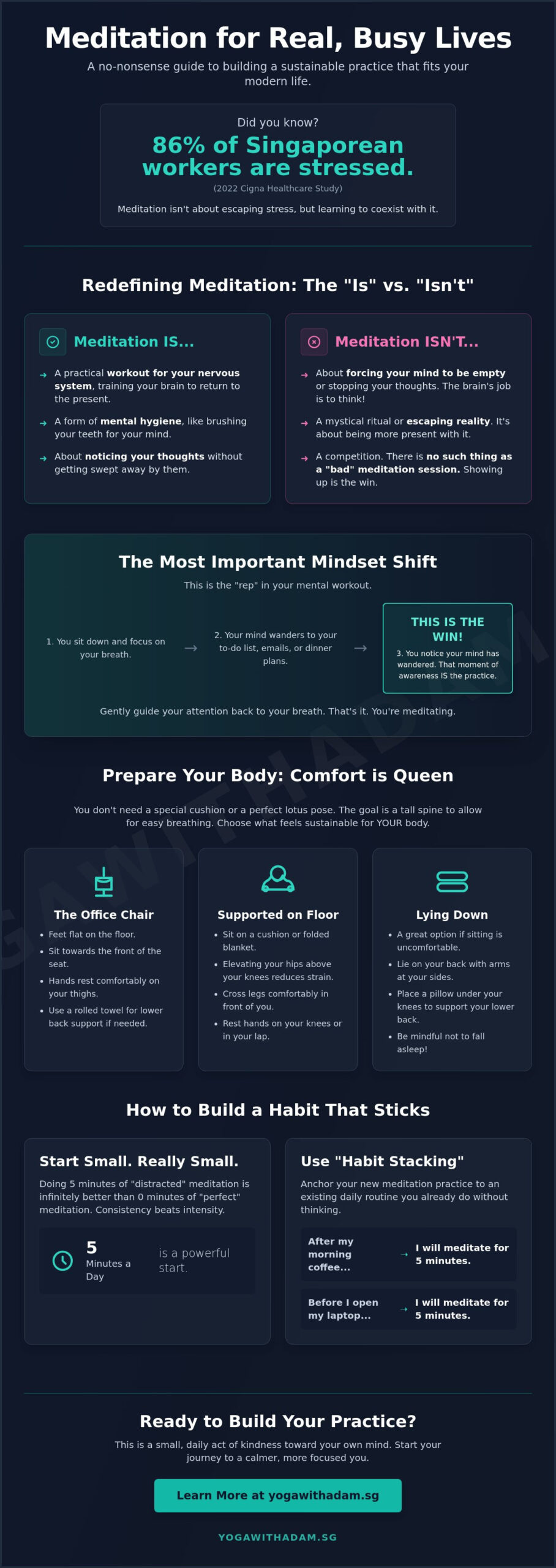
When we talk about how to start a meditation practice, we aren’t talking about levitating or escaping reality. For us, meditation is a functional tool for your nervous system. It’s a practical exercise that trains your brain to return to the present moment. Think of it as a form of mental hygiene. To understand What is Meditation? we should look at it as a deliberate space where we observe our thoughts without getting swept away by them.
We often use the terms mindfulness and meditation interchangeably, but they serve different roles. Mindfulness is a quality of awareness you can carry through your day, like when you are walking through Raffles Place or drinking your morning coffee. Meditation is the formal practice where we set aside time to build that skill. It’s the gym where you train the muscle of focus. By carving out this time, we invest in our own “Human Sustainability.” This concept is about ensuring we have the mental resources to handle the demands of a busy life in Singapore without burning out.
One of the biggest hurdles is the “empty mind” myth. Many people think they’re failing because their thoughts keep racing. I’m here to tell you that meditation isn’t about stopping your thoughts. It’s about noticing them. Your brain is designed to produce thoughts just like your heart is designed to beat. When you realize you’ve drifted off and you gently bring your attention back, that’s the actual “rep.” That moment of noticing is the victory.
The Science of the Quiet Mind
Meditation has measurable effects on your physiology. When we sit, we activate the parasympathetic nervous system, which is our “rest and digest” mode. This counters the “fight or flight” response many of us live in daily. Research into neuroplasticity shows that consistent practice physically changes the brain. A 2011 study from Harvard University found that just eight weeks of practice can increase gray matter density in the hippocampus. This supports holistic mental wellness by improving emotional regulation and reducing stress hormones like cortisol.
Common Misconceptions That Stop Beginners
I hear people say “I can’t sit still” all the time. That’s okay. Your body might be fidgety, and your mind might be loud. You don’t need to be a Zen master to benefit from this. Here are a few things to remember as you learn how to start a meditation practice:
- No religion required: While meditation has roots in various traditions, the practice we teach is secular and focused on mental health and functional movement.
- Five minutes counts: Doing five minutes of “bad” meditation where you’re distracted is significantly better for your brain than doing zero minutes of “perfect” meditation.
- Comfort is key: You don’t need to sit in a lotus position on the floor. You can sit in a chair, on your sofa, or even lie down if that’s what your body needs today.
We want this practice to be sustainable for your real life. It shouldn’t feel like another chore on your to-do list. Instead, view it as a small, daily act of kindness toward your own mind.
How to Prepare Your Space and Body for Practice
You don’t need a S$500 designer meditation cushion or a dedicated “Zen room” to learn how to start a meditation practice. In fact, I’ve had some of my best sessions in a cramped HDB spare room or a quiet corner of a busy office in the CBD. The goal isn’t to look like a statue in a glossy magazine. It’s about creating a sustainable habit that fits your actual, messy, modern life. We want to remove the barriers to entry, not add more expensive gear to your shopping cart.
I follow a simple rule: Comfort is Queen. If your knees are screaming or your lower back is throbbing, your mind won’t settle. You can sit on a sturdy dining chair, lean back on your sofa, or even lie flat on your yoga mat if you aren’t feeling too sleepy. The only technical “rule” we aim for is keeping the spine relatively tall. This alignment allows your breath to move freely through your torso without being restricted by slouching. Think of your spine as a stack of coins that is naturally curved, rather than a rigid steel rod.
Practical Posture for Real Bodies
Finding a position that works for your unique anatomy is the first step toward a consistent practice. We aren’t all built to sit in a perfect lotus position, and that is perfectly okay. Try these three options to see what feels most stable for you:
- The Office Chair: Sit with your feet flat on the floor and your hands resting on your thighs. Use a rolled-up towel behind your lower back if you need extra support to sit tall.
- Supported Floor Sitting: If you prefer the floor, sit cross-legged but place two firm pillows under your seat. Lifting your hips above your knees prevents your legs from “falling asleep.”
- The Wall Support: Sit on the floor with your back against a wall. This takes the strain off your core muscles while keeping your spine straight.
If you find your hands feel awkward or fidgety, try resting one palm inside the other in your lap. You can also touch your thumb and index finger together. These are called mudras. Think of them as physical anchors that remind your brain it’s time to focus. Learning how to meditate becomes much easier when your body feels supported rather than strained.
Setting the Scene (Without the Clutter)
Your environment matters, but it doesn’t have to be silent. Start by putting your phone on “Do Not Disturb” for just 10 minutes. This single act reduces the cortisol spikes that come from constant WhatsApp pings. Check your lighting and temperature too. Dimming the lights or closing the curtains helps your nervous system shift from “alert” to “observational” mode. If you’re looking for more ways to build a body that feels good both in and out of stillness, you might enjoy exploring our sustainable movement classes.
3 Simple Techniques to Start Your Practice Today
Starting doesn’t mean sitting in perfect silence for an hour. It’s about finding a tool that fits your brain and your current energy level. I recommend trying these three methods to see what feels most natural. Don’t feel pressured to master them all at once. Instead, give each technique a solid three days of practice to see what actually “clicks” for your specific lifestyle.
Breathwork: The Gateway to Stillness
We start with the breath because it’s the only anchor that’s always with you. Whether you’re on the MRT or at your desk in Raffles Place, your breath is rooted in the present moment. A great way to learn how to start a meditation practice is using the Box Breath technique. You simply inhale for a count of four, hold for four, exhale for four, and hold the breath out for four. This 1:1:1:1 ratio regulates your nervous system quickly. Many clinical resources, such as a beginner’s guide to meditation, emphasize that focusing on these physical sensations helps quiet the internal chatter. It gives your mind a specific, rhythmic task to follow, making it much harder for your thoughts to wander toward your to-do list.
The Power of Mantra for Busy Minds
If silence feels too loud, a mantra can help. In our studio, we don’t treat a mantra as a mystical spell. It’s just a “mental tool” to give your busy mind a job. I often suggest a simple English phrase for beginners, such as “I am here” or “Safe and steady.” You repeat the phrase silently in coordination with your breath. This provides a rhythmic anchor that is often easier for modern humans than trying to focus on “nothing.” If you want to explore more sound-based techniques, check out this guide on meditation and mantra for deeper insights. Using a mantra creates a steady vibration in the mind that eventually leads to a natural sense of calm.
A Touch of Kundalini: Active Meditation
Sometimes sitting still feels impossible after a stressful day. This is where active meditation and somatic check-ins come in. Instead of forcing your body into a statue-like pose, we use movement to “shake off” the day’s stress first. This could be as simple as rotating your wrists or performing repetitive arm movements. In kundalini yoga, we use these active movements to clear out physical tension so the mind can finally settle. It’s a pragmatic approach for anyone who feels they have too much “buzz” in their system to jump straight into a quiet seat. Noticing the physical sensations of your muscles moving helps ground your energy and brings you back into your body. This makes the eventual transition to stillness feel earned rather than forced.
Try one of these for the next few mornings. You’ll quickly discover that how to start a meditation practice is less about finding the “perfect” way and more about finding the way that works for your human self today. Be patient with the process; the goal is consistency, not perfection.
What to Do When You Get Stuck: Navigating Obstacles
I’ll be honest with you. Learning how to start a meditation practice isn’t a linear path to instant bliss. You’ll likely hit a few bumps. The most common hurdle is the belief that you’re “bad” at it because your mind won’t stop racing. Here’s a secret: the moment you realize you’re distracted is actually the most important part of the practice. That realization is a moment of pure mindfulness. Instead of getting frustrated, just gently return your focus to your breath. It’s like training a puppy; you don’t hit the puppy for wandering off, you just pick it up and put it back on the mat.
Physical discomfort is another reality. If your foot falls asleep or your back aches while sitting on a hard floor in a Bukit Timah shophouse, you don’t have to suffer in silence. If the pain is a sharp “stop” signal, move mindfully. If it’s just a dull itch or restlessness, try to sit with it for three breaths before reacting. You’re learning the difference between a real physical need and a mental urge to escape. Don’t let “The Judge” take over. That inner critic will tell you that you’re failing because you can’t stay still, but meditation isn’t about being a statue; it’s about being aware of what’s happening right now.
Consistency is your best friend here. A 2018 study published in Behavioural Brain Research showed that even 13 minutes of daily meditation for eight weeks decreased negative mood states and improved memory. For most of us, starting with just 5 minutes every single morning is far more effective than trying to force a grueling one hour session once a week. It builds the habit into your actual life, making it a sustainable part of your routine rather than a chore.
Working with Distractions
Singapore is rarely silent. Whether it’s the hum of an aircon unit or the distant sound of traffic on the PIE, external noises will happen. Instead of fighting them, incorporate them. Listen to the sound as just “vibration” or “noise” without building a story about how annoying it is. You can use the “Labeling” technique. When a thought pops up, silently say “thinking” in your mind. If a feeling arises, say “feeling.” This creates a small, healthy gap between you and the distraction. Every distraction is a fresh opportunity to practice the art of coming back to yourself.
The Emotional Release
Sometimes, when we finally get quiet, things we’ve pushed down start to bubble up. You might feel sudden sadness, frustration, or even anxiety. This is normal and actually a sign of progress. Your system is finally safe enough to process old baggage. If things feel too intense to handle alone, you might find clarity through private healing sessions where we can work through these blocks together. There’s also a deep connection between the mental stillness of meditation and the physical release found in tension & trauma releasing exercises (TRE®), which helps the body shake off stored stress physically.
Building the Habit: Meditation for Long-Term Sustainability
Learning how to start a meditation practice is a bit like starting a fitness regime. The first few days feel novel, but the real magic happens when the habit becomes as automated as brushing your teeth. I recommend a method called habit stacking. You anchor your new meditation seat to an existing anchor in your day. Try sitting for five minutes immediately after your morning kopi or right before you climb into bed. By piggybacking on a pre-existing ritual, you skip the mental fatigue of deciding when to practice.
Technology can be a double-edged sword here. We want to unplug, yet our phones are always within reach. Use this to your advantage by setting a simple, non-intrusive timer. You don’t need a library of 500 guided tracks to be successful. A basic chime that signals the start and end of your session is enough. If you prefer guidance, look for apps that offer “minimalist” sessions to avoid over-stimulation. Your first 30 days aren’t about achieving a blank mind. They’re about showing up when you’d rather be doing anything else. Expect your mind to wander. That’s not a failure; it’s just how brains work.
Creating a Sustainable Routine
Sustainability is the heartbeat of my teaching. I suggest starting with just 3 to 5 minutes of stillness. This represents less than 0.5% of your total day, making it an achievable goal even for the busiest Singaporean professional. Each week, increase your time by just one minute. This gradual progression builds “meditation stamina” without the burnout that comes from trying to sit for 30 minutes on day one.
Life happens, and you’ll eventually miss a day. When that happens, apply the “Never Miss Two Days” rule. Missing once is an accident; missing twice is the start of a new habit of not practicing. If you’re struggling to find time during the work week, consider how to integrate these moments into your professional life. Many forward-thinking companies now offer corporate wellness programs that prioritize these somatic breaks to prevent burnout and improve focus.
Finding Your Tribe
Practicing solo is vital, but there’s a unique energy that comes from sitting in a room with others. Solo practice builds personal discipline, while group practice provides a sense of shared humanity. It reminds us that we aren’t the only ones struggling with a “monkey mind” or a stiff back. In Singapore, you can find inclusive, “Yoga for Humans” style classes that ditch the performance and focus on the person.
These spaces are designed for real bodies and real lives. They offer a supportive environment where you can ask questions and feel seen. As you continue your journey of how to start a meditation practice, remember that perfection isn’t the goal. You are already a “meditator” the moment you decide to sit down and take that first conscious breath. Keep it simple, keep it grounded, and keep showing up for yourself.
Take Your First Breath Toward a Sustainable Habit
Meditation isn’t a performance or a quest for a perfectly empty mind. It’s a practical tool for staying grounded in the middle of a busy Singaporean lifestyle. By focusing on somatic techniques and preparing your body properly, you move away from the pressure of “doing it right” and toward a practice that actually lasts. We’ve explored how to set up your space and navigate the inevitable mental noise that happens to every person who tries to sit still.
Learning how to start a meditation practice is much easier when you have a supportive community by your side. You don’t have to figure out the nuances of functional movement or breath-work alone. Adam Fazlur brings 10 years of experience to every session, helping real people in our national community build sustainable habits through a grounded, human-first approach. Our sessions focus on what works for your body today, not some unattainable aesthetic ideal. If you’re ready to move beyond the theory and experience a grounded session for yourself, we’d love to have you join us.
Join a “Yoga for Humans” meditation session with Adam and see how a decade of teaching experience can help you find your steady center. You’ve got this, and we’re here to help you every step of the way.
Frequently Asked Questions
Is it okay to meditate while lying down?
Yes, you can absolutely meditate while lying down. While some traditionalists insist on a cross-legged seat, I believe your practice should fit your body, not the other way around. If sitting causes back pain or distraction, lying flat on your back is a great alternative. Just be mindful that it’s easy to drift off. I often suggest bending your knees and placing your feet flat on the floor to keep your mind alert while your body rests.
How long should I meditate for as a beginner?
Start with just five to ten minutes a day. When people ask me how to start a meditation practice, they often think they need to sit for an hour, but consistency beats duration every time. A 2021 study in the journal Behavioural Brain Research showed that even 13 minutes of daily meditation for eight weeks led to significant improvements in mood and memory. Start small so you actually look forward to it rather than seeing it as a chore.
What is the best time of day to meditate?
The best time is whichever slot you can consistently commit to. Many of my students in Singapore find that a 7:00 AM session before the morning MRT rush works best to set a steady tone for the day. Others prefer a session right before bed to decompress from the office. There’s no magic hour, but linking it to an existing habit, like having your morning kopi, helps the new routine stick to your daily life.
Can I meditate if I have ADHD or a very busy mind?
You can definitely meditate with a busy mind; in fact, that’s exactly why we practice. Meditation isn’t about stopping your thoughts, which is impossible for most humans, but about changing how you relate to them. If you have ADHD, try micro-meditations or walking meditation. Research from the University of California indicates that mindfulness can reduce self-reported ADHD symptoms by roughly 30 percent in adults. It’s about noticing the distraction and gently returning to your breath.
Do I need to close my eyes to meditate properly?
You don’t need to close your eyes to have a successful practice. If closing your eyes makes you feel sleepy or anxious, try a soft gaze instead. Simply look down at a spot on the floor about a meter in front of you and let your vision go slightly out of focus. This is a common technique in Zen traditions and helps you stay present in the room while minimizing visual distractions. It’s a great option for practicing during a lunch break.
What should I do if I keep falling asleep during meditation?
If you keep falling asleep, try changing your posture or the time of day you practice. Sleepiness is often a sign that your body is genuinely exhausted, so don’t beat yourself up about it. Try sitting upright in a firm chair instead of on a soft sofa, or keep your eyes slightly open. If you’re meditating at 11:00 PM after a long day, try moving your session to the morning when your mind is naturally more alert.
How soon will I start feeling the benefits of meditation?
You might feel a sense of calm after your very first session, but physiological changes usually take a bit longer. A landmark 2011 study from Harvard University found that eight weeks of regular mindfulness practice led to measurable increases in grey matter density in the brain. Most of my students report feeling less reactive to daily stressors within the first 14 to 21 days of daily practice. It’s a slow build, much like training a muscle.
Is meditation a religious practice?
Meditation has roots in various spiritual traditions, but the way we approach it here is entirely secular and grounded in science. You don’t need to adopt any specific belief system to benefit from the practice. Think of it as mental hygiene or brain training. We use techniques that focus on the physical sensations of breathing and the mechanics of the mind, making it accessible to everyone in our community regardless of their personal background or faith.