

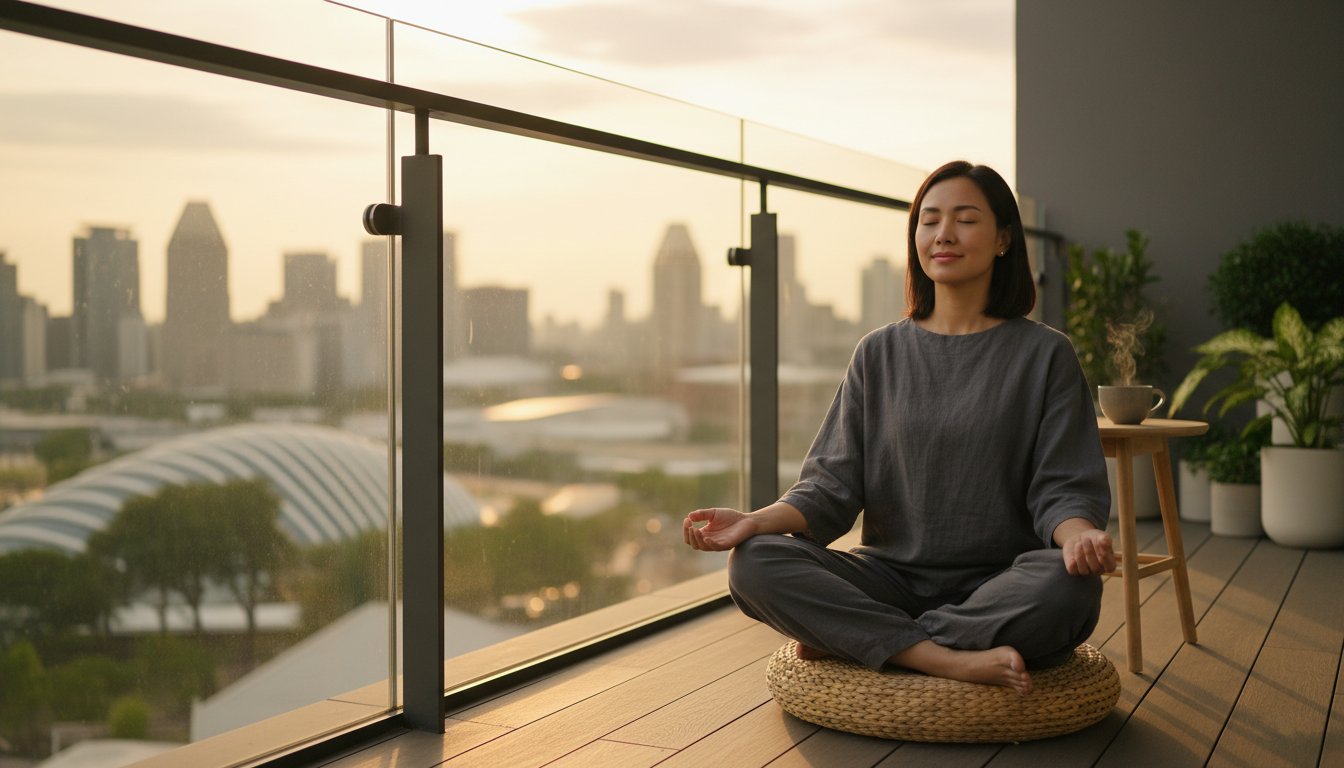
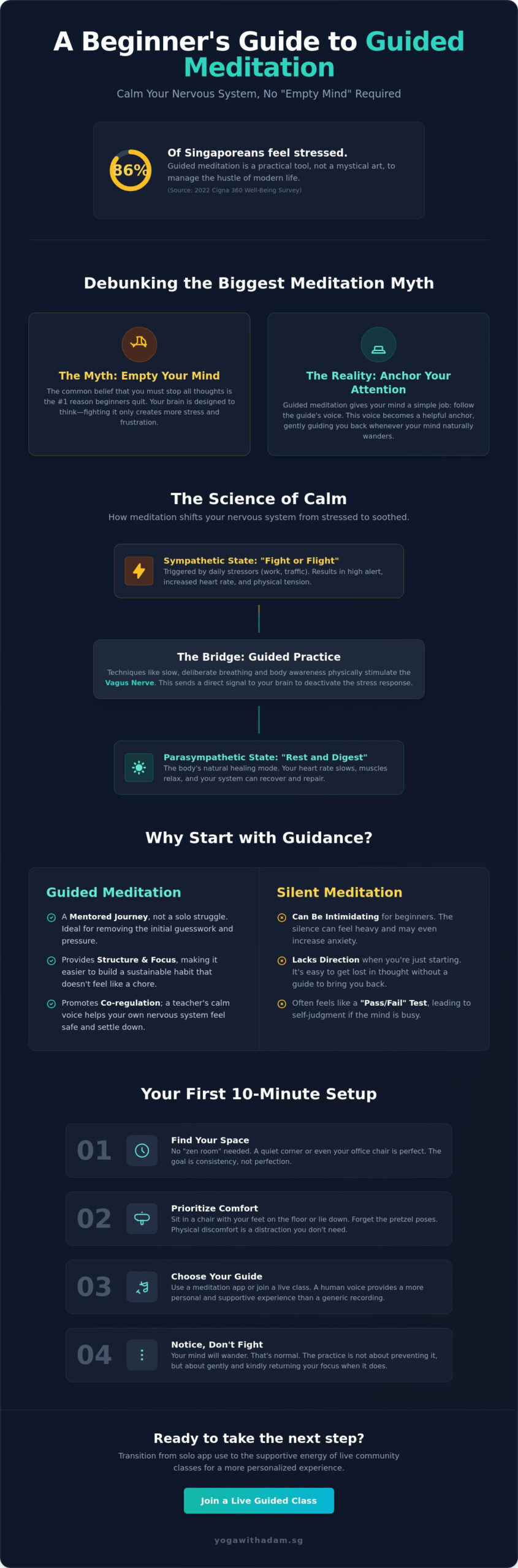
What if the secret to a calmer life isn’t about clearing your mind, but simply learning how to sit with the noise? In a city like Singapore, where the 2022 Cigna 360 Well-Being Survey reported that 86% of us feel stressed, finding a way to unplug is more than just a luxury. If you’ve tried to sit still only to end up frustrated by your wandering thoughts or an aching lower back, you’re not alone. This grounded approach to guided meditation for beginners is designed for real people with busy schedules and noisy neighbors.
I know how it feels to think that meditation is just not for you because you can’t stop your brain from making a grocery list. We often believe we need to be perfectly “zen” before we even start, but that’s simply not true. I promise you can build a practice that actually fits your life and helps regulate your nervous system without any intimidating spiritual jargon. We’re going to explore practical techniques to handle physical discomfort, manage a distracted mind, and create a sustainable daily habit that supports your well-being for the long term.
Key Takeaways
- Drop the “emptying the mind” myth and discover how guided meditation for beginners works as a mentored journey rather than a solo struggle.
- Explore the science behind the Vagus nerve and how specific breathing techniques physically signal your nervous system to move from stress into deep rest.
- Learn why starting with guidance is often more effective than silent practice for building a sustainable habit that doesn’t feel like a chore.
- Master a practical 10-minute setup that fits into your real life, proving you don’t need a dedicated “zen room” or fancy equipment to find your focus.
- Discover how to transition from solo app use to the supportive energy of live community classes for a more personalized and human experience.
What is Guided Meditation for Beginners? (The No-Pressure Definition)
Let’s clear something up right away. Meditation isn’t about sitting in a cave or achieving some mystical state of enlightenment. For most of us living in the hustle of Singapore, it’s simply a tool to help us feel a bit more human. When you explore What is Guided Meditation, you’ll find it’s a mentored journey rather than a solo struggle. Instead of sitting alone with your racing thoughts, you have a guide leading the way.
I often hear people say they can’t meditate because they can’t “empty their mind.” That is a total myth. Your brain is designed to produce thoughts just like your lungs are designed to breathe. Expecting it to stop is unrealistic. In guided meditation for beginners, we don’t try to clear the mind. We just give the mind a specific job to do. The guide’s voice serves as an anchor. It gives your wandering attention a place to land when you inevitably start thinking about your To-Do list or your next meal at the hawker centre.
This practice acts as a vital bridge. According to a 2022 study by the Institute of Mental Health, approximately 13.9% of Singapore’s population reported symptoms of poor mental health. Guided sessions provide a low-barrier entry point to manage that stress. It helps you transition from the “always-on” mode of high-stress living into a state of grounded calm without needing years of training.
The “Yoga for Humans” Approach to Mindfulness
We take a “Yoga for Humans” approach here. That means we prioritise your actual comfort over aesthetic “lotus” poses. You don’t need to be flexible or sit on the floor. If you’re more comfortable in a chair or lying down, do that. We acknowledge that a racing mind is a sign of a healthy, functioning brain. The goal shifts from achieving “perfect silence” to practicing “kind awareness.” We aren’t fighting our thoughts; we’re just noticing them without judgment.
Why Guidance Matters When You Are Just Starting
Sitting in total silence can be incredibly intimidating. For many, it actually increases anxiety because the silence feels heavy. Being led through a technique is different. It provides a structure that removes the guesswork. A teacher’s voice helps regulate your own nervous system through a process called co-regulation. It’s much easier to find a sense of safety when someone is walking the path with you. This removes the “perfection pressure” and makes guided meditation for beginners feel like a conversation with a trusted friend rather than a test you might fail.
The Science of How Meditation Calms Your Nervous System
We often talk about meditation as a way to find “inner peace,” but for most of us living in Singapore, we just want to stop feeling so wired after a long day at the office. It’s not just a vibe; it’s a biological shift. When we engage in guided meditation for beginners, we’re actually training our biology to move away from a state of constant high alert. This practice forms a core pillar of holistic mental wellness because it addresses the physical body as much as the mind. It’s about moving beyond “feeling good” and into the reality of how our cells and nerves respond to stillness.
Central to this process is the Vagus nerve. It’s the longest cranial nerve in your body, acting as a two-way highway between your brain and your organs. When you take those slow, deliberate breaths during a session, you’re physically stimulating this nerve. This sends an immediate “clear” signal to your brain, lowering your heart rate and blood pressure. Somatic awareness, or the act of noticing sensations in the body, helps us release stored tension that we might not even realize we’re carrying in our shoulders or jaw.
From Fight-or-Flight to Rest-and-Digest
Most humans spend too much time in the sympathetic nervous system, better known as the fight-or-flight mode. This was great for escaping predators, but it’s less helpful when you’re just stuck in traffic on the PIE or answering emails at 10 PM. Guided prompts act as a manual override for this response. Instead of letting your thoughts spiral, the guide’s voice gives your brain a specific track to follow. Over time, this shifts you into the parasympathetic nervous system, the “rest-and-digest” state where healing happens.
Research shows that consistent practice can actually change the physical structure of your brain. A 2011 study by Harvard researchers found that just eight weeks of mindfulness can lead to a decrease in gray matter density in the amygdala, which is the part of the brain responsible for fear and anxiety. If you’re looking for a practical step-by-step guide to starting this process, it’s much more accessible than the movies make it look.
The Connection Between Meditation and TRE®
Sometimes, sitting still feels impossible because our bodies are holding onto too much “charge.” If you’ve ever felt restless or twitchy while trying to focus, you aren’t doing it wrong; your nervous system just needs a different outlet first. This is why we often suggest “shaking off” stress before trying to be still. Using tension & trauma releasing exercises can be the perfect partner to a sitting practice. These exercises help release the deep muscular patterns of stress, making it much easier to transition into a quiet seat. Somatic meditation is the bridge between physical release and mental clarity. By using guided meditation for beginners alongside these physical tools, we create a sustainable practice that respects how our bodies actually work. If you want to explore these tools in a supportive environment, come join our community for a session that keeps things grounded and real.
Guided vs. Silent Meditation: Which One Should You Choose?
Choosing between sitting in total silence or following a teacher’s voice is a common fork in the road. For most of us in Singapore, our days are loud, scheduled, and packed with mental chatter. Jumping straight into a 20-minute silent sit often feels like being thrown into the deep end of a pool without knowing how to tread water. It’s why many people quit after three days. They think they’re failing because their mind won’t stop racing, but the reality is they just haven’t been given a map yet.
Silent meditation is a beautiful destination, but guided meditation for beginners is usually the best vehicle to get you there. Guidance provides a focal point that keeps you anchored. Instead of getting lost in a loop about your grocery list or a meeting at Raffles Place, you have a voice gently pulling you back to the present. If you want a solid foundation on the basics, the NHS offers a clear resource on how to meditate for beginners that complements a guided approach well.
Different styles of guidance offer different “anchors” for your attention:
- Breathwork: Focuses on the physical sensation of air moving in and out.
- Visualization: Uses mental imagery to create a sense of calm or focus.
- Mantra-based: Uses sound or phrases to occupy the analytical mind.
The Power of Mantra in Guided Practice
I often tell my students that the mind needs a job. If you don’t give it one, it’ll start making to-do lists or rehashing old arguments. Using a meditation and mantra approach is like putting your mind on a treadmill. It gives the “monkey mind” something repetitive and productive to do so it doesn’t wander off into the weeds. This repetition helps you bypass the part of your brain that wants to over-analyze everything.
You don’t need complex phrases to start. Simple mantras work best for daily use. You might try “So” on the inhale and “Hum” on the exhale, which translates to “I am.” Or, keep it even more grounded with “Breath in, breath out.” These sounds act as a rhythmic safety net for your focus.
Kundalini Meditation: A Dynamic Alternative
If the idea of sitting perfectly still makes you want to crawl out of your skin, you aren’t alone. This is exactly why Kundalini yoga is frequently called the meditation of the active person. It’s a fantastic guided meditation for beginners who struggle with the “fidget factor.” Instead of forcing stillness on a restless body, we use “kriyas.” These are specific sets of movements and breathing patterns designed to prepare the body for deep quiet.
By moving your arms, changing your breath, or chanting, you burn off that excess nervous energy first. It’s a practical way to transition from a high-stress workday into a state of relaxation. Once the movement is done, the stillness that follows feels earned and natural, rather than forced. It’s meditation for real humans who have a hard time staying still.
Your First 10 Minutes: A Practical Step-by-Step Guide
You don’t need a dedicated “zen room” or a S$200 designer cushion to start. In fact, trying to create the perfect aesthetic often becomes just another barrier to actually sitting down. If you have ten minutes and a place to sit, you have everything you need for guided meditation for beginners. Let’s keep it simple and sustainable.
- Step 1: Find a seat that doesn’t hurt. A standard dining chair or your office seat is perfectly fine. We aren’t looking for a “perfect” lotus pose; we’re looking for a base that supports your body without causing pins and needles.
- Step 2: Set a realistic intention. Don’t aim for enlightenment on day one. Instead, tell yourself, “I will be present for 5 minutes.” Keeping the goal small makes it a win you can actually achieve.
- Step 3: Choose your guide. Whether it’s an audio track, a video, or joining a live class, having a voice to follow helps anchor your focus. It takes the guesswork out of the process.
- Step 4: The Gentle Return. When your mind inevitably wanders to your grocery list or a work email, just notice it and come back. That’s the whole game.
Posture and Physical Comfort
We aim for a tall spine, not a rigid one. Think of your spine as a stack of coins rather than a literal metal rod. If your hips feel tight, use a firm pillow or a couple of yoga blocks to lift your seat. This creates a natural curve in your lower back and makes sitting much easier for real human bodies. If sitting causes genuine physical pain, lying down on a mat is a valid alternative. The only caveat is that you might fall asleep, so try to keep your knees bent with feet flat on the floor to stay present.
Dealing with Distractions and the “Wandering Mind”
Living in a bustling city like Singapore means you’ll likely hear a bus braking outside or a neighbor’s aircon unit humming. Instead of fighting these sounds, treat them as part of the landscape. Use the “Note and Return” technique: when a thought or sound appears, mentally label it as “thinking” or “noise” without any judgment. Then, gently shift back to your breath. Mindfulness is the act of returning to the breath, not the act of staying there. Every time you notice you’ve drifted and you choose to come back, you’re actually “doing” the meditation correctly. It’s like a bicep curl for your brain.
Ready to move your body and clear your mind? Check out our inclusive yoga classes in Singapore designed for real human bodies.
Taking the Next Step: Community and Personalised Healing
Apps are a brilliant way to start your journey. They make guided meditation for beginners feel private and accessible from your own sofa. However, there is a ceiling to what a pre-recorded voice can offer. Real human connection is what turns a fleeting interest into a sustainable habit. When you sit with others in a live class, the collective energy keeps you anchored. It stops being another item on your to-do list and starts being a shared experience that feels grounded and real.
Sometimes we hit a wall that an app cannot help us climb. Maybe it is a physical tension that will not budge or a mental loop that feels too loud. This is where private healing sessions come into play. These one-on-one meetings allow us to look at your specific blockages without the distraction of a crowd. We focus on personal transformation that feels practical rather than performative.
The goal is to integrate mindfulness into your busy Singapore lifestyle without it feeling like “another chore.” We already have enough of those. Instead of forcing a rigid hour of silence, we look at how to weave these tools into your commute on the MRT or the ten minutes between back-to-back meetings. It is about making the practice work for your life, not the other way around.
The Value of a Live Guide
In a live setting, I can see when you are struggling. I can offer a real-time adjustment or answer a question that has been bugging you for weeks. We all hit that “boring” or “difficult” phase where the novelty of guided meditation for beginners wears off. A teacher provides the accountability needed to push through those flat periods. You are not just clicking “play”; you are showing up for yourself and for the person waiting to guide you through the process.
- Real-time feedback: Get answers to your specific questions about posture or wandering thoughts.
- Consistency: A regular class schedule creates a rhythm that apps often lack.
- Shared space: There is a unique, quiet power in meditating alongside other humans.
Corporate Wellness and Group Practice
Work in Singapore can be relentless. Burnout is a genuine crisis, with recent studies showing that over 60% of employees feel significant work-related stress. We can change this by bringing these tools directly into the office through corporate wellness programs. These sessions improve team dynamics by fostering a sense of “human sustainability” rather than just relentless productivity. It is a way to breathe together before hitting the next deadline.
You can start small. Join a weekend workshop to refine your technique or book a discovery session to see which path fits your current energy levels. Whether you are looking for a group setting or a private deep dive, the next step is simply about showing up as you are. No fancy gear or “Zen” personality required.
Take Your First Breath Toward a Steadier You
You’ve seen that meditation doesn’t require a mountain top or a perfectly silent mind. It’s really about giving your nervous system a chance to reset through simple, science-backed techniques that fit into a busy Singaporean schedule. Whether you’re starting with ten minutes of breathing or exploring the difference between guided and silent practice, the goal is to build something sustainable for your actual life. I’ve spent more than 12 years as a guide focusing on somatic healing, and I’m here to tell you that showing up as you are is enough.
We believe in Yoga for Humans, which means we prioritize your comfort over performative poses. My sessions across Singapore, including private and corporate options, are designed to be accessible for every body. If you’re ready to stop overthinking and start feeling better, I’d love to welcome you into our community. Finding the right guided meditation for beginners is simply about finding a guide who understands the real world. Join a “Yoga for Humans” session and start your meditation journey with Adam. You’re already doing better than you think, and I can’t wait to see you on the mat.
Frequently Asked Questions
How long should a beginner meditate for each day?
Start with just five to ten minutes a day. It’s much better to do five minutes consistently than an hour once a month. I always tell my students in Singapore that building the habit is the hardest part. A 2018 study from Harvard researchers found that consistent daily practice, even in small doses, helps regulate the nervous system. Aim for a duration that feels like a win rather than a chore.
Do I have to sit cross-legged to meditate effectively?
No, you don’t have to twist yourself into a pretzel to find peace. Effective guided meditation for beginners can happen while sitting in a firm chair with your feet flat on the floor or even lying down if you have back pain. The goal is a spine that feels long and supported. Use a cushion or a S$20 yoga block to tilt your pelvis forward if you prefer the floor. Comfort is the priority here.
What if I fall asleep during a guided meditation?
It’s perfectly fine if you drift off. Falling asleep usually means your body is catching up on much-needed rest. If you find yourself napping every time, try practicing while sitting upright in a chair instead of lying in bed. This keeps your mind a bit more alert while your body relaxes. About 25 percent of my new students report nodding off during their first few sessions, so you’re in good company.
Can I meditate if I have a very busy mind or ADHD?
Yes, you absolutely can. Meditation isn’t about stopping your thoughts; it’s about changing your relationship with them. For folks with ADHD, guided meditation for beginners provides a focal point that makes the process more accessible than sitting in total silence. Think of it like training a puppy. When your mind wanders off, you just gently lead it back to the guide’s voice without any judgment or frustration.
What is the best time of day to practice guided meditation?
The best time is the slot that fits naturally into your existing routine. Many of my students prefer first thing in the morning to set a steady tone for the day. Others use it at 6:00 PM to transition from work mode to home life. There’s no magic hour for results. Consistency matters more than the clock, so pick a time where you won’t be interrupted by your phone or family.
Is guided meditation as effective as silent meditation?
It’s just as effective for building mindfulness and reducing stress. While silent meditation is a great goal, a guided track acts like training wheels on a bicycle. It keeps you on track when your brain starts listing your grocery needs or work emails. A 2011 study published in Psychiatry Research showed that structured mindfulness programs lead to measurable changes in brain regions associated with memory and empathy, whether they’re guided or silent.
Do I need to be spiritual or religious to practice?
No, you don’t need any specific beliefs to benefit from this practice. I treat meditation as a functional tool for mental hygiene, much like brushing your teeth is for your mouth. While meditation has deep roots in various traditions, the modern secular approach focuses on the biological and psychological benefits. We focus on breath, body sensations, and awareness. It’s about being a human in the world, not subscribing to a new ideology.
What should I do if I feel emotional during a session?
Allow yourself to feel whatever comes up without trying to fix it. It’s common for suppressed emotions to surface once we finally sit still and quiet the external noise. If you feel overwhelmed, take a few deep breaths or gently open your eyes to ground yourself in the room. Remember that crying or feeling frustrated is a natural part of the process. You’re simply processing the human stuff we usually ignore during a busy day.