


What if the most effective way to heal your mind isn’t by talking about it at all? Many of us in Singapore have spent hours on a therapist’s sofa, only to find that our bodies still feel braced for a fight that ended years ago. It’s exhausting to re-tell a story when your muscles are already screaming in “armoring” or your heart is racing with hypervigilance. According to a 2024 report on mental health in Singapore, nearly 14 percent of residents will experience a mood or anxiety disorder in their lifetime, yet many find that verbal processing only goes so far. We know that feeling of being stuck in your head while your body stays trapped in the past. If you’ve reached a limit with clinical conversations, you aren’t alone and you aren’t broken.
In this guide, we’ll explore how somatic practices and bottom-up healing can release trauma stored deep in your tissues. You’ll learn about 2026’s most effective alternatives to talk therapy for trauma that help you find a genuine sense of safety in your own skin. We’ll look at practical tools to calm your nervous system, from trauma-informed yoga to sensory grounding, so you can build a sustainable path to mental wellbeing that feels like Yoga for Humans rather than a clinical chore.
Key Takeaways
- Understand why trauma lives in the nervous system and how “bottom-up” healing addresses the physical responses that logic alone often can’t reach.
- Discover the biological purpose of shaking and how somatic exercises help you release stored stress through your body’s natural tremor mechanism.
- Explore effective alternatives to talk therapy for trauma by comparing somatic practices, EMDR, and Internal Family Systems to find the right fit for your recovery.
- Learn how to integrate meditation and mantra into your daily life to create a stable, grounded foundation for deeper healing work.
- Find out how “Yoga for Humans” and personalized private sessions can help you build a sustainable, approachable routine for long-term well-being.
Why Talk Therapy Isn’t Always the Final Answer for Trauma
I’ve met so many people in Singapore who feel like they’re failing at recovery because they’ve spent years in a therapist’s chair without feeling “better.” They can explain their past with clinical precision, yet their heart still hammers against their ribs when a door slams. This happens because trauma isn’t just a memory stored in your brain; it’s a physical state held in your nervous system. While traditional methods are valuable, we’re seeing a massive shift in 2026 toward alternatives to talk therapy for trauma that address the body’s physiological reality. If your body still feels like it’s in danger, no amount of logical “talk” will convince it otherwise.
We often distinguish between top-down and bottom-up healing. Talk therapy is top-down; it uses the thinking brain to try and calm the emotional brain. The problem is that during a panic response, the thinking brain essentially goes offline. You can’t reason your way out of a flashback because the part of your brain responsible for reason isn’t the one in charge at that moment. This is where narrative therapy can sometimes backfire. For some, re-telling a traumatic story over and over doesn’t provide relief. Instead, it just re-traumatizes the system, keeping the person looped in a state of high distress. While looking for an overview of trauma therapies, it’s clear that the most effective approaches now integrate the body’s experience.
My approach with “Yoga for Humans” focuses on the physiological experience of safety over the intellectual understanding of events. We don’t need to analyze why you feel tight in your chest to help that tightness soften. We focus on the “here and now” of your physical sensations, building a sustainable sense of security within your own skin.
The Science of the Vagus Nerve and Survival Responses
Our autonomic nervous system is a survival machine that sometimes gets stuck in the “on” position. When we face a threat, the amygdala triggers a physical reaction in about 20 milliseconds, which is much faster than conscious thought. This can leave us trapped in fight, flight, or freeze long after the actual danger has passed. The vagus nerve is the information superhighway between body and brain. It’s the primary channel for the parasympathetic nervous system, responsible for telling your heart rate to slow down and your muscles to relax. If this highway is congested or “stuck,” your body remains on high alert regardless of your surroundings.
When Talking Reaches a Plateau
You’ll know you’ve reached a plateau when you have processed the “story” but not the “stress.” You might have total cognitive insight into your past, yet you still struggle with insomnia, digestive issues, or chronic tension. There’s a profound difference between cognitive insight and somatic release. Understanding your trauma is a mental exercise; releasing it is a physical one. Somatic practices are a necessary partner to traditional therapy because they address the 80% of signals that travel from the body up to the brain. In our local community, I’ve seen that moving together in a safe, non-judgmental space helps bridge this gap, allowing for a more complete form of recovery that talk alone cannot reach.
Somatic Healing: Releasing Trauma Through the Body’s Natural Tremor Mechanism
Traditional therapy often focuses on the “top-down” approach, using logic and language to process difficult events. However, trauma often lives in the body long after the mind has tried to move on. Tension & Trauma Releasing Exercises (TRE®) offer a “bottom-up” solution. This method doesn’t require you to talk through your past or revisit painful memories. Instead, it relies on a biological reflex that every human possesses. When we experience high stress, our nervous system prepares us to fight or flee. If that energy isn’t used, it stays trapped in our muscles as chronic tension. By using TRE®, we can tap into the body’s innate ability to let go of this stored pressure.
Nature provides a clear blueprint for this process. If you watch a wild animal after it escapes a predator, you’ll often see it shake its entire body. This isn’t a sign of trauma; it’s the animal’s way of discharging the massive surge of adrenaline and cortisol from its system. Humans have the same biological equipment, but we’ve been socialized to suppress it. We see shaking as a sign of weakness or loss of control. Reclaiming this “shake” is one of the most powerful alternatives to talk therapy for trauma because it bypasses the analytical mind and speaks directly to the nervous system.
The Mechanism of Neurogenic Tremors
TRE® works by gently fatiguing and then stretching the psoas muscle, which is often called the “fight or flight” muscle. This deep-seated muscle group connects the torso to the legs and is the first to contract when we feel threatened. When these muscles are activated through specific movements, they trigger neurogenic tremors. These are involuntary vibrations that travel through the body, helping to release deep-seated patterns of tension. For high-stress professionals in Singapore’s fast-paced environment, this provides a physical “reset button” that doesn’t require a single word of explanation.
During a session, you might feel a light buzzing in your legs or a rhythmic rocking in your pelvis. It’s a strange sensation at first, but most people find it deeply relaxing. Organizations like the U.S. Department of Veterans Affairs recognize that evidence-based alternative treatments can be crucial for recovery, especially for those who find traditional clinical settings overwhelming. The beauty of this practice is its efficiency; your body already knows how to heal itself if we simply get out of the way.
Safety and Self-Regulation in Somatic Practice
While the shaking mechanism is natural, it’s important to approach it with care. We use a concept called titration, which means doing a little bit at a time. In our practice, we never push for a massive emotional release. Instead, we look for small, manageable shifts. You’ll learn to recognize when your body is successfully discharging energy versus when you might be starting to feel overwhelmed. If the sensation becomes too intense, you simply straighten your legs or roll onto your side to stop the tremors instantly. This builds a sense of agency and safety that is often missing in trauma recovery.
If you’re curious about the science or want to try the movements yourself, you can explore our full guide to tension & trauma releasing exercises. It’s a sustainable way to manage the physical toll of stress without needing to “fix” your thoughts first. Many of our students find that once the body feels safe, the mind naturally follows. If you’re ready to explore how your body can lead the way, finding a practice that fits your life is the first step toward a more grounded version of yourself.
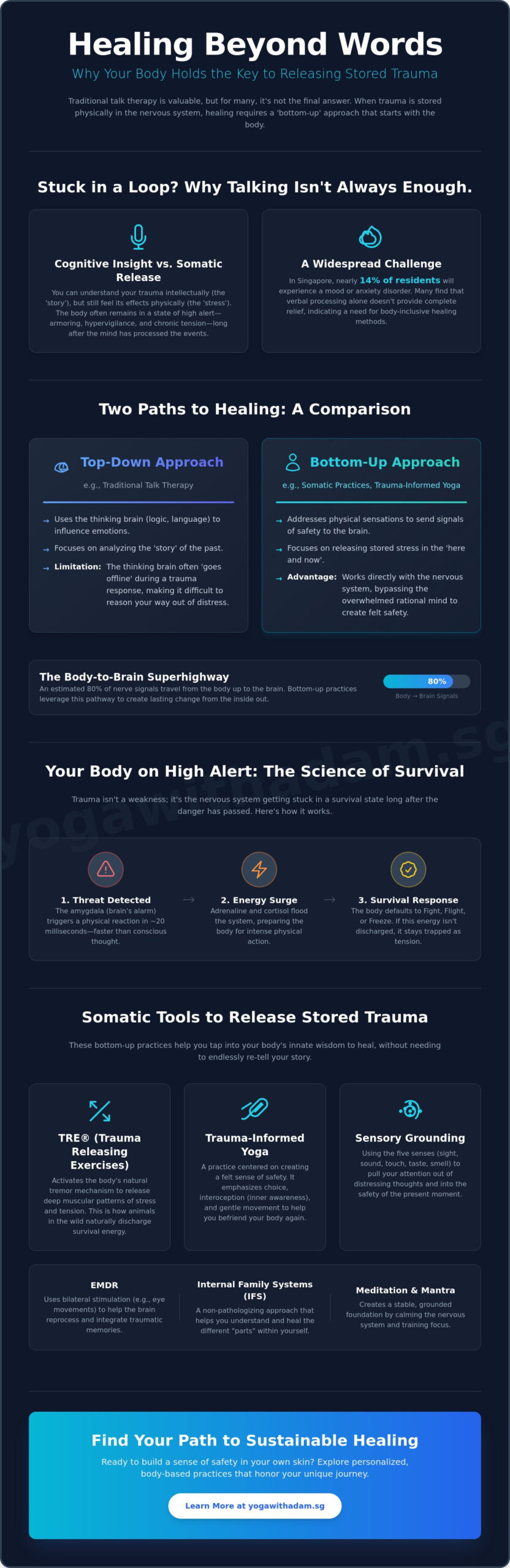
Comparing Top-Down and Bottom-Up Approaches to Mental Wellbeing
I often meet students in my Singapore studio who feel stuck after years of traditional counseling. They understand their trauma intellectually, but their bodies still react as if the danger is present. This gap exists because traditional Cognitive Behavioral Therapy (CBT) is a “top-down” approach. It focuses on the prefrontal cortex to change thoughts and behaviors. While CBT is a gold standard for many, it often misses the physical imprints left in the nervous system.
Bottom-up approaches, such as Kundalini Yoga or Somatic Experiencing, work in reverse. We start with the body to reach the brain. We use breath, alignment, and functional movement to signal safety to the brain stem. This isn’t “woo-woo” science; it’s grounded in the Polyvagal Theory, introduced by Dr. Stephen Porges in 1994. By shifting the state of our nervous system, we create a foundation where traditional talk can actually stick. A 2014 study published in the Journal of Clinical Psychiatry found that trauma-informed yoga significantly reduced PTSD symptoms in patients who didn’t respond to other treatments.
EMDR and IFS: The Middle Ground
Eye Movement Desensitization and Reprocessing (EMDR) and Internal Family Systems (IFS) serve as vital alternatives to talk therapy for trauma. EMDR uses bilateral stimulation to help the brain process traumatic memories without requiring a detailed verbal narrative. IFS, developed by Richard Schwartz, views the psyche as a system of “parts.” We learn to lead from our “Self” rather than being driven by protective parts like anxiety or anger. These tools are often the first step for those who find talking too overwhelming or ineffective.
Somatic Experiencing and Sensorimotor Psychotherapy
These clinical practices focus on the “felt sense” rather than the “thought sense.” While I teach yoga for humans to help with general mobility and stress, Somatic Experiencing (SE) is a specific clinical method developed by Peter Levine. It tracks how survival energy stays trapped in our posture and breath. In a session, a therapist might help you notice a slight tremor in your hand or a tightness in your chest. By staying with these sensations, the body finally completes the “fight or flight” cycle it couldn’t finish during the original trauma. This discharge of energy is what leads to long-term, sustainable recovery.
I believe the most effective path involves a multi-modal approach. We don’t have to choose between the mind and the body. When we combine the cognitive insights of talk therapy with the somatic release of movement, we treat the whole human. These integrated options provide powerful alternatives to talk therapy for trauma by addressing the physical root of the distress. This integrated method is becoming more accessible in Singapore as local practitioners move toward holistic, trauma-informed care models.
Practical Steps to Incorporating Somatic Practices into Your Daily Life
Starting a somatic routine shouldn’t feel like another stressful chore on your to-do list. We often think healing needs to be a grand, hour-long event, but your nervous system actually prefers small, predictable check-ins. If you’re exploring alternatives to talk therapy for trauma, the goal is to move from the head back into the body without triggering a “freeze” response. It’s about teaching your brain that your body is a safe place to inhabit again.
Before diving into deep body work, we need a stable foundation. Using meditation and mantra acts as a mental anchor. It’s not about achieving a perfectly “clear” mind. Instead, these tools give your brain a simple, repetitive task to focus on so your nervous system can finally feel secure enough to release stored tension. This stabilization is the first step in building a somatic toolkit for moments of acute stress. Consistency is the secret here. A 10-minute daily practice is 100% more effective for trauma recovery than a three-hour workshop once a month.
Kundalini Yoga as a Functional Trauma Tool
Forget the “mystical” labels for a second. We look at what is kundalini yoga through a functional lens: it’s a series of nervous system resets. Specific breathwork (Pranayama) and repetitive movements (Kriyas) work to break the cycle of chronic stress that often follows a traumatic event. These aren’t just poses; they’re physical interventions that help your brain realize the “threat” is over. This makes it one of the most effective alternatives to talk therapy for trauma for people who feel stuck in a loop of hyper-vigilance.
Creating a Sustainable Home Practice
Your environment dictates your ability to release. Find a corner of your HDB or condo that feels private and quiet. Setting up a dedicated “safe space” tells your brain it’s okay to let its guard down. Use the 10-minute rule to keep things manageable. If you can commit to just ten minutes a day, you’ll avoid the “all-or-nothing” trap that usually leads to burnout.
Tracking your healing is about looking for concrete physical data rather than just “vibes.” You’ll know the practice is working when you notice specific changes in your physiology:
- A lower resting heart rate over a 30-day period.
- An average increase of 45 minutes of deep sleep per night.
- Fewer instances of “jaw clenching” during your commute or work day.
- A faster “return to baseline” after a stressful meeting or interaction.
Ready to move beyond words and start feeling better in your own skin? Join our community and start your somatic journey today.
Finding Your Path to Sustainable Healing with Yoga for Humans
I often meet people in Singapore who feel like they’ve failed because traditional counseling hasn’t quite reached the heavy knots they carry in their shoulders or the constant buzz of anxiety in their chest. If you’re exploring alternatives to talk therapy for trauma, please hear this first: you aren’t broken. Your nervous system is simply doing the job it was designed to do, which is protecting you. At my studio, we approach this through “Yoga for Humans,” a philosophy that strips away the intimidating, bendy tropes of modern fitness to focus on what your body actually needs to feel safe again.
The shift from “recovery” to “sustainability” is where the real magic happens. We don’t want your mental wellness to feel like another chore on an already packed To-Do list. Instead, we work on making these somatic tools a natural part of your lifestyle. When you work with a guide who understands the human side of the struggle, the transition becomes much lighter. We move away from the “fix-it” mindset and toward a way of living that supports your body for the long haul.
For those who need a more focused environment, private healing sessions offer a dedicated space to unpack physical tension without the distraction of a group. These sessions allow us to tailor every movement to your specific history. It’s a down-to-earth way to explore how your body holds onto the past and, more importantly, how it can finally let go. This personalized support is one of the most effective alternatives to talk therapy for trauma because it prioritizes your comfort and pace above all else.
The Role of Community and Mentorship
Healing doesn’t have to be a lonely, uphill climb. In our space, we value “co-regulation,” which is the simple but profound act of settling your nervous system by being in the presence of someone who is calm and grounded. This is the main difference between a high-pressure corporate fitness class and a trauma-informed wellness space. My approach prioritizes integrity and radical inclusivity. We don’t care about aesthetic poses or how you look in a mirror; we care about how you feel from the inside out. We’ve built a community where you can show up exactly as you are, messy or quiet, and find steady support.
Next Steps: From Awareness to Action
Taking the first step can feel daunting, but it doesn’t have to be a giant leap. If you’re new to somatic work, start by deciding which environment feels safest for you right now. Group classes are wonderful for building a sense of belonging, while 1-on-1 sessions provide the highest level of customization. When preparing for your first session, just bring yourself in comfortable clothes that let you breathe; no fancy gear is required. To see how this fits into a larger picture of health, you can explore this guide to holistic mental wellness. We’re here to help you move toward a version of yourself that feels sustainable, grounded, and vibrantly human.
Start Your Journey Toward Embodied Recovery
Healing in 2026 means moving beyond the traditional therapist’s couch. We now recognize that trauma often stays trapped in the nervous system, long after the mind has tried to process the event. By shifting from top-down talking to bottom-up somatic practices, you can access your body’s natural tremor mechanism to release deep-seated tension. This physical shift provides one of the most effective alternatives to talk therapy for trauma because it addresses the biological roots of your stress response. I focus on long-term human sustainability, ensuring the tools we use are practical and grounded in real-world results for people living in Singapore.
You don’t need to master complex poses or navigate mystical jargon to find peace. My trauma-informed guidance is down-to-earth and designed for real bodies. If you’re ready to explore a path that prioritizes your comfort and steady progress, I’d love to support you. Book a Private Healing Session or Class with Adam to start building a practice that truly works for you. Your body already knows how to heal; we’re just here to give it the right environment to do so. You’re capable of finding a balance that lasts.
Frequently Asked Questions
Is somatic therapy better than talk therapy for trauma?
Somatic therapy isn’t necessarily better than talk therapy, but it addresses the physiological “stuckness” that conversation alone often misses. While talk therapy works with the logical mind, somatic practices target the autonomic nervous system. A 2017 study published in the Journal of Traumatic Stress found that 44% of participants using somatic experiencing saw a clinically significant reduction in PTSD symptoms. We find that combining both often creates the most sustainable path for recovery.
Can I do TRE (Tension Releasing Exercises) on my own safely?
You can practice TRE on your own once you’ve learned the basics, but I always recommend starting with a certified provider for your first 4 sessions. In Singapore, several trauma-informed studios offer guided workshops to ensure you don’t overwhelm your nervous system. Learning to self-regulate is a skill that takes practice. It’s safer to have a guide hold the space while you discover how your body responds to the tremors.
How long does it take to see results from somatic trauma healing?
Most people start noticing subtle shifts in their physical tension or sleep patterns within 6 to 10 consistent sessions. These alternatives to talk therapy for trauma aren’t overnight fixes because we’re retraining the nervous system. According to data from the Somatic Experiencing International 2023 report, practitioners typically see foundational progress after 3 months of bi-weekly practice. I tell my students to focus on small wins rather than a total overhaul.
What if I can’t feel my body or I feel ‘numb’ during exercises?
Feeling numb or disconnected from your body is a standard survival response known as dissociation, and it’s something we work with gently. If you can’t feel your legs or chest, we start with the smallest possible sensation, like the weight of your hand on a chair. This isn’t a failure; it’s just where your body is today. We use grounding techniques to slowly bridge that gap without forcing a connection that isn’t ready.
Do I have to talk about my past during a somatic healing session?
You don’t have to recount every detail of your past to find relief in a somatic session. These alternatives to talk therapy for trauma focus on how your body carries the memory now, not the story of what happened years ago. We look for somatic markers like a tight jaw or shallow breath. By releasing the physical charge, we can process the trauma without the risk of re-traumatization that sometimes comes with verbal storytelling.
What is the difference between EMDR and somatic experiencing?
The main difference is the entry point; EMDR uses bilateral eye movements to process memories, while Somatic Experiencing uses internal body sensations. EMDR is often more structured and focused on specific traumatic events. Somatic Experiencing is more about the “felt sense” and moving through the fight-or-flight cycle. Both are effective, but SE is often gentler for those who find direct memory recall too intense.
Is Kundalini Yoga safe for people with severe PTSD?
Kundalini Yoga can be safe, but it requires a trauma-informed approach because the rapid breathing and intense movements can trigger the nervous system. A 2021 study in the Journal of Clinical Psychiatry showed that while 33% of people with anxiety benefited from Kundalini, those with severe PTSD need modifications. I always suggest starting with slow, Yoga for Humans style movements before jumping into high-intensity breathwork.
Can somatic practices help with chronic pain caused by trauma?
Somatic practices are highly effective for chronic pain, which often stems from a nervous system stuck in a high-alert state. When the body stays in survival mode, muscles remain chronically tight, leading to pain. By teaching the body that it’s safe to relax, we’ve seen students reduce their reliance on pain management tools. It’s about restoring the natural flow of movement that trauma tends to freeze.