

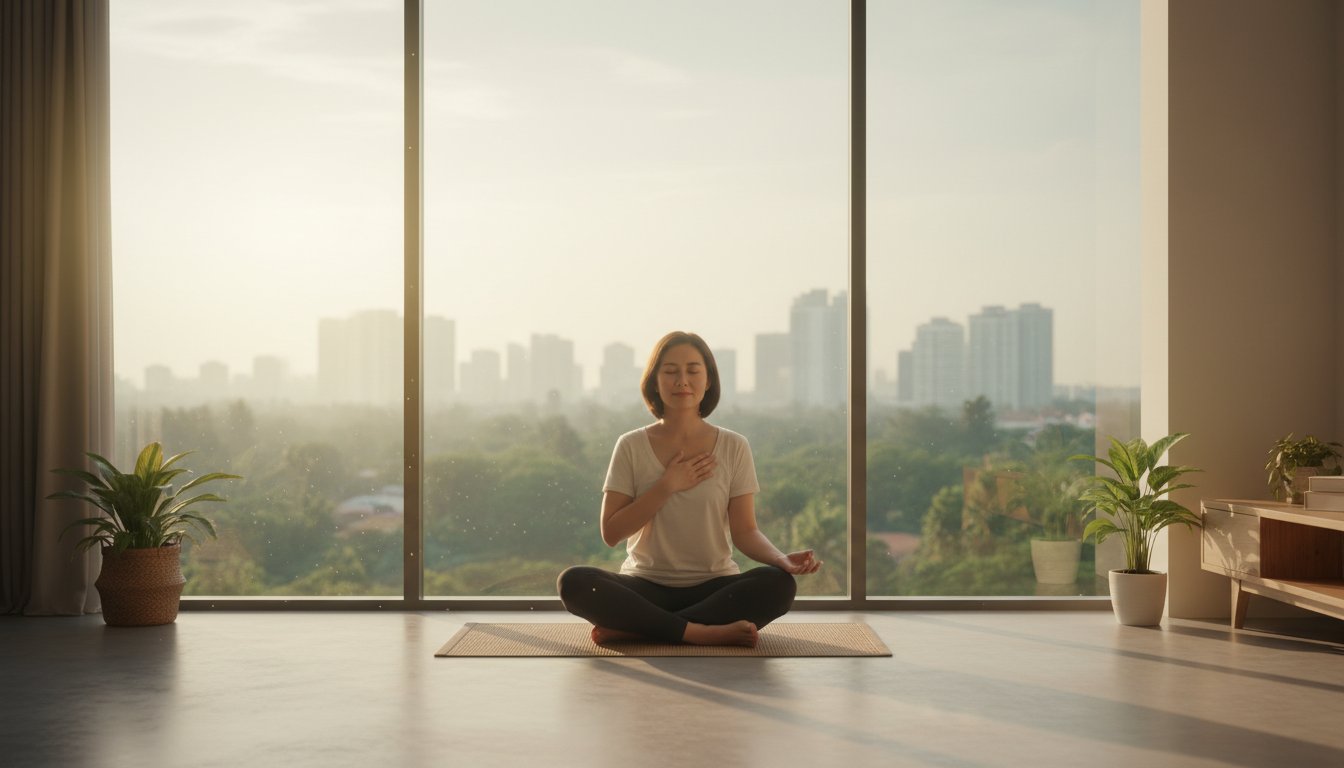
What if the reason you can’t seem to relax isn’t a lack of willpower, but a nervous system that’s stuck in a perpetual state of high alert? You’ve probably noticed that no matter how many times you tell yourself to just calm down or attend another talk therapy session, that familiar knot in your stomach or the numbness in your limbs stays put. It’s exhausting to live in a body that feels like a battlefield or, worse, a place you’ve had to check out of just to get through the day. I understand that feeling safe in your body again can feel like a distant dream when you’re dealing with chronic tension that won’t budge.
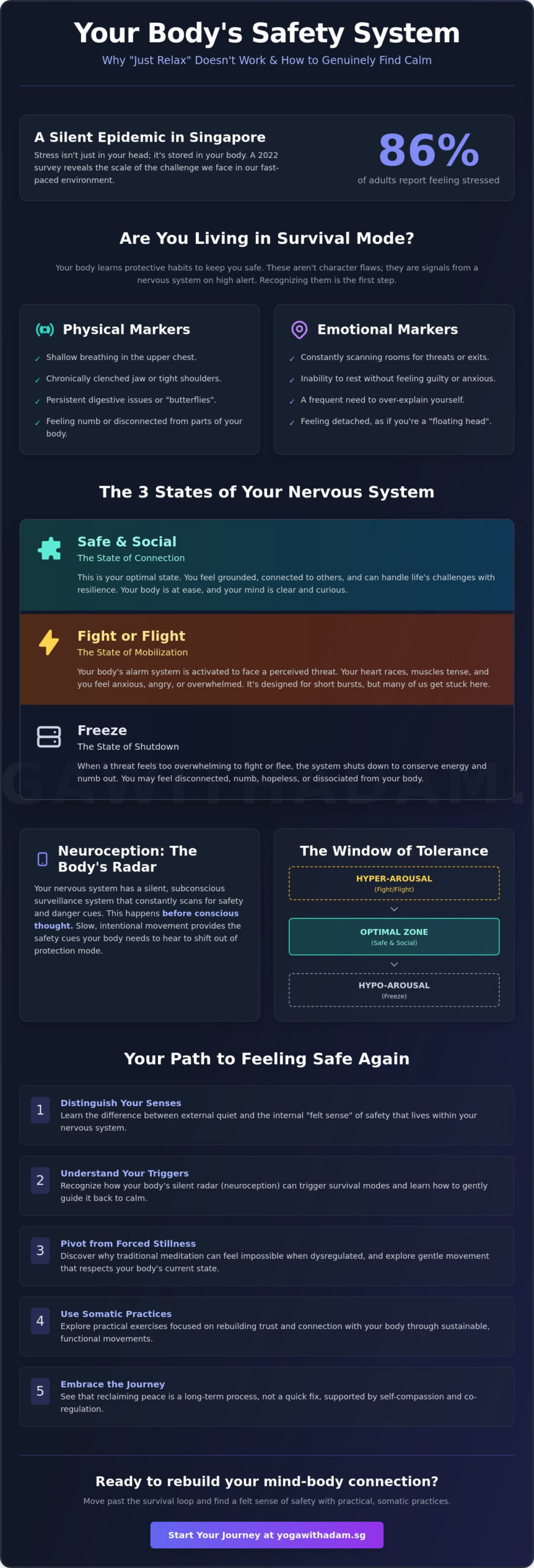
In a fast-paced environment like Singapore, where a 2022 Cigna 360 Well-Being Survey found that 86% of adults report feeling stressed, this physical bracing has become a silent epidemic. I’m here to help you move past the survival loop and find a felt sense of safety through practical, somatic practices designed for real people. We’ll look at how to rebuild your mind-body connection and use functional movement to finally let go of that internal pressure, moving you toward a life of genuine ease and self-regulation.
Key Takeaways
- Learn to distinguish between your external environment and the “felt sense” of internal security that lives within your own nervous system.
- Understand how your body’s subconscious surveillance system—neuroception—triggers survival modes like freeze or flight, and how to gently shift back to calm.
- Discover why traditional meditation can feel frustrating when you’re dysregulated and how to pivot toward movement that respects your body’s current state.
- Explore five practical somatic exercises focused on feeling safe in your body again through sustainable, functional movements designed for real human bodies.
- See why reclaiming your peace is a long-term journey rather than a quick fix, and how the power of co-regulation can support your path home to yourself.
What Does It Actually Mean to Feel Safe in Your Body?
We often think of safety as something external, like a locked front door or a stable job in the CBD. But true internal safety is a “felt sense” rather than an intellectual concept. You can tell yourself you’re safe a thousand times, but if your nervous system disagrees, your body will stay on high alert. This is the core challenge of feeling safe in your body again. It is the difference between knowing you are out of danger and actually feeling that peace in your bones.
In my practice, I call this “Yoga for Humans.” It’s not about achieving a specific shape or looking like a fitness influencer. It’s about meeting your body exactly where it is today, without judgment. Many of us live as “floating heads,” where we are almost entirely disconnected from the neck down. We treat our bodies like a vehicle that carries our brain from one meeting to the next, ignoring the physical signals of stress until they become too loud to ignore. Reclaiming that connection is the first step toward internal peace.
The Difference Between Calm and Safety
You can be in a perfectly quiet room and still feel like you’re under attack. This happens because “calm” is often just an environmental state, while safety is a physiological one. We often operate within a “Window of Tolerance.” This is the space where we can handle the ups and downs of life in Singapore without crashing or exploding. When we are outside this window, we might engage in performative relaxation, like forcing ourselves to sit still while our heart is actually racing. Genuine somatic release, a concept often explored in Somatic Experiencing, happens only when the nervous system feels it no longer needs to stay on guard.
Signs You Are Living in Survival Mode
Living in survival mode is exhausting, yet it becomes the “normal” baseline for many people. If you are working on feeling safe in your body again, it helps to recognize the markers that your system is stuck in a protective loop. These aren’t signs of weakness; they are signs that your body is trying to look out for you.
- Physical markers: Shallow breathing that stays in the upper chest, a jaw that feels permanently clenched, and chronic digestive issues or “butterflies” that never seem to settle.
- Emotional markers: A constant need to over-explain yourself, an inability to rest without feeling guilty, and a habit of “scanning” every room you enter for potential threats or social exits.
Survival mode is a protective habit your body learned to keep you alive, not a character flaw you need to fix.
When we recognize these signs, we can stop fighting our bodies and start listening to them. We move away from trying to “control” our anxiety and toward a more sustainable, supportive relationship with our physical selves.
The Science of Safety: Understanding Your Nervous System
To start feeling safe in your body again, we have to look under the hood at the biology of your survival instincts. Your nervous system doesn’t care about your logic or your five-year plan. It cares about one thing: keeping you alive. Most of us are walking around with a nervous system that’s stuck in “protection mode” long after the actual threat has passed. This isn’t a personal failing; it’s a physiological loop. The Autonomic Nervous System (ANS) generally operates in three states. First is “Safe,” where you feel connected and calm. Second is “Fight/Flight,” where your heart rate spikes to meet a challenge. Third is “Freeze,” where the system becomes overwhelmed and shuts down to minimize pain.
Neuroception: The Body’s Silent Radar
Neuroception is a term used to describe how your body scans for cues of safety versus cues of threat without you even knowing it. It’s a silent radar operating 24/7. While your conscious mind is focused on a meeting in the CBD, your nervous system might be reacting to a loud noise or a specific tone of voice. In our “Yoga for Humans” sessions, we prioritize giving your body those safety cues through slow, intentional movement. This process relies heavily on the Vagus Nerve. It acts as the primary information highway between your brain and your internal organs. About 80 percent of the fibers in the Vagus Nerve are sensory, meaning they send information from the body up to the brain. Research into Polyvagal Theory shows that when we provide the body with physical signals of safety, we can effectively “hack” this highway to calm the brain down.
The Survival Loop: Why We Get Stuck
When we face chronic stress, the body doesn’t just forget. It stores that energy in the physical tissues and fascia. The Psoas muscle, located deep in your core, is a primary player here. It’s often the first muscle to contract when we feel threatened, pulling us into a protective fetal curl. If we don’t complete the stress cycle, the Psoas stays tight. This keeps us in a survival loop where the body constantly tells the brain that danger is still present. This is why willpower alone fails. You can’t think your way out of a physiological response. To break this cycle, many of my students in Singapore find relief through tension & trauma releasing exercises. These movements help the body physically shake off that stored charge. If you’re tired of feeling “on edge,” you might find that exploring somatic movement is the missing piece in your wellness routine. It’s about teaching the body that the “tiger” is gone so you can finally relax.
Why Traditional Meditation Might Not Be Working for You
If you’ve ever sat down to meditate only to find your heart racing and your legs twitching with a desperate urge to run, you aren’t doing it wrong. It’s incredibly frustrating to be told to “just breathe” when your internal environment feels like a thunderstorm. For many of us, the traditional approach of sitting in total silence is like asking a person in a burning building to sit down and enjoy a cup of tea. It doesn’t feel peaceful; it feels dangerous.
The reason for this struggle usually lies in how our nervous system processes safety. Most meditation is a “top-down” practice. It asks the mind to control the body. But when you’re working on feeling safe in your body, your brain’s logic often gets hijacked by your physical survival instincts. If your body is stuck in a state of high alert, quieting the mind simply removes the distractions that were keeping your anxiety at bay. You’re left alone with the roar of a dysregulated system. We need a “bottom-up” approach instead, where we use physical sensations and movement to tell the brain that the environment is secure. Somatic practices provide this essential foundation, making traditional meditation feel like a choice rather than a chore.
When Stillness Feels Scary
Closing your eyes can trigger a sense of vulnerability that’s hard to explain to someone who hasn’t felt it. If you’ve ever felt “bad” at yoga or meditation because you couldn’t stop fidgeting, I want to validate that experience. Your body was likely signaling that it didn’t feel safe enough to drop its guard. We handle this through titration. This means we take tiny, manageable bites of stillness rather than forcing ourselves into a twenty-minute sit. We keep our eyes open if we need to. We move if we need to. We respect the body’s pace because forcing relaxation is just another form of stress.
The Power of Somatic Movement
Somatic movement is a conversation with the body. While static stretching focuses on the length of a muscle, somatic movement focuses on the internal experience of the motion. It’s rhythmic and functional. This is a big reason why kundalini yoga is so effective for modern humans. It uses active, repetitive movements to physically discharge the “charge” of stress from the nervous system. By shaking, reaching, or moving rhythmically, we give the body a way to process stored tension. This active clearing is often the missing link to feeling safe in your body again. Once the physical “static” is gone, the quiet mind you’ve been looking for usually arrives all on its own.
5 Somatic Practices to Rebuild Body Trust
Reclaiming your body doesn’t require touch-your-toes flexibility or hours of silent meditation. It starts with grounding. We want to move from feeling like a guest in our own house to actually feeling safe in your body again. I always tell my students that these tools are built for the long haul. They’re sustainable practices for real Singaporean lives; whether you’re dealing with the heat of the CBD or the quiet of a HDB flat. I want you to approach these exercises with curiosity. Instead of judging your tight hamstrings or a racing heart, just notice them. We aren’t trying to fix anything; we’re just getting reacquainted.
1. Therapeutic Shaking (TRE®)
Our bodies have a built-in reset button that most of us have forgotten how to use. When we experience stress, our nervous system primes us for action. If that energy isn’t used, it gets stuck in our tissues. Using tension and trauma releasing exercises (TRE®) allows us to tap into a natural shaking reflex. This isn’t a workout. It’s a way to complete the stress response cycle. If you’re at home, try a mild wall-sit for about 45 to 60 seconds until your legs feel a bit fatigued. When you stand up and keep a soft bend in your knees, you might feel a subtle tremor. Let it happen. It’s your body’s way of letting go of what it no longer needs to carry.
2. Orienting to Your Environment
Safety starts with knowing exactly where you are in space. When we’re anxious, our internal alarm system screams that there’s a threat, even if we’re just sitting at a desk. By slowly scanning the room with your eyes, you’re telling your brain “I am here now.” This is a core part of holistic mental wellness. You can use the 5-4-3-2-1 technique through a somatic lens. Name 5 things you see, 4 you can touch, 3 you hear, 2 you smell, and 1 you can taste. This pulls you out of your head and back into the physical world, which is the first step in feeling safe in your body again.
3. Rhythmic Breathing and Mantra
Sound is a physical vibration. When we use a mantra or even just a simple hum, we’re physically stimulating the Vagus nerve. This nerve acts as the off switch for your fight-or-flight response. You don’t need a complex chant to make this work. A low, steady hum or a deep “om” creates an internal vibration that calms the nervous system from the inside out. For more on how sound impacts your state of mind, you can explore my guide on meditation and mantra. It’s about finding a rhythm that feels supportive for your unique body.
Ready to explore these movements in a supportive environment? Join our community and book your first yoga for humans session today.
Creating a Sustainable Path Home to Yourself
Healing isn’t a destination with a fixed end-date on a calendar. It’s a continuous, unfolding process of returning to yourself. Some days you’ll feel grounded and present. Other days, old patterns might resurface, making you feel as though you’ve taken a step back. That’s not a sign of failure; it’s simply how the human nervous system operates. The goal isn’t perfection. It’s about building enough resilience so that when you do feel off-balance, you have the tools and the confidence to find your way back. This journey is about progress, not a finish line.
The Role of a Guide in Somatic Healing
Working through chronic stress or long-held tension alone can feel like a heavy lift. This is where the concept of co-regulation makes a massive difference. When you spend time with a calm, grounded person, your nervous system naturally begins to mirror theirs. It’s a biological way of borrowing safety to help settle your own system. My private healing sessions focus on this exact dynamic. I provide a non-judgmental, down-to-earth space for humans to explore their physical sensations without any pressure to perform. I’ve spent years working with people from all walks of life in Singapore, helping them reconnect with their physical selves in a way that feels safe and manageable. This collaborative approach can significantly speed up the process of feeling safe in your body again because you aren’t carrying the weight of the work by yourself.
Your Next Small Step
You don’t need to change your entire life by tomorrow morning. In nervous system work, consistency beats intensity every time. A small, five-minute practice done daily is far more effective for your brain and body than a grueling two-hour session once a month. Pick just one tool from this guide that felt right for you. Maybe it’s a gentle grounding exercise or a simple breath check-in during your commute. Start there.
Your body possesses an incredible, innate ability to heal when it’s given the right environment. It wants to feel secure. It wants to come home. If you’re looking for a supportive community or one-on-one guidance to help you navigate this path, book a class or private session to start your journey. Let’s make feeling safe in your body again a sustainable, accessible reality. We’ll take it one step at a time, together.
Taking the Next Step Toward Your Internal Home
You now understand that your nervous system’s response to stress is a physical reality, not a personal failing. By moving away from rigid expectations and embracing somatic tools like TRE® or Kundalini Yoga, you’ve started the process of feeling safe in your body again. These practices aren’t about masterfully holding a pose; they’re about creating a sustainable, grounded connection with your physical self. I focus on “Yoga for Humans” because I believe wellness should be accessible, down-to-earth, and free from intimidating jargon.
I’m Adam Fazlur, and I’ve dedicated my work in Singapore to helping people navigate trauma release through a supportive, non-mystical lens. Whether you’re dealing with long-term stress or just want to feel more present, we can find a rhythm that works for your real life. It’s time to stop performing and start listening to what your body actually needs.
Begin your journey to internal safety with a Private Healing Session. Let’s work together to rebuild that trust, one steady breath at a time. You deserve to feel at home within yourself.
Frequently Asked Questions
Is it really possible to feel safe in my body again after trauma?
Yes, it’s entirely possible to recover your sense of security because the brain is capable of change throughout your life. Research from the 2014 publication The Body Keeps the Score demonstrates that somatic practices help rewire the brain’s alarm system. I’ve seen students in our Singapore sessions move from a state of constant hyper-vigilance to a place of genuine ease. It’s a process of teaching your nervous system that the threat has passed.
How long does it take to start feeling the effects of somatic work?
You might feel a subtle shift in your first session, but lasting change usually takes about 8 to 12 weeks of regular practice. A 2021 study published in Frontiers in Psychology tracked participants through a somatic program and found that consistent repetition is key for neural pathways to stabilize. We focus on small, sustainable wins here. It’s not about a quick fix; it’s about building a foundation that lasts for the rest of your life.
What if I feel “nothing” when I try these exercises?
Feeling “nothing” is actually a very common physiological response known as dissociation or “freeze.” Statistics suggest that up to 30 percent of individuals with a history of high stress experience this numbness when they first try to connect with their bodies. It’s your system’s way of protecting you. If this happens, we simply acknowledge the numbness without judgment. We treat it as a valid data point rather than a failure.
Can I do somatic safety exercises if I have physical limitations?
You can absolutely practice these exercises regardless of your physical mobility or energy levels. Somatic work focuses on the internal experience rather than achieving a specific aesthetic pose. At Yoga with Adam, we ensure 100 percent of our safety drills can be performed while sitting in a chair or lying down. We’re interested in how you feel on the inside, not how you look in a photo or how far you can bend.
Why does shaking help with stress and safety?
Shaking helps by physically discharging the “fight or flight” energy that gets stuck in your muscles during stressful events. This technique is a core part of feeling safe in your body again, as it signals to the brain that the danger is over. Dr. David Berceli’s research into neurogenic tremors shows that this natural reflex helps reset the nervous system. It’s a simple, human way to let go of tension without needing complex equipment or expensive gym memberships.
Is somatic healing a replacement for traditional therapy?
Somatic healing is a powerful companion to talk therapy, but it doesn’t replace the need for professional psychological support. A 2017 study in the Journal of Traumatic Stress highlighted that combining “top-down” talk therapy with “bottom-up” bodywork provides the most comprehensive recovery. I always encourage my students to work with a licensed therapist alongside our movement practices. We’re building a toolkit for your well-being; every tool has its own specific purpose.
What are the first signs that my nervous system is starting to feel safe?
The first signs of feeling safe in your body again are often quiet shifts like a deeper breath, a gurgling stomach, or a sudden desire to yawn. These are indicators that your parasympathetic nervous system is coming back online. Dr. Stephen Porges, the developer of Polyvagal Theory, identifies these as markers of the Social Engagement System. You might also notice you’re less reactive to loud noises or sudden changes during your daily Singapore commute.
Do I need to be “good at yoga” to start feeling safe in my body?
You don’t need any prior yoga experience or flexibility to begin this journey. My Yoga for Humans approach is built on the idea that if you can breathe, you can do this work. We skip the intimidating poses and focus on functional movements that support your daily life. It’s about reclaiming your space, not touching your toes. We’re here to build confidence and steady ground, not to perform for an audience or a camera.