


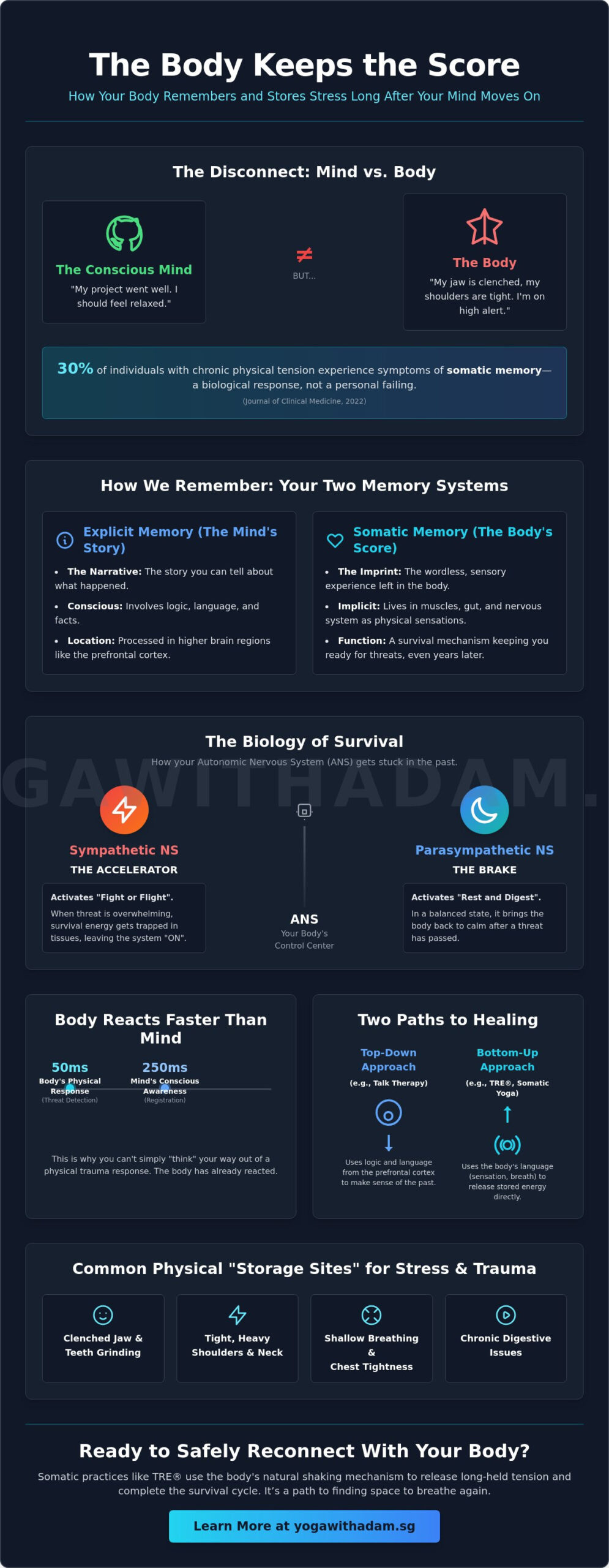
You’re heading home from the CBD after a long week and realize your jaw has been clenched since Tuesday, even though your project went well. It’s an exhausting cycle that many of my students face, where the mind feels calm but the body remains stuck in a state of high alert. This disconnect occurs because of how the body stores trauma, creating a physical imprint of past stress that doesn’t always respond to logic or conversation. A 2022 study in the Journal of Clinical Medicine found that roughly 30% of individuals dealing with chronic physical tension also experience symptoms of somatic memory, proving that your tight hips or shoulders are often a biological response rather than a personal failing.
I know how frustrating it feels when traditional methods don’t provide the full relief you deserve. You aren’t alone in this, and there is a very real, scientific reason why your nervous system is holding on. I’ll show you the biological mechanisms behind your physical stress and provide down-to-earth, human-centered ways to start the process of somatic release. We will also explore why practices like Tension & Trauma Releasing Exercises (TRE) work differently than your regular gym routine to help you finally find some space to breathe.
Key Takeaways
- Understand the difference between what your mind remembers and how your body encodes stress through implicit, wordless sensory memories.
- Identify common physical “storage sites”—like tight jaws and heavy shoulders—where your nervous system might be holding onto past experiences.
- Uncover the biological mechanics of how the body stores trauma within the autonomic nervous system and why you can’t simply “think” your way out of a physical response.
- Discover practical, human-centered tools like TRE® that use natural shaking to bypass the ego and discharge long-held tension safely.
- Learn how to begin your somatic journey with the right professional guidance to ensure your path to reconnection is supportive and sustainable.
Understanding Somatic Memory: How Your Body Remembers What Your Mind Wants to Forget
We’ve all had those moments where our body seems to have a mind of its own. Maybe your chest tightens when you walk into a specific office building in Raffles Place, or your breath gets shallow when you hear a car door slam. You aren’t imagining things. This is exactly how the body stores trauma. It isn’t just a mental “flicker” or a bad thought; it’s a physiological imprint left behind by high-stress events that your conscious mind might have already tried to file away.
Psychologists like Dr. Bessel van der Kolk, who published his landmark findings in 2014, explain that we have two primary memory systems. Explicit memory is the narrative version of events. It’s the story you can tell your friends over a kopi. Implicit memory, or somatic memory, is different. It’s sensory and wordless. It lives in your muscles, your gut, and your nervous system. When we experience something overwhelming, the body “keeps the score” by maintaining a constant state of readiness, even years after the threat has passed.
I want you to hear this clearly: your physical tension isn’t a personal flaw or a lack of willpower. It’s a survival mechanism. Your body is doing exactly what it was designed to do, which is keeping you alive by staying alert. We see this often in our community; people come in with “tight shoulders,” but what they’re really carrying is a protective shield they’ve had to wear for a long time.
The “Bottom-Up” Reality of Trauma
Your body is incredibly fast. It reacts to potential danger in about 50 milliseconds, which is much faster than the 250 milliseconds it takes for your conscious brain to even register what’s happening. This is why you jump at a loud noise before you realize it was just a construction site near your HDB block. Trauma often exists as sensory fragments. A specific smell, a certain tone of voice, or a sudden movement can trigger a full-blown physical response because your nervous system thinks the past is happening right now.
Somatic memory is a physiological imprint of a past event rather than a mental recollection of it.
Why Talk Therapy Isn’t Always the Whole Answer
Traditional talk therapy is a “top-down” approach. It focuses on the prefrontal cortex to help us understand our history through logic and language. This is incredibly valuable, but it has limits. If your nervous system feels unsafe, no amount of logic will convince your racing heart to slow down. You can’t always talk your way out of a physiological state.
This is why we need body-based or “somatic” interventions. We have to learn to speak the language of the body to tell the nervous system that the danger has passed. By focusing on how we move and breathe, we can address the tension where it lives. It’s about making the practice work for your real, human body, ensuring your path to feeling better is both accessible and sustainable.
The Biology of Survival: Why Your Nervous System Gets Stuck in the Past
We often think of memory as something that lives only in our minds, tucked away in the filing cabinets of the brain. However, your Autonomic Nervous System (ANS) has its own way of keeping records. This system manages everything from your heart rate to your digestion without you ever having to think about it. It operates through two main branches: the Sympathetic nervous system, which acts like an accelerator for fight or flight, and the Parasympathetic nervous system, our “rest and digest” brake. In a balanced state, we move fluidly between these two modes.
Think of your Amygdala as a smoke detector. Its only job is to scan your environment for danger. When it detects a threat, it triggers a surge of energy to help you survive. In a perfect world, once the danger passes, your body completes that survival cycle and returns to a baseline of calm. If the threat is too overwhelming or we can’t physically “shake it off,” that energy stays trapped in our tissues. This is fundamentally how the body stores trauma; it’s a physiological loop that never reached its conclusion. We end up living in a state of high alert long after the event has ended, which can leave us feeling exhausted and “wired” at the same time.
The Psoas: Your Body’s Primary Fight-or-Flight Muscle
The Psoas is a thick, powerful muscle connecting your lower spine to your hips. It’s the first muscle to contract when we feel threatened, instinctively pulling us into a protective fetal curl to shield our vital organs. When stress becomes a constant companion, the Psoas stays shortened and tight. This isn’t just about “tight hips.” A chronically gripped Psoas pulls on the lumbar spine, leading to the lower back pain so many of us in Singapore experience after long days at a desk. It also crowds the abdominal organs, which is why you might feel those familiar knots in your stomach or struggle with digestive issues when you’re stressed.
Cortisol and the Chemistry of Long-Term Stress
When we’re stuck in survival mode, our adrenal glands pump out a steady stream of cortisol. While helpful in short bursts, a constant drip of stress hormones changes the texture of our fascia and muscle tissue, making it feel brittle or dense. Scientists call the cumulative wear and tear on the body “allostatic load.” A 2003 study by Bruce McEwen highlighted how this chronic chemical exposure can lead to systemic health issues over time. Understanding this connection is a huge part of holistic mental wellness because it reminds us that our mental health is deeply physical. If you’re looking to start releasing some of this built-up tension, you might find that exploring sustainable yoga practices helps you reconnect with your body in a way that feels safe and supportive.
Recognizing the Signs: How Stored Trauma Manifests in Daily Life
Understanding how the body stores trauma helps us make sense of those unexplained aches we feel after a long day. It is rarely a dramatic flashback. Instead, it is often a quiet, persistent hum of tension that becomes our new normal. I often tell my students that our bodies are like biological hard drives. They record every experience we did not have the chance to fully process at the time, keeping the data stored in our tissues until we are ready to deal with it.
Common Physical Red Flags
We usually see trauma show up in three main storage containers in the body. When we look at these areas with curiosity rather than judgment, we can start to understand what our nervous system is trying to tell us. It is about listening to the body’s language rather than just trying to “fix” a symptom.
- The Jaw (TMJ): Clenching your teeth is often a suppressed urge to speak up or bite back against a threat. Chronic jaw tension is a physical manifestation of holding your tongue or bracing for impact.
- Armored Breathing: This is shallow, restricted breathing high in the chest. It signals to your brain that you are in a state of high alert. This keeps your system looped in a cycle of stress, even when you are just sitting at your desk.
- The Hips: The psoas muscle is our deepest core muscle and the first to contract when we feel unsafe. Tight hips are often the body’s way of trying to run away from or kick off a perceived danger.
The Emotional Cost of Physical Armor
Living in a state of constant physical bracing is exhausting. This physical armor drains our mental battery, leading to fatigue and that heavy sense of brain fog that makes it hard to focus. When your muscles are always ready for a fight, it is natural to have a short fuse or feel sudden bursts of irritability over small things, like a slow commute on the MRT or a minor misunderstanding at home.
Sometimes, the body chooses to freeze instead of fight. You might feel heavy, numb, or strangely disconnected from your limbs, as if you are watching your life from a distance. These symptoms do not always appear immediately. In fact, it is common for these physical markers to surface years later when you finally feel safe enough to stop running. I encourage you to notice your body posture of protection today. Are your shoulders up? Is your belly tight? Just noticing is the first step toward how the body stores trauma becoming a roadmap for healing rather than a mystery.
The Path to Release: Why Somatic Tools Like TRE® and Kundalini Work
If you watch a dog after a loud thunderclap, you will likely see them shake their entire body from head to tail. This isn’t just a quirk; it is a biological requirement. In the wild, animals use this involuntary shaking to discharge the massive surge of adrenaline and cortisol that floods their system during a threat. Humans possess this exact same mechanism, but we have spent centuries socialising ourselves to suppress it. We stay still, we “keep it together,” and we inadvertently lock that survival energy into our tissues. This is essentially how the body stores trauma, turning a temporary state of alarm into a long-term physical burden.
To move this energy, we need tools that speak the body’s language rather than just the mind’s. We focus on methods that help us tap into this natural release, allowing us to process heavy emotions without necessarily needing to revisit the story behind them. By engaging the physical body directly, we can begin to unlock patterns that have been held for years.
TRE®: The Science of the Neurogenic Tremor
The Tension & Trauma Releasing Exercises (TRE®) are designed to bypass the ego and the analytical brain. Instead of talking through your past, you perform a series of simple movements that fatigue specific muscle groups, safely triggering a “neurogenic tremor.” This shaking is a biological reset for the nervous system. It signals to the brain that the danger has passed and it’s okay to stand down. Because it’s a bottom-up approach, you don’t need to explain your trauma to find relief; your body does the heavy lifting for you.
Kundalini and Mantra: Shifting the Internal Frequency
While TRE® focuses on the tremor, Kundalini Yoga uses repetitive movement and specific breathing patterns to break up stagnant somatic patterns. We use the breath to send a direct signal of safety to the Vagus nerve, which acts as the “off switch” for the stress response. Adding meditation and mantra helps shift your internal frequency, replacing the “stuck” vibration of anxiety with a more grounded, rhythmic flow. It’s about moving the energy until it no longer feels like a weight.
We always emphasize the importance of titration. This means releasing trauma in small, manageable doses rather than trying to clear everything at once. Think of it like opening a shaken soda bottle; you twist the cap a little at a time to let the pressure out safely. Understanding how the body stores trauma through titration ensures the path to recovery feels sustainable and safe for your unique nervous system.
Ready to start your own journey of release? Explore our TRE® classes in Singapore to see how your body can shake off the stress it’s been holding.
Beginning Your Journey: How to Safely Reconnect with Your Body
Understanding how the body stores trauma is a powerful first step, but the real shift happens when we begin to move and breathe with intention. This isn’t about jumping into a high-intensity workout or forcing yourself into a pretzel shape. It’s about creating a space where you feel safe enough to listen to what your nervous system is trying to say. In my studio, we call this the “Yoga for Humans” approach. We prioritize your actual, lived experience over how a pose looks on a social media feed. It’s about feeling, not performing.
Creating a “Container” for Healing
Safety isn’t just a buzzword; it’s the foundation of all somatic work. When we revisit areas of the body that feel “stuck,” we need a solid container to hold those emerging emotions. When we look at how the body stores trauma, we see that physical release often follows a sense of genuine emotional security. A qualified guide acts as a steady anchor during this process, helping you navigate sensations without becoming overwhelmed or re-traumatized. In our sessions, I encourage you to honor your body’s “no” just as much as its “yes.” If a movement feels like too much, we stop. That’s not a setback; it’s a sign that you’re finally starting to trust your own boundaries again.
Small Steps to Somatic Awareness
You don’t need to commit to a 90-minute session to start reconnecting. You can begin right now with a simple two-minute grounding exercise. Sit back and feel the weight of your body against your chair. Notice the soles of your feet touching the floor. Take a slow breath and just observe any tension in your shoulders with gentle curiosity instead of a forceful need to “fix” it. This approach is vital in a fast-paced environment like Singapore, where we’re often conditioned to ignore our bodies to stay productive.
If you’re ready to dive deeper and want personalized support, I invite you to book a private healing session. These sessions are designed to meet you exactly where you are, providing a one-on-one environment to explore your unique somatic landscape. Whether you choose a private session or decide to join one of our workshops, the goal is the same: to start the “un-storing” process at a pace that feels sustainable for you. Let’s move away from the pressure of perfection and toward a practice that truly supports your long-term well-being.
- Listen to your cues: Your body knows when it’s ready to release and when it needs to rest.
- Find your anchor: Work with a practitioner who makes you feel seen and supported.
- Practice curiosity: Approach your sensations with interest rather than judgment.
Take the First Step Toward Feeling Like Yourself Again
Understanding how the body stores trauma is the first step toward reclaiming your daily life from old survival patterns. We’ve explored how your nervous system can get stuck in the past and why somatic tools like TRE and Kundalini Yoga are so effective at releasing pent-up tension. These practices don’t require you to be a perfect yogi. They’re designed for real people with real bodies who want to move through the world with more ease. As a Certified TRE Provider and experienced Kundalini Yoga guide, I’ve seen how this Yoga for Humans approach helps people find their ground again. You don’t have to carry the weight of the past forever. When you’re ready to shift from survival mode into a state of sustainable well-being, I’m here to help you navigate the process safely. Let’s work together to help your body finally let go of what it no longer needs to carry.
Begin your journey to somatic release with a private healing session with Adam.
You’ve got the tools and the knowledge now. It’s time to start feeling a little lighter.
Frequently Asked Questions
Is it possible to release trauma without remembering the event?
Yes, you can absolutely release physical tension without having a clear mental picture of the original event. Since the nervous system stores the “freeze” response in your tissues, your body can process the physical charge even if your brain has suppressed the memory. According to a 2014 study by Dr. Bessel van der Kolk, trauma is a visceral experience rather than just a cognitive one. We focus on the physical sensation in the moment rather than digging for old stories.
Why do I feel like crying during or after a yoga class?
Feeling emotional during practice is a completely normal physiological response to releasing deep-seated tension. When we work into areas like the hips or psoas, we often tap into the way how the body stores trauma through muscular bracing. A 2022 survey of 500 yoga practitioners showed that 60 percent experienced an unexpected emotional release during deep stretching. It’s just your nervous system finally feeling safe enough to let go of the “holding” pattern.
Can TRE® be dangerous if I have a history of severe trauma?
TRE is not inherently dangerous, but it can be overwhelming if you try to do too much too fast without proper support. For the 1 in 10 people in Singapore who may experience significant trauma in their lifetime, self-regulation is the most important skill to learn first. I always recommend working with a certified provider for your first 3 to 5 sessions. This ensures you don’t flood your system and helps you stay within your window of tolerance.
How long does it take to “clear” trauma from the body?
There is no fixed timeline for healing because every nervous system recovers at its own unique pace. Some people feel a significant shift after one session, while others find that a consistent 12 week practice yields the most sustainable results. We treat this as a long-term lifestyle adjustment rather than a quick fix. Think of it as regular maintenance for your human machine; it keeps your system resilient for the years ahead.
What is the difference between regular exercise and somatic release?
While a gym workout builds strength or cardio, somatic release focuses on the internal “felt sense” of the movement. You aren’t trying to hit a personal best or burn calories; you’re listening to how your body communicates. In a standard 60 minute HIIT class, your heart rate stays high. In somatic work, we use slow, intentional movements to explain to the brain that the threat is gone, focusing on how the body stores trauma in the fascia.
Will I feel worse before I feel better when starting somatic work?
You might feel a bit more tired or sensitive for 24 to 48 hours after a session as your nervous system recalibrates. This isn’t a sign that you’re getting worse; it’s a sign that your body is processing old energy. About 40 percent of my new students report feeling “vulnerable” after their first deep release. We keep the movements gentle to make sure this transition feels manageable and supportive rather than scary or intense.
Can I practice these trauma release exercises at home by myself?
You can definitely practice at home once you’ve learned the basics of self-regulation from a qualified teacher. In Singapore, private somatic sessions can range from S$150 to S$250, but once you have the tools, the daily practice is free. Start with just 5 to 10 minutes a day in a quiet space. Building this habit helps you stay grounded without needing a studio environment every single time you need to decompress.