

Last Tuesday, a student named Wei Ting arrived at our studio feeling like her brain had twenty tabs open at once. She stood in front of our class schedule, paralyzed by the choice between kundalini vs vinyasa and not knowing which would actually help her decompress. It’s a common struggle in our fast-paced Singapore lifestyle. You want a practice that supports your goals, but you don’t want to waste S$35 on a session that leaves you feeling more frustrated than when you walked in.
We’ve all been there, staring at a booking app and wondering if we’re about to do 50 sun salutations or sit in silence for an hour. I promise that by the end of this post, you’ll understand the functional differences between these styles so you can choose the right tool for your body and mind. We’re going to compare the physical intensity, the impact on your nervous system, and exactly what to expect when you step onto the mat for your next Yoga for Humans session.
Key Takeaways
- Understand the fundamental shift between breath-linked movement and internal kriyas to decide which style of kundalini vs vinyasa best supports your current lifestyle in Singapore.
- Discover how to choose between Vinyasa’s focus on functional strength and Kundalini’s unique ability to build nervous system resilience against the stressors of modern life.
- Identify the distinct breathing techniques and class structures that set these practices apart, helping you select the right rhythm for your specific energy levels.
- Apply a practical decision framework to match your yoga practice to your current mental state, whether you are navigating “wired and tired” burnout or seeking sharp focus.
- Learn how to approach your first session in a “Yoga for Humans” environment that removes pretension and prioritizes your comfort and long-term physical sustainability.
Understanding the Core Differences Between Kundalini and Vinyasa
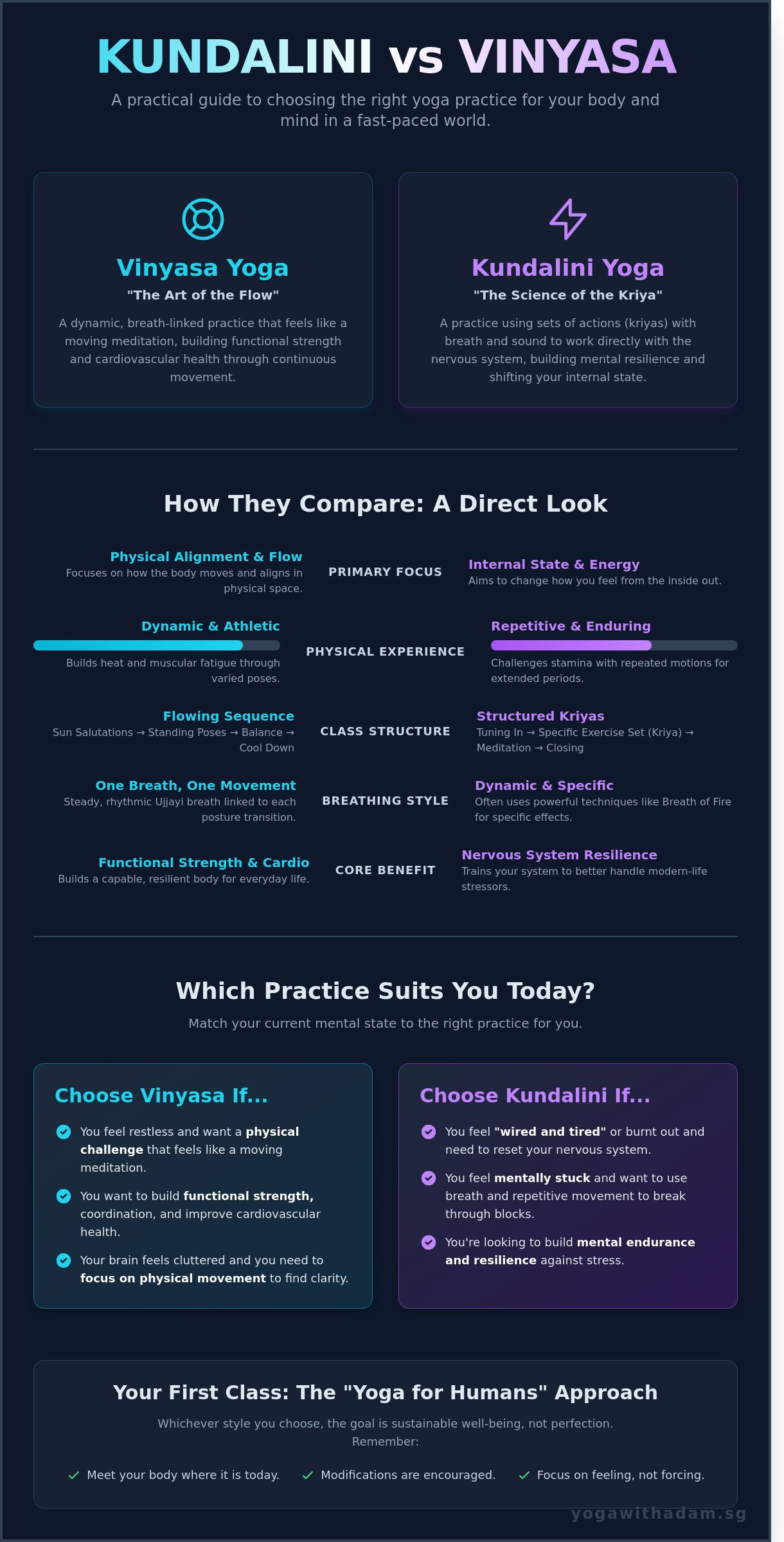
If you’ve ever stepped into a studio in Singapore and felt a bit lost between the class names, you aren’t alone. Deciding between kundalini vs vinyasa usually comes down to what your body and mind need on a specific day. At its heart, Vinyasa is a breath-linked movement system. It’s about finding rhythm in the flow and focusing on how your body aligns in physical space. Kundalini, on the other hand, is often described as a technology. It uses specific sets called kriyas that combine breath, movement, and sound to shift your internal state.
The vibe check is the easiest way to tell them apart. Vinyasa feels like an external dance where you move through poses to build heat. Kundalini feels like an internal engine room where you’re working directly with your nervous system. You don’t need to be flexible to start either one. You also don’t need to subscribe to any specific spiritual path. We practice yoga for humans, which means meeting your body exactly where it is today without the pressure of perfection.
Vinyasa: The Art of the Flow
In a Vinyasa class, we follow a one breath, one movement philosophy. This means your inhale carries you into a pose and your exhale transitions you to the next. You’ll usually see a familiar sequence of Sun Salutations, standing poses, and balance work. It’s an excellent choice for those who want a physical challenge that feels like a moving meditation. The benefits are tangible and immediate:
- Builds functional strength across all major muscle groups.
- Improves cardiovascular health by keeping the heart rate steady.
- Enhances coordination and spatial awareness.
Kundalini: The Science of the Kriya
We should demystify the word Kriya right away. A Kriya is simply a specific set of actions, including postures and sounds, designed to produce a specific result. To understand the broader history and principles, you can look into What is Kundalini Yoga? for context. These sets often involve repetitive motion and dynamic breathing, which can feel quite different from a standard gym workout.
The focus here is on the repetitive nature of the movement to break through mental blocks. It’s incredibly effective for building mental resilience. I often point students toward our grounded guide on what is kundalini yoga to see how these ancient tools work for real people living busy lives in Singapore. While the kundalini vs vinyasa debate often focuses on the physical, Kundalini is where you go when you want to change how you feel from the inside out.
The Mechanics of Movement: How Each Style Shapes Your Body
When we look at kundalini vs vinyasa, we’re comparing two distinct ways to use the body as a tool for well-being. Vinyasa feels like a rhythmic dance, while Kundalini feels more like a systemic recalibration. Both offer incredible rewards, but they target different layers of your physical and mental health. I believe yoga should be a lifelong companion, so understanding how these movements impact your joints and nerves is the first step toward a sustainable practice.
Vinyasa and Physical Alignment
Vinyasa is built on the concept of “flow.” We link breath to movement to create internal heat, which helps with the health benefits of yoga like improved cardiovascular health and joint mobility. In my classes, I focus on functional movement. We aren’t just stretching; we’re building the strength you need to carry heavy bags or navigate the stairs at an MRT station. This style taps into a moving meditation state that leaves you with a satisfying muscular fatigue.
We have to be mindful of repetitive strain, though. Doing 50 Chaturangas every single class can wear on the shoulders if the alignment isn’t right. We prioritize “Yoga for Humans” by offering modifications that keep the practice safe for your body as it changes over time. It’s about building a body that feels capable and resilient, not just one that can do a fancy pose for a photo.
Kundalini and the Nervous System
Kundalini takes a very different path. Instead of flowing through a variety of poses, we often repeat one specific movement for three to eleven minutes. This might involve rhythmic shaking or keeping your arms raised at a specific angle. These repetitive actions “shout” at the nervous system, forcing it to reset its stress response. It’s a powerful way to build mental grit and glandular health.
The role of shaking in Kundalini is particularly interesting for releasing deep-seated tension. It’s a physical release that complements tension & trauma releasing exercises quite well. While Vinyasa works on your muscles, Kundalini works on your internal wiring. You won’t always leave class feeling physically tired, but you’ll likely feel an energetic shift that leaves you clear-headed and steady. If you’re looking for a way to manage the fast pace of life in Singapore, you might view our current class offerings to see which approach feels right for your current energy levels.
- Vinyasa: Focuses on muscular endurance, joint range of motion, and functional strength.
- Kundalini: Focuses on nervous system resilience, glandular balance, and mental endurance.
- Sustainability: Both styles can be practiced for a lifetime when we listen to our bodies and prioritize comfort over performance.
Kundalini vs. Vinyasa: A Direct Comparison of Your Experience
Walking into a studio in Singapore, the atmosphere tells you exactly what to expect. The choice between kundalini vs vinyasa often comes down to how you want to spend your energy during that hour. Vinyasa is a rhythmic, athletic flow where we link one movement to the next with the breath. It feels familiar and structured, usually moving from a warm-up into Sun Salutations and peak poses. Kundalini follows a “kriya,” which is a pre-defined set of exercises. These might involve repetitive arm movements or specific breathing patterns held for 3, 11, or even 31 minutes. It feels less like a dance and more like a targeted internal shift.
- The Breath: Vinyasa relies on Ujjayi breath, a steady constriction in the throat that creates an “ocean” sound to stay present. Kundalini uses “Breath of Fire,” a rapid, rhythmic navel pump that generates intense energy and heat quickly.
- The Gaze: In Vinyasa, we use “Drishti” to focus on a specific external point, like your hand or the tip of your nose. In Kundalini, your eyes are almost always closed, focusing on the space between your eyebrows or repeating a silent mantra.
- The Gear: You’ll see standard athletic wear in Vinyasa. While some traditions suggest wearing white to expand your energetic field, it’s totally optional here. Wear your favorite comfortable leggings; we care more about your practice than your outfit.
Understanding the difference in kundalini vs vinyasa helps you choose the right tool for your current mental state. If you want to move your body and get out of your head, Vinyasa is great. If you want to change how you feel from the inside out using breath and sound, Kundalini is the way to go.
Sweat, Breath, and Sound
The “heat” in Vinyasa is physical. You’ll sweat because your muscles are working hard through planks and lunges. In Kundalini, the heat is glandular and internal. It’s a different kind of intensity that comes from repetitive motion. Music also plays a huge role. Vinyasa classes might feature modern lo-fi or upbeat tracks. Kundalini uses rhythmic mantras and sound healing, like gongs, to help shift your brainwaves. It’s about using sound as a tool rather than just background noise.
The Role of the Teacher
In a Vinyasa class, I act as a conductor, keeping the pace and ensuring your alignment is safe. Kundalini is different. I’m a guide sharing a specific “technology” of movement. I don’t believe in the “guru” model. My goal is to be a humble, knowledgeable partner in your practice. We call this “Yoga for Humans” because it’s about making these tools accessible to everyone, whether you’re a busy professional in the CBD or a student. I’m here to help you navigate the experience, not to sit on a pedestal.
Decision Framework: Which Practice Suits Your Current Life Stage?
Picking a practice isn’t about what looks best in a studio window. It’s about what your body actually needs when you step off the MRT after a long day in the CBD. When we look at kundalini vs vinyasa, the choice usually comes down to your current internal battery level. I’ve seen students try to power through a high-intensity Vinyasa flow when they are already running on fumes, which often leads to more fatigue rather than a release.
If you feel “wired and tired,” your nervous system is likely overstimulated. A 90-minute Vinyasa session might feel like too much “doing.” On the flip side, if you’ve been sitting at a desk for eight hours and feel physically stagnant, the movement of Vinyasa can be exactly what you need to break through that brain fog. About 45% of my regular students in Singapore now use a hybrid approach, alternating styles depending on their weekly stress levels. This flexibility ensures their practice remains sustainable for the long term.
Time is another factor. While a full studio immersion usually lasts 60 to 75 minutes, Kundalini offers specific 15-minute resets that you can do at home. Vinyasa generally requires more space and a longer warm-up to ensure your joints are safe during transitions. Whether you have an hour or just a few minutes, there is a way to make yoga work for your real life.
Choose Vinyasa If…
- You want a physical workout: You’ll build functional strength and heat while clearing your mind through constant movement.
- You love rhythm: The “dance-like” transitions between poses help you find a state of flow that feels intuitive and creative.
- You focus on longevity: Your primary goals are improving flexibility and muscular endurance to keep your body moving well as you age.
Choose Kundalini If…
- You’re facing burnout: It’s a powerful tool if you’re dealing with high stress or that heavy feeling of “adrenal fatigue.”
- Mental clarity is a priority: You want to explore the benefits of kundalini yoga to sharpen your focus without a heavy aerobic workout.
- You’re a total beginner: You don’t need to be able to touch your toes or hold a plank to start this practice and feel its effects immediately.
I believe yoga should support your life, not become another chore on your to-do list. If you’re ready to find the right balance for your body, explore our class schedule and join our community of humans practicing for real-world wellness.
Booking Your First Session: A Grounded Approach to Transformation
Deciding between kundalini vs vinyasa shouldn’t feel like a high-stakes life decision. It is just yoga. At Yoga with Adam, I strip away the intimidating jargon and the “perfect” Instagram aesthetics that often make studios feel exclusive. Whether you are a desk-bound professional in the CBD or a busy parent in Tampines, your first session is about feeling better in your skin. We focus on movement that makes sense for your unique anatomy and daily life.
You don’t need to be flexible to start. In fact, 85% of my new students in Singapore describe themselves as “stiff as a board” during their first consultation. My goal is to create a space where you can breathe, move, and fail without judgment. We prioritize the internal experience over how a pose looks in a mirror. You’ll find a welcoming, no-pressure environment that treats you like a person, not a performance artist.
Yoga for Humans: Our Philosophy
The “Yoga for Humans” signature is built on radical inclusivity. Since I began teaching in 2018, I’ve seen how often people feel “not yoga enough” for traditional classes. We flip that script. I’ve specifically adapted kundalini yoga for beginners to be grounded and practical. We swap mystical abstractions for clear instructions on how to regulate your nervous system. It is about building a sustainable practice that supports your joints and mental health for the next 30 years.
Join the Community
You don’t need fancy gear or a specific body type to join us. Most students show up in comfortable gym wear with a simple bottle of water. I offer several ways to dive into the practice:
- Group Classes: Weekly sessions held in welcoming spaces across Singapore where community comes first.
- Private 1-on-1: Personalized sessions starting from S$150, tailored to your specific physical goals or injury recovery.
- Online Workshops: High-quality digital sessions that fit into your busy schedule from the comfort of home.
When you walk into your first class, expect a low-stakes, high-reward vibe. There is zero pressure to keep up with anyone else. We are all just humans moving together to find a bit of peace. If you are still weighing up the benefits of kundalini vs vinyasa, the most effective way to choose is to experience the energy for yourself. Explore our upcoming classes and workshops to find a time that fits your life. I look forward to seeing you on the mat.
Your Path to a Sustainable Practice Starts Here
Choosing between kundalini vs vinyasa doesn’t have to be a rigid decision based on 2026 trends; it’s about what your body needs to feel grounded today. Vinyasa offers functional movement that builds strength through fluid sequencing, while Kundalini provides a direct route to nervous system regulation through breath and rhythm. I’ve spent over 10 years refining the “Yoga for Humans” approach to ensure every session is accessible and effective for real bodies. We’ve taken this mission across the globe, hosting featured retreats in diverse locations across Asia and Europe to help students find their center. You won’t find any intimidating jargon or impossible poses here. Instead, you’ll find a supportive community focused on long-term well-being and sustainable movement. Whether you’re a seasoned practitioner or a complete beginner in Singapore, the best time to start is now. Let’s find the rhythm that supports your life without the pressure of perfection.
Explore our upcoming Kundalini and wellness sessions
I can’t wait to see you on the mat and help you build a practice that truly lasts.
Frequently Asked Questions
Is Kundalini harder than Vinyasa for a beginner?
Whether one is harder depends on your personal strengths; Vinyasa tests your physical endurance while Kundalini tests your mental focus. In a standard 60 minute Vinyasa session, you’ll likely perform 20 or more Chaturangas. Kundalini might ask you to hold your arms at a 60 degree angle for 11 minutes straight. I find beginners often struggle more with the repetitive movements of Kundalini because they require a unique type of mental grit.
Can I practice both Kundalini and Vinyasa in the same week?
You can definitely practice both in the same week to create a balanced routine. I recommend scheduling 2 Vinyasa classes for physical strength and 1 Kundalini session for mental clarity. This mix ensures you aren’t overworking specific muscle groups. When looking at kundalini vs vinyasa, combining them offers a full spectrum of benefits for your nervous system and your physical body.
Do I need to be flexible to do Vinyasa yoga?
You absolutely don’t need to be flexible to start Vinyasa. I started my own journey with tight hamstrings and couldn’t touch my toes for the first 12 months. We use blocks and straps to make the practice accessible for every body type. Flexibility is a byproduct of a sustainable practice, not a requirement to enter the studio.
Why do people wear white in Kundalini yoga classes?
Practitioners wear white to follow a tradition that suggests it expands the electromagnetic field by 12 inches. While you’ll see this in many Singaporean studios, it’s never a requirement in my classes. I want you to wear what makes you feel comfortable and confident, whether that’s a white organic cotton tee or your favorite black leggings.
How many calories does a Vinyasa class burn compared to Kundalini?
A vigorous 60 minute Vinyasa class typically burns between 400 and 600 calories. Kundalini is less about cardiovascular output and usually burns about 150 to 300 calories. If you’re comparing kundalini vs vinyasa for fitness goals, Vinyasa provides a more traditional aerobic workout. Most studios in Singapore charge around S$35 for a single drop-in session for either style.
What should I bring to my first Kundalini yoga session?
Bring a reusable water bottle, a small towel, and an open mind. Most studios in the CBD provide mats for a S$2 to S$5 rental fee, but I suggest bringing your own for hygiene. Wear loose, breathable clothing that allows you to move your diaphragm freely. You don’t need fancy gear to start; simple gym clothes work perfectly for your first time.
Can Kundalini yoga help with anxiety and stress?
Yes, research from 2021 shows that Kundalini yoga significantly reduces symptoms of Generalized Anxiety Disorder in 54 percent of participants. The practice uses specific breathing techniques to calm the sympathetic nervous system. I’ve seen students find a sense of peace after just 3 sessions. It’s a powerful tool for managing the fast paced life we lead here in Singapore.
Is there chanting in every Kundalini or Vinyasa class?
You’ll find chanting in almost every Kundalini class, usually starting with the Adi Mantra to center the group. Vinyasa classes in Singapore rarely include chanting unless it’s a specialized Jivamukti style. Most Vinyasa teachers focus on the flow of movement and breath instead. If you’re nervous about making noise, start with a Vinyasa class where the focus remains on your physical alignment.