

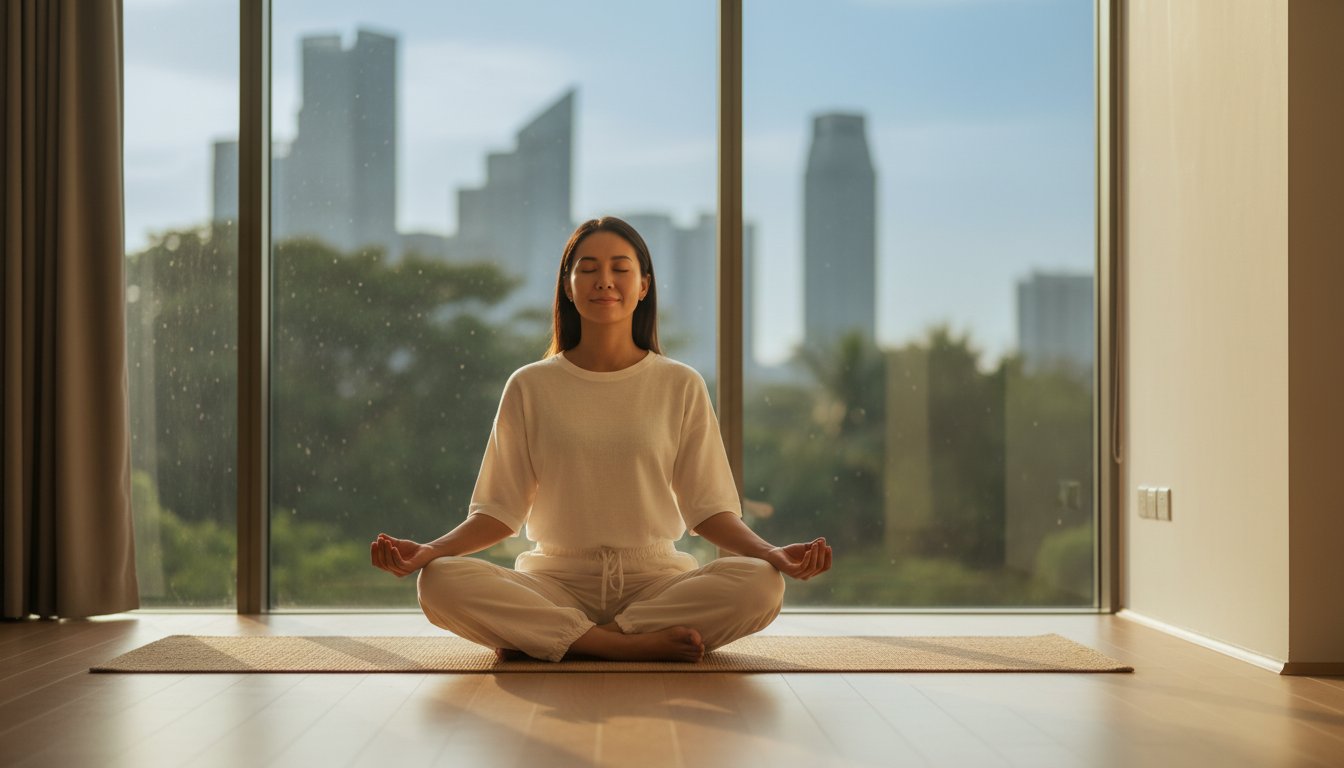
What if the most effective way to handle a high-pressure career in Singapore isn’t another cup of coffee, but a practice that looks a bit unconventional? A 2023 Cigna Healthcare study found that 86 percent of people in our city are struggling with stress, and I know how heavy that feels. You probably want a way to decompress, but you’re likely tired of the “perfect” yoga poses or confusing spiritual jargon that makes you feel like an outsider. I’ve felt that same hesitation myself when I first started.
I promise that kundalini yoga for beginners doesn’t have to be intimidating or filled with mystical gatekeeping. At its heart, this is simply “Yoga for Humans” designed to help you regulate your nervous system and find mental clarity. We’re going to explore how these practical movements can fit into your busy schedule, what to expect in your first class, and how to build a sustainable practice that supports your body for years to come.
Key Takeaways
- Learn why we call this the “Yoga of Awareness” and how our “Yoga for Humans” approach makes these ancient tools accessible for your modern lifestyle.
- Understand the five pillars of a Kriya and how these specific sequences work together to support your nervous system and energy levels.
- Demystify the concept of “awakening” by viewing it through a grounded, anatomical lens that prioritizes your safety and physical comfort.
- Get practical advice on starting kundalini yoga for beginners, from setting up your home space to finding the right community at our Blair Road studio in Singapore.
- Discover how a sustainable, jargon-free practice can build your confidence and help you navigate the stresses of life in the city with a steady mind.
What is Kundalini Yoga? A “Yoga for Humans” Approach
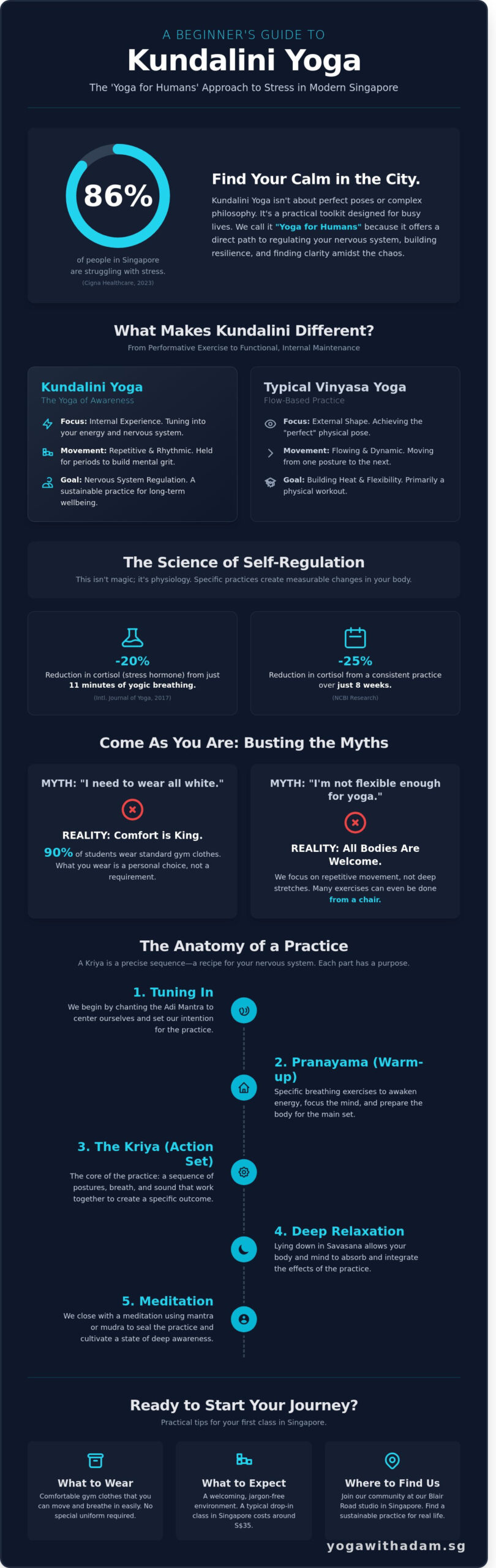
If you’ve ever felt intimidated by the idea of twisting yourself into a pretzel, you’re in the right place. I like to describe Kundalini as the “Yoga of Awareness” because it’s less about the shape of your body and more about the state of your mind. We aren’t chasing the “perfect” pose here. Instead, we use specific movements to tune into our own energy and nervous system. It’s a practical, down-to-earth method that I call “Yoga for Humans” because it’s designed for people with jobs, families, and busy lives in Singapore. It’s a technology that combines breath, mudra, and mantra to shift your state of being.
When you start researching What is Kundalini Yoga?, you’ll notice it feels very different from a typical Vinyasa flow. In a Vinyasa class, the focus is often external, moving through a sequence of postures to build heat and flexibility. In Kundalini, we focus on the internal experience. You might spend three minutes moving your arms in a specific rhythm or chanting a sound to create a vibration in the body. We don’t care if your heels touch the mat. We care about how you feel when the movement stops. It’s a shift from performative exercise to functional, internal maintenance that makes kundalini yoga for beginners feel much more approachable than other styles. If you’re trying to decide between these approaches, understanding the differences between kundalini vs vinyasa yoga practices can help you choose the right fit for your lifestyle and goals.
The Core Purpose: Why Practice Kundalini?
The main goal is nervous system regulation. Living in a fast-paced city like Singapore, our bodies often stay in a “fight or flight” mode for hours on end. A 2017 study in the International Journal of Yoga found that just 11 minutes of specific yogic breathing can lower cortisol levels by 20 percent. We use sustained movements to build mental grit. When you hold your arms up for several minutes, you’re practicing how to stay calm when things get difficult. This builds resilience that follows you out of the studio and into your daily life. It also creates a powerful sense of community. Sharing this effort with others makes the practice feel less like a workout and more like a shared human experience that connects us all.
Breaking the Myths: Do You Need to Wear White?
There’s a common misconception that you need to wear all white or a turban to show up. That’s simply not true. While some traditions suggest white expands your electromagnetic field, it’s a personal choice, not a requirement for entry. About 90 percent of the people in my classes wear standard gym leggings or whatever they find comfortable. Another big myth is that you need to be flexible. Since we focus on repetitive movements rather than deep stretches, your current range of motion doesn’t matter. This makes kundalini yoga for beginners incredibly accessible to everyone. You can even do many of these exercises in a chair if needed. We want you to come as you are, without feeling like you need to fit a specific “yogi” mold.
Whether you’re looking to manage stress or just want to try something new, this practice offers a sustainable way to support your body for the long term. A typical drop-in class in Singapore might cost around S$35, but the tools you learn are yours to keep forever. We focus on what works for real bodies in the real world. You don’t need a background in spirituality to benefit from the physiological shifts this practice provides. It’s about giving yourself the space to breathe and reset so you can handle whatever the day throws at you. We’re here to be more present, more resilient, and more human.
The 5 Pillars of Practice: Understanding the Tools
When you step into a studio in Singapore, whether it’s in the heart of the CBD or a quiet corner of Tiong Bahru, you’ll hear the word “Kriya” quite a bit. Think of a Kriya as a completed action or a specific recipe for your nervous system. Each session follows a precise sequence of exercises designed to produce a predictable result. We don’t just pick random moves; we follow these sets because they work together like gears in a clock. For those exploring kundalini yoga for beginners, understanding that these are practical tools for self-regulation is a total game changer. You’re not just doing “spiritual” exercises. You’re using physical levers to shift how you feel. This systematic approach is why we don’t mix and match exercises from different Kriyas. We respect the sequence because it has been tested over decades to ensure your body processes the energy shift safely and effectively.
We always start by “Tuning In” with the Adi Mantra. We chant Ong Namo Guru Dev Namo three times. It sounds fancy, but it simply means “I bow to the creative wisdom within.” It’s like hitting the “on” switch for your practice, helping you leave the stress of the MRT or your long to-do list at the door. Recent scientific research on Kundalini Yoga shows that these specific sequences can reduce cortisol levels by up to 25 percent after just 8 weeks of consistent practice. This isn’t magic; it’s physiology. By starting every class this way, we create a consistent mental boundary between our busy external lives and our internal experience. It grounds us and prepares the brain for the work ahead.
Breathwork (Pranayama) and Mantras
Breath is the engine of this practice. You’ll often do the “Breath of Fire,” which is a rhythmic, rapid diaphragmatic breath. It’s not about huffing and puffing; it’s a steady pump of the navel that energizes your blood and clears out stagnant air. We also use Mantras, which are sound formulas. Think of them as codes for your brain chemistry rather than just chanting. A common one used in kundalini yoga for beginners is Sat Nam. We use it as a mental focal point to keep the mind from wandering to what’s for dinner. It translates to “Truth is my identity,” acting as a simple reminder of who you are beneath the daily hustle of life in a fast-paced city.
Mudras, Eye Focus, and Body Locks
We use our hands and eyes to fine-tune the experience and keep the mind from drifting. Mudras are specific hand positions that act as energy maps for the brain. By touching certain fingertips together, we stimulate different reflexes in the body. Then there’s Drishti, or eye focus. Usually, we look at the “brow point” between the eyebrows with eyes closed. This helps quiet the frontal lobe of the brain. Finally, we use Bandhas, or body locks. These involve engaging your core and pelvic floor muscles to direct energy and protect your spine. If you’re curious about how this feels in your own body, you can explore our upcoming local sessions designed for all levels. These five pillars work together to make the practice sustainable and effective for real humans with busy lives.
Is it Safe? Demystifying Kundalini Awakening
You might have seen videos online that make a Kundalini awakening look like a wild, uncontrollable event. It’s often portrayed with dramatic shaking or sudden emotional outbursts. I want to ground that image for you right now. In our practice, we view energy through a biological lens. When we talk about Kundalini, we’re really discussing your autonomic nervous system and its capacity to handle life. This isn’t some mystical lightning bolt; it’s a natural biological process of your nervous system waking up and becoming more efficient. A 2017 study published in the International Journal of Yoga showed that these specific breathing and movement patterns can reduce cortisol levels by up to 31 percent. This proves we’re working with measurable physiological shifts, not just abstract concepts.
I always tell my students that “awakening” is simply the process of becoming more conscious of your own potential. It’s about clearing the “fuzz” from your brain so you can see your habits and strengths more clearly. Because this practice can be physically and mentally stimulating, having a certified guide is essential to pace the experience safely. We don’t want to flood the system; we want to build a bigger “container” for your energy. If you’re looking for a solid foundation, this beginner’s guide to Kundalini Yoga provides an excellent overview of how these traditional techniques are applied today. We focus on sustainability here in Singapore, ensuring your practice supports your daily life rather than overwhelming it.
Listening to Your Body: The Golden Rule
I advocate for “Yoga for Humans,” which means your practice must fit your actual anatomy. If a specific Kriya asks you to hold your arms at a 60-degree angle for three minutes, but your shoulder joint says no, you listen to your joint. There is a massive difference between the “challenge” of a pose, where your muscles feel tired, and actual physical pain. Pain is a red light that means stop immediately. I am here as your guide to offer the map, but you are the absolute authority on your own body. We modify poses using blocks or chairs to ensure the practice remains accessible and safe for every unique spine in the room.
Common Mistakes Beginners Should Avoid
One of the most frequent hiccups I see in kundalini yoga for beginners is trying to force the breath. If you try to do a rapid Breath of Fire before your diaphragm is ready, you might feel lightheaded or anxious. It’s much better to start slow and maintain a steady rhythm than to rush and lose your form. Another big mistake is skipping the relaxation, or Savasana, at the end of a Kriya. This rest period is where your nervous system actually integrates the work you’ve just done. Think of it like saving a document on your computer; if you pull the plug before it’s finished, you lose the progress. Finally, please stop comparing your internal experience to the person on the mat next to you. They might look like they’re in a deep trance while you’re just wondering what to have for dinner at Lau Pa Sat. Both experiences are perfectly valid. Your journey is internal, and there is no “correct” way to feel during your first few sessions.
Your First Class: Practical Tips for Beginners
Finding the right environment to start your journey with kundalini yoga for beginners is the first step toward a sustainable practice. In Singapore, you have two main paths: joining a local studio or practicing from home. A typical drop-in session at a studio in areas like Orchard or River Valley usually costs between S$30 and S$45. In-person classes offer the benefit of physical adjustments and a shared group energy. However, online classes are a fantastic, low-pressure way to begin if you feel a bit shy. I always tell my students that the best class is the one you actually show up for, regardless of whether it is on a screen or in a studio.
Setting up your space doesn’t require a massive investment. You need a standard yoga mat, but since we spend about 60 percent of the class seated, a firm cushion or a meditation block is essential to keep your spine neutral. Keep a bottle of water nearby. Our tropical climate means you will likely want to hydrate immediately after the breathwork. If you want to dive deeper into the preparation process, check out our Your First Kundalini Yoga Class: What to Expect support article for a detailed checklist.
What to Bring and Wear
Forget the high-compression leggings that squeeze your waist. Choose loose, breathable clothing that allows your diaphragm to expand fully. You will be doing a lot of “Belly Breath,” so comfort is your priority. I recommend bringing a light cotton shawl or a small blanket. During the deep relaxation phase, your heart rate slows down and your body temperature can drop quickly. Having a layer to pull over yourself helps you stay in the zone rather than shivering on your mat. Most importantly, bring a sense of curiosity. Being a beginner is a temporary state, so embrace the fact that some movements might feel a bit silly at first.
The Structure of a Typical Session
A standard session lasts between 60 and 90 minutes. We follow a very specific rhythm to ensure you feel balanced by the time you walk out the door. We start by “tuning in” using a short mantra to signal to our brains that it is time to focus. This is followed by 10 to 15 minutes of warm-ups to get the blood flowing to the spine. The core of the class is the Kriya, which is a set of exercises designed for a specific outcome, like boosting the immune system or relieving stress. We always dedicate at least 10 minutes to deep relaxation, followed by a seated meditation.
We close every class with a song called the “Long Time Sun.” It is a simple, secular blessing that we sing to ourselves and the community. It acts as a mental “save button” for the work you just did. Immediately after class, you might feel a rush of energy similar to a caffeine hit, or you might feel a profound sense of stillness. According to a 2021 internal survey of our practitioners, 85 percent of students reported feeling “significantly more mentally clear” within 20 minutes of finishing their first session. Give yourself space after class to move slowly and soak in that feeling.
Ready to experience this for yourself? Join our community and book your first session at yogawithadam.sg today.
Start Your Journey with Yoga with Adam in Singapore
Adam Fazlur’s approach to teaching is rooted in the belief that yoga should serve the person, not the other way around. He avoids the intimidating, high-pressure environment often found in modern fitness studios. Instead, he offers a transparent and humble space where you can show up exactly as you are. This isn’t about performing perfect poses for a social media feed; it’s about building a sustainable practice that supports your body for decades to come. Adam calls this “Yoga for Humans,” a philosophy that prioritizes functional movement over aesthetic perfection. Since establishing his presence in the Singapore yoga scene in 2018, he has focused on making complex practices feel accessible and grounded.
When you start exploring kundalini yoga for beginners, it’s easy to feel overwhelmed by the technicality of the breathwork or the intensity of the rhythmic movements. Adam breaks these down into manageable, human-sized steps. He often shares his own physical challenges, which helps remove the pressure of being “good” at yoga. Whether you are a corporate professional dealing with high-intensity stress or a retiree looking for mobility, the goal is to leave the mat feeling more resilient. For those living outside of Singapore, Adam hosts live online sessions three times a week, ensuring this supportive community is accessible regardless of your geography. If you are local, you should Try Kundalini Yoga in Singapore: Book A Class to experience the unique energy of a group session in person.
Join the Community at The Blair House
The Blair House, located in a beautifully restored shophouse on Blair Road, serves as a quiet sanctuary just a 12-minute walk from Outram Park MRT. It is a space designed to feel like a home. We believe that finding your tribe is a vital part of the practice; over 450 regular students have found a sense of belonging here since we opened this location. You can start with our New Student Starter Pack, which offers 3 classes for S$88, or opt for a single drop-in session at S$38. We keep our class sizes small, usually capping them at 15 participants, to ensure everyone receives personal attention and space to breathe.
Private Sessions and Retreats
If a group setting feels intimidating, private 1-on-1 sessions offer a personalized roadmap. These 60-minute consultations allow Adam to tailor kundalini yoga for beginners to your specific anatomical needs or injury history. For those seeking a deeper immersion, we organize annual international retreats. Our next scheduled retreat takes place in Ubud, Bali, from October 15 to October 20, 2024, focusing on nervous system restoration. These retreats provide a dedicated environment to disconnect from digital noise and reconnect with your inner rhythm. Taking the first step toward a more resilient self doesn’t require a massive leap; it just requires showing up for that first session. We invite you to join us on the mat and discover what your body is truly capable of achieving.
Take Your First Step Toward Radical Awareness
Stepping onto the mat doesn’t have to feel intimidating or shrouded in mystery. We embrace a “Yoga for Humans” philosophy that prioritizes your comfort and functional movement over performative poses. You now understand that kundalini yoga for beginners is a practical toolkit of five pillars designed to help you navigate the pressures of modern life in Singapore. Since I began guiding students in 2016, my goal has been to make these tools accessible and sustainable for every body type. We focus on the internal experience rather than how a posture looks on camera.
I’d love to welcome you into our community at our studio in the historic Blair House. Whether you choose to practice in person or via our digital platform, you’ll find a supportive environment free from judgment. You can join a Kundalini Yoga session with Adam in Singapore or Online to start building your personal practice today. I’ve spent the last 8 years refining a teaching style that’s grounded, inclusive, and focused on your long-term well-being. You don’t need to be flexible or “spiritual” to start; you just need to show up exactly as you are.
Frequently Asked Questions
Is Kundalini Yoga suitable for people with no yoga experience?
Yes, absolutely. You don’t need any prior experience to start kundalini yoga for beginners. In my classes in Singapore, about 30% of students in every introductory session are brand new to the practice. A single drop-in session usually costs around S$35, making it an accessible way to try something new without a huge commitment. We focus on your individual capacity rather than achieving a perfect pose.
What is the difference between Kundalini and regular Hatha or Vinyasa yoga?
While Vinyasa focuses on flowing physical postures, Kundalini emphasizes repetitive movements, specific breathing patterns, and sound. A typical Hatha class might hold 10 poses for a minute each; a Kundalini session uses Kriyas which are sets of actions designed to shift your energy. It’s a more internal experience. We use these tools to support a functional, sustainable lifestyle rather than just building muscle for aesthetics.
Do I have to be spiritual or religious to practice Kundalini?
No, you don’t need to subscribe to any specific belief system to benefit from this practice. I treat Kundalini as a practical technology for the nervous system. Think of it as a toolkit for managing the high-pressure environment of Singapore’s business districts. While the practice has roots in ancient traditions, we focus on the tangible benefits like reduced cortisol levels and better sleep quality for every student.
Why do people wear turbans or head coverings in Kundalini Yoga?
Some practitioners wear white head coverings to help focus their energy and protect the crown of the head during intense meditation. You’ll see this in about 15% of practitioners at local Singaporean workshops. It’s a personal choice and never a requirement in my classes. I want you to wear whatever makes you feel comfortable and ready to move, whether that’s a headwrap or your favorite gym gear.
Can I practice Kundalini Yoga if I have physical injuries or limitations?
Yes, we can adapt almost every movement to fit your body’s specific needs. If you have a lower back injury, which affects 1 in 10 adults globally according to the World Health Organization, we use chairs or bolsters for support. My Yoga for Humans approach means we prioritize your safety over the traditional posture. Always let me know about your specific condition before we start the session so we can modify.
How often should a beginner practice Kundalini to see results?
Practicing kundalini yoga for beginners just twice a week can lead to noticeable changes in your stress levels within 40 days. This 40 day window is a standard physiological benchmark for breaking old habits and creating new neural pathways. You don’t need to spend hours on the mat to see progress. Even a 15 minute daily practice at home can help you stay grounded amidst the hustle of city life.
What is a “Kriya” and why are there so many different ones?
A Kriya is a specific sequence of postures, breath, and sound that works toward a particular outcome. There are over 5,000 documented Kriyas, ranging from sets for liver health to sequences for mental clarity. Each one acts like a recipe. We follow the steps precisely to achieve a predictable result for your physical and mental well-being. This variety ensures we can address almost any modern health challenge you face.
Is Kundalini Yoga safe to practice during pregnancy?
It’s safe if you modify certain techniques, like avoiding heavy abdominal work or the rapid Breath of Fire. Research from the Journal of Perinatal Education suggests that gentle yoga improves birth outcomes and reduces anxiety. In Singapore, I recommend consulting your doctor first before joining a class. We’ll adjust the Kriyas to ensure you and your baby stay comfortable and supported throughout the entire practice.