
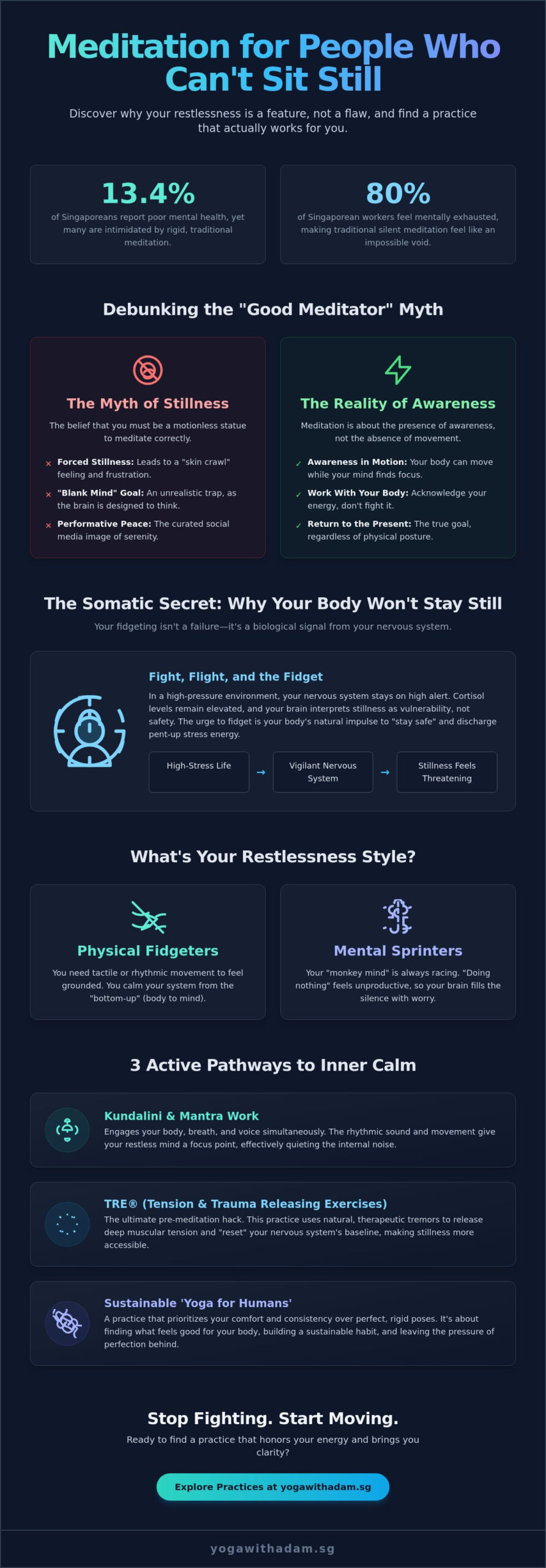
What if the reason you feel like a failure every time you open a mindfulness app isn’t a lack of willpower, but a simple case of using the wrong method? For many of us in Singapore, the idea of sitting perfectly still for twenty minutes feels more like a punishment than a path to peace. If your thoughts start racing the moment you close your eyes or your back begins to ache after two minutes, you aren’t alone. Data from the 2022 National Population Health Survey shows that 13.4% of Singaporeans report poor mental health, yet many still feel intimidated by traditional, rigid practices. This guide explores meditation for people who can’t sit still, proving that you don’t need a fancy cushion to find your center.
I’ve been there myself, fidgeting through classes and wondering why my brain wouldn’t just shut up. We often believe that “real” meditation requires absolute stillness, but that’s just not true for every body. I’ll show you how to trade the cross-legged struggle for practices that involve movement, shaking, and sound. You’ll discover how to lower your stress and gain mental clarity through techniques that actually feel good. We’ll look at why movement works for restless humans and how to build a sustainable practice that fits your real life.
Key Takeaways
- Let’s debunk the myth that you need to be a statue to find peace and understand why your nervous system might actually need movement to relax.
- Explore active meditation styles like Kundalini and mantra work that engage your body and mind simultaneously to quiet the internal noise.
- Learn how TRE® (Tension Releasing Exercises) uses natural tremors to “reset” your baseline, making meditation for people who can’t sit still an accessible reality.
- Discover how to build a sustainable “Yoga for Humans” practice that prioritizes your comfort and consistency over the pressure of perfect, seated stillness.
Why ‘Sitting Still’ is the Hardest Way to Start Meditating
I’ve seen it hundreds of times in my classes here in Singapore. A student walks in, looks at a meditation cushion, and their shoulders immediately hike up toward their ears. There is a persistent myth that to meditate correctly, you must transform into a stone statue. We’re told that if we aren’t cross-legged and perfectly motionless, we’re failing. This rigid approach is exactly why meditation for people who can’t sit still often feels like an impossible task. For a high-energy human, forcing stillness doesn’t lead to peace; it leads to a “skin crawl” feeling where every nerve ending seems to scream for movement.
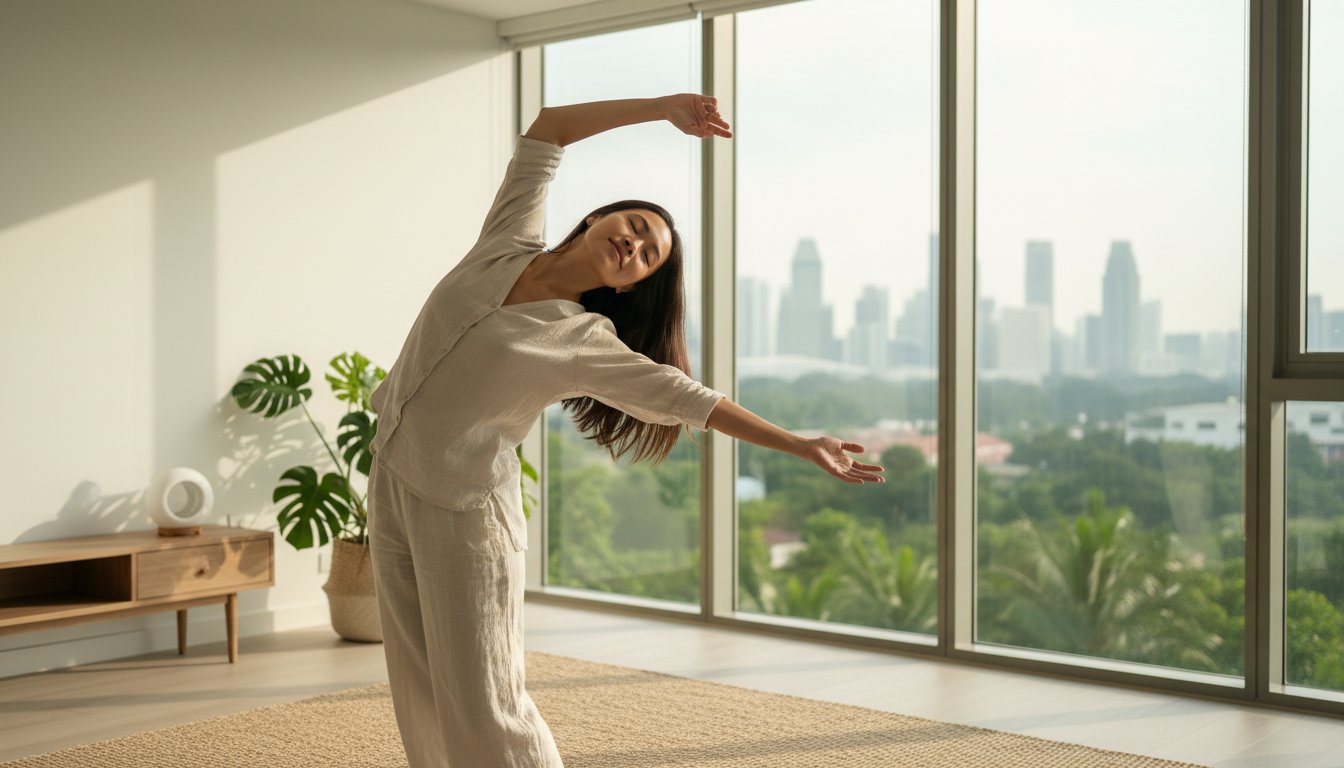
We need to redefine what we’re doing here. Meditation isn’t about the absence of movement; it’s about the presence of awareness. If you have a body that thrives on rhythm, then a static seated posture is the most difficult entry point you could choose. Instead of fighting your nature, we can view meditation as a focused awareness that can happen in motion. This shift is vital because the “blank mind” goal is a trap. Your brain is designed to produce thoughts, and your body is designed to move. Trying to shut both down simultaneously usually backfires, making you feel more stressed than when you started.
The ‘Good Meditator’ Stereotype vs. Reality
Social media has skewed our view of mindfulness, filling our feeds with curated images of people looking serene in expensive linen. This performative stillness isn’t the reality for most of us living in a fast-paced city. When we force ourselves to stay still while our internal engine is revving, we often trigger a stress response rather than a relaxation one. This is where Somatic Experiencing becomes relevant, as it highlights how our bodies process tension through physical sensation. We have to remember that meditation is the art of returning to the present, regardless of your physical shape.
Identifying Your Restlessness Style
Understanding your specific brand of restlessness helps us find a practice that actually sticks. Most people fall into one of two camps:
- Physical fidgeters: These are the folks who need tactile or rhythmic movement to feel grounded. If you’re constantly tapping your pen or bouncing your knee during meetings in the CBD, your body likely needs a “bottom-up” approach to calm.
- Mental sprinters: For you, “doing nothing” feels like a waste of time. Your “monkey mind” is highly developed because our modern, high-stimulation lifestyles demand it. In a 2022 study on workplace wellness, 80 percent of Singaporean respondents reported feeling mentally exhausted, which makes traditional silence feel like a void we need to fill with worry.
It’s time to stop apologizing for your energy. We aren’t trying to fix you because you aren’t broken. We’re just looking for a more sustainable way to help you find your center without the frustration of the traditional “sit and stay” command.
The Somatic Secret: Why Your Body Won’t Stay Still
If you’ve ever sat down to meditate only to feel an overwhelming urge to bolt, I want you to know you aren’t failing. Your nervous system is just doing its job. We often treat meditation like a purely mental exercise, but the body has its own agenda. For many of us in Singapore, living in a high-pressure environment keeps our Vagus nerve in a state of constant vigilance. This nerve acts as the highway for our parasympathetic system. When it’s stuck in a high-tone state, sitting in silence feels physically threatening rather than peaceful.
Instead of fighting your brain, we need to shift our focus to the body’s felt sense. This means noticing the physical sensations of restlessness without judging them. When we understand that meditation for people who can’t sit still is about working with biology rather than against it, the pressure of perfection starts to melt away. We stop seeing our fidgeting as a flaw and start seeing it as a signal that our system needs a different approach.
Fight, Flight, and the Fidget
When cortisol levels remain elevated from a long day at the office or a stressful commute, your brain interprets stillness as a vulnerability. It thinks you should be moving to stay safe. This is why Active Meditation is often a much more effective starting point than traditional seated styles. For a high-tone nervous system that craves input, the sensory feedback of movement is actually what allows the mind to quiet down.
Trying to force relaxation can sometimes cause more tension; a phenomenon often called relaxation-induced anxiety. Your body tightens because it doesn’t feel safe enough to let go. It’s not that you’re bad at meditating; it’s that your internal alarm system is still ringing at a high volume. We have to address the physical alarm before we can expect the mind to follow suit. Movement provides the outlet that your nervous system is screaming for.
The Gateway to Stillness: Somatic Release
To reach a place of quiet, we often have to move the charge out of our muscles first. This is where tension & trauma releasing exercises (TRE) become a game changer. By leaning into the body’s natural shaking mechanism, we can discharge the kinetic energy that keeps us twitchy. It’s like letting the steam out of a pressure cooker so the lid doesn’t blow off.
Once you’ve allowed that physical energy to dissipate, you’ll find that your body settles into a natural quietude. Shaking off the day’s stress isn’t just a workout; it’s a biological reset. If you’re tired of the struggle, you might find that our community-focused classes provide the perfect space to explore these movements without any pressure to perform. When we stop demanding stillness and start inviting it, the whole experience of meditation for people who can’t sit still changes from a chore into a relief.
3 Active Meditation Styles for People in Motion
If the idea of sitting like a statue for 20 minutes makes you want to run for the hills, you aren’t alone. For many of us, the traditional “sit and be still” approach feels more like a chore than a practice. This is where meditation for people who can’t sit still becomes a total game-changer. By giving our bodies something to do, we actually give our minds permission to settle down. We use movement as a bridge to stillness rather than a barrier to it.
Kundalini: The Meditation of Movement
Kundalini uses specific sequences called “kriyas.” These involve repetitive arm movements, spinal flexes, or rapid breathing patterns that we hold for a set amount of time. Unlike a static sit, these movements provide a physical focal point that quiets the brain through sheer repetition. I’ve found that for beginners, this “active” style is often more effective than passive ones because it burns off excess physical energy first. You can learn more about how this works in this grounded guide on What Is Kundalini Yoga?. It’s a practical way to find focus without the pressure of being perfectly still.
The Power of Mantra for Busy Brains
Chanting gives the “monkey mind” a specific job to do. When we use vibration and rhythm, the brain focuses on the sound rather than the grocery list or tomorrow’s meeting. You don’t need a complex script; even a simple phrase like “Peace” or “I am here” works. In our practical guide to meditation and mantra, we explore how these vibrations create a steady internal rhythm. You can use these while commuting on the MRT or walking to the office to create a mental buffer against the noise of the city. It’s about making the practice sustainable for your real life.
Walking with Intention
Walking meditation is perhaps the most accessible tool for a restless human. It turns a simple stroll into a deep practice by merging your breath with your pace. Research cited by Walking Meditation highlights how this practice reduces anxiety and improves blood flow. Whether you’re at East Coast Park or just walking around your HDB block, try this 3-step approach:
- Match your breath to your steps: Try inhaling for four paces and exhaling for four paces to create a steady cadence.
- Focus on physical contact: Pay attention to the sensation of your feet hitting the ground, noticing the transition from heel to toe.
- Acknowledge and return: When a distraction pops up, like a passing bus or a loud neighbor, acknowledge it and gently bring your focus back to the physical feeling of movement.
Dynamic breathwork serves as another rhythmic anchor for those who need to move. By using the lungs intentionally, we create a physical sensation that’s impossible to ignore. This isn’t about forcing anything; it’s about finding a flow that supports your nervous system while you’re on the move. We want to build confidence in your ability to find calm, even when your body is in motion.
TRE®: The Ultimate Pre-Meditation Hack for Fidgeters
If you have ever felt like your skin is crawling the moment you try to close your eyes, you are not alone. I have spent years working with students in Singapore who feel like their nervous systems are permanently stuck in “high alert” mode. This is where TRE®, or Tension & Trauma Releasing Exercises, becomes a total game-changer. It is a series of seven simple movements that evoke a natural shaking response in the body. We call these neurogenic tremors. Instead of forcing your mind to be quiet while your body is buzzing with adrenaline, TRE® allows you to discharge that energy first. It resets your nervous system’s baseline, making meditation for people who can’t sit still feel like a natural next step rather than a chore.
Think about a dog after a loud thunderstorm or a gazelle that just escaped a predator. They shake. This is not because they are cold; it is a biological mechanism to release the chemical charge of stress. Humans have the same hardware, but we have been taught to suppress it. By intentionally “shaking it off,” we clear the physical static that makes sitting still feel impossible. It is like emptying a full cup before you try to pour in some peace and quiet.
The Science of the Shake
When we experience stress, our psoas muscles often tighten as part of a protective reflex. Shaking sends a direct signal to the brain that the threat has passed. This is fundamentally different from shivering when you are cold. Therapeutic tremors are an involuntary release of deep muscular tension. TRE® is a bottom-up approach to mental health. This means we work with the body first to influence the mind, rather than trying to think our way out of anxiety. Research published in 2011 showed that these tremors can significantly reduce symptoms of secondary traumatic stress in large groups.
How to Integrate TRE® into Your Routine
You do not need an hour to see results. I often suggest a 10 to 15 minute session to my students before they try a seated practice. This short window is enough to down-regulate the nervous system and make meditation for people who can’t sit still much more accessible. You can combine this shaking with traditional mindfulness to reach a much deeper state of relaxation.
- Start small: Try the exercises twice a week to see how your body responds.
- Focus on the feeling: Notice the sensation of the tremor without trying to control its path.
- Prioritize safety: If you are a beginner, I recommend working with a certified provider. These tremors can sometimes release stored emotions, and having a guide helps you stay grounded.
Creating a Sustainable ‘Yoga for Humans’ Practice
I believe that yoga and mindfulness should be tools for your life, not another chore on your to-do list. When we explore meditation for people who can’t sit still, we’re really talking about giving ourselves radical permission to move. If you’ve spent the last year feeling like a failure because you can’t clear your mind while sitting cross-legged, it’s time to change the metric. Success isn’t a silent brain; it’s the moment you notice your mind has wandered and you gently bring it back to your breath or your movement.
We need to set realistic expectations to make this stick. Five minutes of mindful movement in your living room beats zero minutes of “perfect” sitting every single time. This is the core of the ‘Yoga for Humans’ philosophy. We make the practice fit your messy, busy, beautiful life, rather than trying to squeeze your life into a rigid, intimidating mold. Consistency creates change, but that consistency doesn’t have to look like an hour-long ordeal. It can be a few conscious breaths while waiting for the lift at your office in Tanjong Pagar.
A sustainable practice also honors your fluctuating energy levels. Some days you’ll feel like a 10/10 on the “fidget scale,” and other days you might feel heavy or sluggish. Your routine should reflect that:
- High Energy Days: Use walking meditations or rhythmic, flow-based movements to burn off excess steam.
- Low Energy Days: Focus on restorative stretches or gentle joint rotations while lying down.
You’ll know your practice is working when you notice small, tangible shifts in your daily life. You might find you’re 15% less reactive during a stressful meeting, or perhaps you’re finally sleeping through the night without your mind racing. According to various wellness studies, even short, five-minute bursts of mindfulness can help lower resting heart rates and improve focus over time.
Building Your Personal Toolkit
Your toolkit is a collection of “go-to” movements that you can pull out whenever you feel restless. Don’t feel guilty if you can’t find your “zen” on a Tuesday afternoon. Self-compassion is the secret sauce that keeps you coming back to the mat. If you’re struggling to find balance, explore this guide on Holistic Mental Wellness to see how different movement techniques support your brain health.
Next Steps: From Solo to Community
Practicing alone is a great start, but there’s a unique power in group energy. Being in a room with others who are also working through their restlessness can help you stay anchored and focused. If you feel like your body needs a more tailored approach, private healing sessions allow us to build a routine that respects your specific physical history and goals. Whether you’re a seasoned mover or a total beginner, there’s a way to make meditation for people who can’t sit still work for you. Join a session with Adam and find your own version of calm today.
Embrace Your Restless Nature and Start Moving
You don’t need to force yourself into a statue-like pose to find mental clarity. We’ve explored how somatic techniques like TRE® and active meditation styles allow your body to release tension naturally. By working with your restless energy instead of against it, you can build a practice that actually lasts. Finding the right meditation for people who can’t sit still is about honoring your biology rather than fighting it. It’s time to stop feeling like a failure for having a body that wants to move.
Adam Fazlur founded Yoga with Adam to provide a down-to-earth space for real humans who find traditional, mystical wellness spaces a bit intimidating. Our approach in Singapore focuses on functional, sustainable movement that supports your body for a lifetime. Whether we’re shaking out deep-seated stress with TRE® or moving through a dynamic Kundalini sequence, the goal is a grounded sense of confidence. We prioritize your comfort over the pursuit of aesthetic poses, making wellness feel attainable. You’re invited to join our community and discover a practice that feels like a relief instead of a chore.
Ready to try meditation that actually works for your body? Explore Kundalini and TRE® with Adam.
Frequently Asked Questions
Is it still meditation if I’m moving?
Yes, movement is a valid form of mindfulness because the goal is focus rather than physical stillness. Whether you’re walking through East Coast Park or practicing mindful stretching, you’re training your brain to stay present. In fact, the “Yoga for Humans” approach focuses 100% on the internal experience rather than looking like a statue. If you’re paying attention to your breath and body while moving, you’re definitely meditating.
Why do I feel more anxious when I try to sit still and meditate?
You feel more anxious because forcing stillness can trigger a stress response in bodies used to constant motion. Clinical studies show that up to 31% of people experience increased tension when trying to sit still for traditional practices. This happens because your nervous system interprets the sudden lack of activity as a threat. We call this relaxation-induced anxiety; it’s a clear sign that movement-based meditation is a better entry point for your needs.
What is the best time of day for restless people to meditate?
The best time for restless humans is usually mid-afternoon or immediately after a physical workout. Most of my students in Singapore find that a 15-minute session at 3:00 PM helps bridge the gap between office tasks and evening rest. By using meditation for people who can’t sit still during these peak energy times, you work with your body’s natural rhythm instead of fighting it. It’s about finding a slot that’s sustainable for your life.
Can I meditate while lying down if I can’t sit up straight?
You can definitely meditate while lying down if sitting up feels uncomfortable or distracting. I always tell my students that comfort is the priority because a painful back makes focus impossible. Use a firm mat or even your bed to support your spine. Just be mindful that lying down can lead to sleep; if you find yourself drifting off, try propping your knees up with a bolster to keep your body slightly engaged.
How long does it take to see the benefits of moving meditation?
Research from Harvard University indicates that consistent practice for 8 weeks can lead to measurable changes in brain density related to stress regulation. You’ll likely notice a shift in your patience levels or sleep quality within the first 14 days of daily 10-minute sessions. Consistency matters more than duration. I’ve seen students transform their relationship with restlessness by committing to just one mindful walk a day around their local HDB estate.
Do I need special equipment for Kundalini or TRE®?
You don’t need any expensive gear or special equipment to start these practices. For Kundalini, a simple yoga mat or a rug is enough to provide a stable base for the movements. TRE, or Tension Releasing Exercises, requires only enough floor space to lie down and move your legs. Most practitioners in our community use basic household items like a cushion or a chair to stay comfortable during the session without spending extra money.
What should I do if my mind keeps wandering during active meditation?
It’s completely normal for your mind to wander, so just acknowledge the thought and bring your focus back to your movement. If you’re walking, refocus on the sensation of your feet hitting the pavement. I treat mind-wandering like a bicep curl for the brain; every time you bring your attention back, you’re getting stronger. Don’t judge yourself for thinking, as that just adds more mental noise to your practice and creates unnecessary frustration.
Is meditation for people who can’t sit still less effective than traditional styles?
Active styles are just as effective as seated ones for reducing cortisol and improving focus. Choosing meditation for people who can’t sit still ensures you actually do the practice, which is the most important factor for success. A 20-minute mindful walk provides the same neurological benefits as 20 minutes of seated Zen meditation. The best style is always the one that you can actually stick with for the long term without feeling miserable.