

What if the secret to stopping those 2 AM racing thoughts isn’t another meditation app, but a shift in how you talk to your body? In Singapore, a 2022 study by Duke-NUS Medical School found that over 30% of adults are dealing with high levels of stress and exhaustion. You’ve likely felt that specific drain; you’re physically tired from a long day in the CBD, yet your brain feels like it’s running a marathon on a loop. We often feel guilty for not being able to “just relax,” but the truth is that learning how to quiet a busy mind isn’t about forcing stillness. It’s about understanding the physiological signals your body is sending when it doesn’t feel safe enough to power down.
I’ve been there myself, staring at the ceiling and wondering why my brain won’t take the hint. In this guide, I’ll show you why your mind stays stuck in overdrive and share practical, somatic techniques that actually work for real human bodies. We’ll move beyond the mystical jargon to explore functional movements you can use at your desk or before bed. You’ll gain a simple tool to regain control over your internal narrative and finally improve your sleep quality tonight.
Key Takeaways
- Understand that “cognitive noise” is a natural physical response to modern life, not a personal failure or something you need to “fix” overnight.
- Discover why traditional sitting meditation can feel frustrating and how somatic movement provides a more accessible, regulated path to stillness.
- Learn the science-backed connection between your Vagus nerve and mental chatter to find out exactly how to quiet a busy mind through the body.
- Master simple, down-to-earth techniques like therapeutic shaking and rhythmic breathwork to physically release stored adrenaline and tension.
- Shift from seeking quick fixes to building a sustainable practice that supports your long-term mental well-being within a supportive community.
Understanding Why Your Mind Refuses to Quiet Down
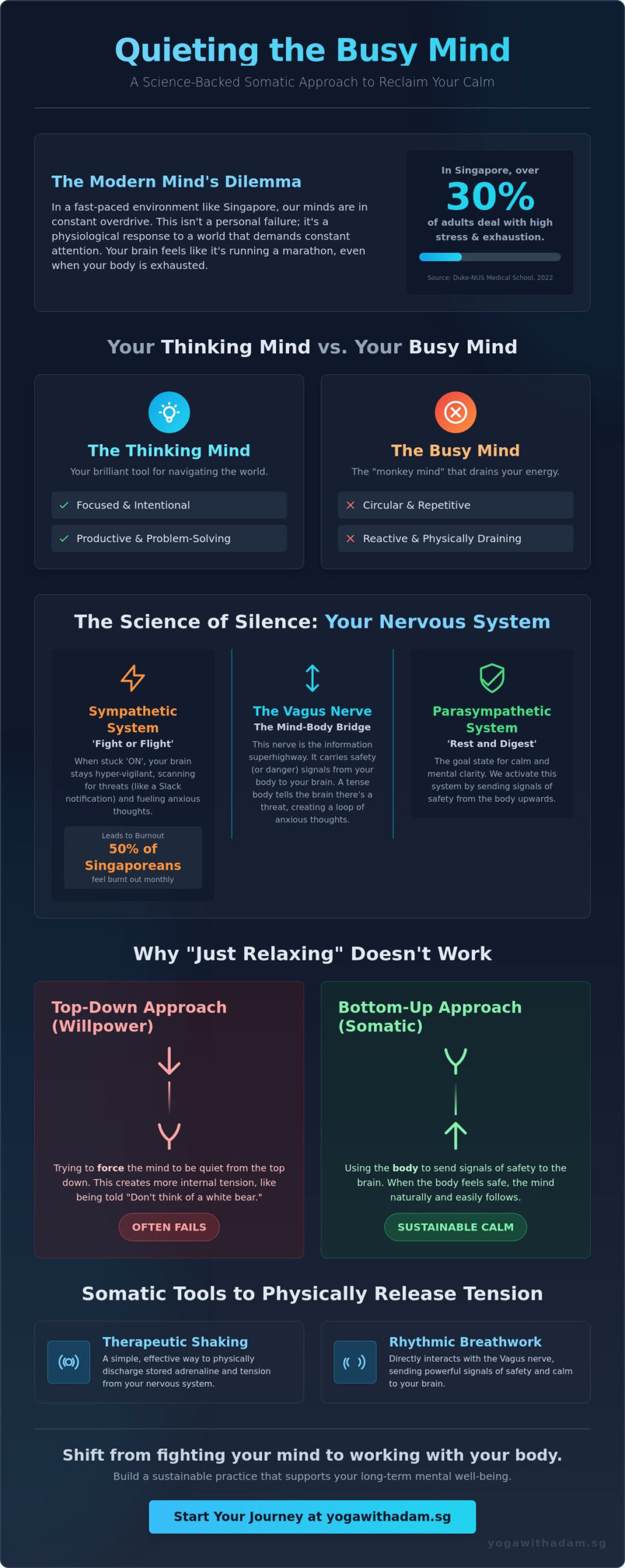
If you find yourself lying awake at 2 AM wondering if you sounded awkward in a meeting, please know that your brain is just doing its job. We live in a world that demands constant attention, especially in a fast-paced environment like Singapore. This mental chatter isn’t a flaw in your character; it’s a natural physiological response to modern life. I like to distinguish between the ‘thinking mind’ and the ‘busy mind.’ Your thinking mind is a brilliant tool. It helps you navigate the MRT, plan your week, or solve a problem at work. Your busy mind, however, is what we call the ‘monkey mind.’ It jumps from one worry to the next without actually reaching a resolution.
I often talk to students who feel frustrated because they can’t just ‘turn it off.’ They spend their commute or their wind-down time stuck in loops of repetitive thought. This is a common hurdle when learning how to quiet a busy mind. By looking at Understanding Why Your Mind Refuses to Quiet Down, we can see that this isn’t just a mental habit. It’s often a symptom of a nervous system that’s stuck in a high-alert state. When your body feels like it needs to stay ‘on’ to keep you safe, your mind stays busy to match that energy.
The Myth of the Blank Mind
One of the biggest hurdles I see in my classes is the idea that a quiet mind must be a blank one. This is a total myth. Your brain is designed to produce thoughts just like your lungs are designed to breathe. The goal of our practice isn’t to delete your thoughts or achieve a state of zero mental activity. Instead, we’re working on changing your relationship with those thoughts. Mental stillness is actually a state of non-reactivity. It’s the ability to notice a thought passing by without feeling like you have to chase it down or act on it immediately.
Why Willpower Alone Fails to Stop Thinking
Have you ever noticed that the harder you try to relax, the more stressed you feel? Psychologists call this the ‘white bear’ effect. If I tell you not to think about a white bear, it’s the only thing you’ll see. This is why willpower usually fails us when we’re stressed. For many high-achievers, ‘trying’ to quiet the mind just creates more internal tension.
In our Yoga for Humans approach, we stop trying to force the mind from the top down. Instead, we work from the bottom up. This means we use the body to send signals of safety to the brain. When we address the physical tension in our shoulders or the rhythm of our breath, the mind naturally begins to follow suit. This somatic shift is often the missing piece in how to quiet a busy mind effectively and sustainably.
- Thinking Mind: Focused, intentional, and productive.
- Busy Mind: Circular, reactive, and physically draining.
- Somatic Approach: Using body-based tools to calm the nervous system first.
The Science of Silence: Your Nervous System and Mental Chatter
I’ve spent years watching people arrive at my studio with their shoulders practically touching their ears. When we talk about how to quiet a busy mind, we’re really talking about biology, not just willpower. That mental chatter is often just a symptom of your sympathetic nervous system being stuck in ‘on’ mode. This is your fight-or-flight response; it’s designed to keep you alive, not to help you feel peaceful. When this system dominates, your brain stays hyper-vigilant, scanning for problems even when you’re trying to rest.
Your Vagus nerve is the secret bridge here. It runs from your brain down through your chest and abdomen, carrying messages about how safe you are. If your body is physically tense, your Vagus nerve tells your brain there’s a threat, which triggers more anxious thoughts. It’s a feedback loop that can feel impossible to break without a somatic approach. We have to talk to the body to convince the mind to settle down.
Nervous system regulation is the intentional practice of shifting your body from a state of high-alert stress back into a balanced, calm baseline where mental clarity becomes possible.
The Fight-or-Flight Response in the Office
In a fast-paced city like Singapore, our brains often mistake a pestering Slack notification for a physical predator. A 2023 study by Milieu Insight found that 50% of Singaporeans feel burnt out at least a few times a month, often because our bodies stay in a state of high alert long after the work day ends. Your brain ruminates on problems as a way to stay safe by anticipating every possible disaster. We need to prioritize Human Sustainability, which means treating our energy as a finite resource rather than an endless well. Following Mayo Clinic’s guide to stress relief can help, but we also need to address the physical tension stored in our muscles through movement.
Neuroplasticity and the Habit of Overthinking
A busy mind isn’t a fixed personality trait; it’s often just a practiced neural pathway. Every time we spiral into worry, we’re essentially training our brain to stay there. The good news is that neuroplasticity allows us to build new, calmer pathways through regular somatic work. You don’t need a week-long silent retreat to see results. I’ve found that consistent, five-minute interventions during your commute or lunch break are far more effective for long-term change. By choosing a sustainable movement practice, you’re teaching your nervous system that it’s okay to let go of the noise. This is why I advocate for Yoga for Humans; it’s about making the practice work for your actual, busy life.
Why Traditional Meditation Can Feel Impossible (and What to Do Instead)
I can’t tell you how many times a student has walked into my studio and confessed, “I tried to meditate, but my mind wouldn’t shut up.” It’s the most common frustration I hear. We’ve been sold this idea that meditation is a light switch; you sit down, close your eyes, and suddenly the clouds part. For most of us living in the real world, that’s just not how it works. When you’ve spent ten hours navigating the fast-paced environment of Singapore, your nervous system is likely humming at a high frequency. Forcing yourself to “just sit” when you’re that wired can actually be dysregulating. It feels like trying to stop a freight train by standing in front of it.
If you’re struggling with how to quiet a busy mind, remember that stillness is a skill we build, not a switch we flip. For a highly stressed person, the sudden absence of movement can feel like a threat to the brain. Instead of finding peace, you find a heightened sense of anxiety as your internal chatter becomes deafening. This is why I advocate for active meditation. We need to give the body a way to process all that pent-up “doing” energy before we can expect the mind to find its way to “being.”
The Trap of the Quiet Room
External silence often acts like a megaphone for internal noise. When we remove all sensory distractions, our brain has nothing to chew on except our own worries and to-do lists. This is why movement-based practices are so effective for beginners. By using physical sensations as a grounding tool, we give the mind a “job” that isn’t thinking. Sensory input, like the feeling of your feet on the floor or the rhythm of your breath, provides a safe anchor that prevents the mind from drifting into the future or the past.
Active Stillness: The Kundalini Approach
I often describe Kundalini Yoga as a practical technology for the modern human. It’s not about escaping reality; it’s about building the internal capacity to handle it. In this practice, we use repetitive movements, specific breath patterns, and mantras to engage the mind fully. This active somatic release helps “drain the tank” of excess stress. When your body is moving rhythmically, your brain doesn’t have the bandwidth to obsess over your inbox. It’s a much more accessible entry point for busy professionals who find traditional seated meditation intimidating. If you want to dive deeper into these techniques, you can explore my guide on What Is Kundalini Yoga? to see how these tools work in practice. By the time we reach the end of a session, that elusive quiet mind often arrives on its own, no force required.
- Passive relaxation: Trying to relax by doing nothing (often leads to more thinking).
- Active somatic release: Using movement to discharge stress so relaxation happens naturally.
- The “Job” for the mind: Giving the brain a physical rhythm to follow instead of a thought loop.
Learning how to quiet a busy mind isn’t about achieving a blank slate. It’s about changing your relationship with the noise. When we use the body as a bridge, we stop fighting ourselves and start working with our biology. It’s a shift from performance to presence, and it’s much more sustainable for the long haul.
Three Somatic Techniques to Quiet the Mental Chatter Today
We’ve all been there. You’re trying to focus on a task or drift off to sleep, but your brain is busy rehearsing a conversation from three years ago. Understanding how to quiet a busy mind isn’t about forcing the thoughts to stop; it’s about giving the body a different signal. These three somatic techniques are designed for real life. You don’t need a mountain retreat or an hour of silence. You can practice these in 5 to 10 minutes right where you are in Singapore, whether you’re at your desk or in your living room.
TRE®: Shaking Off the Day
We often forget that humans are animals. When animals in the wild survive a stressful event, they shake. This involuntary tremor is a biological reset button that releases stored adrenaline. Tension & Trauma Releasing Exercises (TRE®) tap into this exact mechanism. Instead of holding onto the tension from a long commute or a high-pressure meeting, we use specific movements to trigger these natural tremors. This process helps release deep muscular patterns of stress without needing to talk through the “why” of your anxiety. It’s a physical solution for a physical buildup of energy. You can find a deeper dive into this practice in our Ultimate Guide to TRE®.
Breath as a Remote Control for the Brain
Your breath is the most accessible tool you have to shift your nervous system state. If you feel your thoughts racing, it’s likely your body is stuck in a “fight or flight” response. We can use the breath as a remote control to change that channel. For an immediate “emergency” reset, try the 4-7-8 technique. Inhale quietly through your nose for a count of 4; hold your breath for a count of 7; then exhale forcefully through your mouth for a count of 8. This long, slow exhale is the key. It signals the vagus nerve to slow your heart rate and lower your blood pressure. This shift makes it physically difficult for the mind to maintain a frantic pace.
Mantra for the Modern Skeptic
Don’t let the word mantra intimidate you. In a somatic context, a mantra is simply a mental tool used to occupy the parts of your brain that won’t stop talking. It’s not about religious ritual; it’s about sound vibration and focus. When we chant or hum, the physical vibration affects the cranial nerves and creates a soothing resonance in the chest and throat. This vibration acts as a “circuit breaker” for the internal monologue. If you’re looking for a grounded way to start, our Practical Guide to Meditation and Mantra explains how to use these sounds without the fluff. Even humming a low, steady tone for three minutes can create a sense of internal space that wasn’t there before.
These tools are meant to be sustainable and accessible for every body. If you’re ready to move beyond the theory and start practicing these techniques in a supportive environment, join our community at Yoga with Adam today.
Building a Sustainable Path to Mental Calm
I don’t view mental wellness as a luxury or a quick fix to be squeezed into a frantic schedule. I call it Human Sustainability. In a high-pressure environment like Singapore, we often treat our bodies like machines that just need a quick oil change. True calm doesn’t work that way. It’s about creating a lifestyle that supports your nervous system for the next forty years, not just the next forty minutes. We’re looking for a foundation that lasts.
My philosophy, Yoga for Humans, is built on being grounded and entirely pretension-free. We don’t care about perfect poses or mystical jargon. We focus on what’s functional and accessible for real bodies living real lives. While individual practice is vital, there’s something powerful about the collective energy of a group. Practicing with a community in Singapore provides an anchor. It turns a solo struggle into a shared journey, making it much easier to stay consistent when your personal motivation feels low.
From Crisis Management to Daily Practice
Most of us only look for tools when we’re already in the middle of a meltdown. That’s “putting out fires,” and it’s an exhausting way to live. Building a resilient nervous system means moving toward proactive care. You can start this shift tomorrow with a simple 10-minute morning routine. Spend five minutes sitting quietly, noticing the weight of your body on the chair, followed by five minutes of gentle neck and shoulder circles. This small investment sets a steady tone before the workday noise begins. For those ready to explore deeper, long-term strategies, my guide on Holistic Mental Wellness offers a roadmap for staying grounded in a chaotic world. Understanding how to quiet a busy mind is much more effective when it becomes a daily habit rather than an emergency response.
Finding Your Guide
Sometimes, the noise in our heads is too loud to tackle alone. If you’re feeling stuck, Private Healing Sessions offer a way to receive personalized guidance tailored to your specific physical and emotional needs. These sessions provide a safe space to unpack tension without the pressure of a group setting. Whether you choose to join us for in-studio classes in Singapore or prefer the flexibility of online sessions, the goal remains the same: giving you practical tools that actually work. I want to leave you with one final thought: you are not broken; you just need the right tools. Learning how to quiet a busy mind is a practical skill that anyone can master with a bit of patience and the right support.
Start Your Journey Toward a Calmer State of Being
Finding a sense of peace in a fast paced environment like Singapore starts with the body, not just the thoughts. We’ve looked at why your nervous system stays stuck in overdrive and how somatic tools offer a practical bridge to stillness that traditional meditation often misses. Learning how to quiet a busy mind is a skill you can develop through consistent, sustainable practice rather than forced perfection. It’s about giving your body the physical cues it needs to finally feel safe enough to let go.
With over 10 years of experience specializing in Kundalini and TRE, I help people reconnect with themselves through a grounded, “Yoga for Humans” approach. These sessions are designed for real people dealing with real stress. I offer 1-on-1 private sessions for personalized guidance and corporate wellness programs to help teams thrive. You deserve a practice that supports your long-term well-being without the pressure of performing complex poses or achieving mystical states.
Ready to move from mental chatter to embodied calm? Explore upcoming classes and workshops with Adam to find the right fit for your lifestyle. I’m looking forward to meeting you on the mat and helping you build a more resilient, peaceful version of yourself.
Frequently Asked Questions
Is it possible to actually have a completely quiet mind?
No, a completely silent mind isn’t the goal because our brains are built to process about 6,000 thoughts per day according to 2020 research from Queen’s University. Instead of chasing total silence, we focus on changing our relationship with those thoughts. We use somatic tools to lower the volume. This makes the mental chatter feel less like a shouting match and more like background noise while you focus on your life in Singapore.
How long does it take to see results from these somatic techniques?
You will likely feel a shift in your nervous system within the first 10 to 15 minutes of a single session. For long-term changes in how to quiet a busy mind, consistency is key. A 2018 study on mindfulness and somatic practices showed that participants reported a 30 percent reduction in perceived stress after practicing for 8 consecutive weeks. Most of our students in Singapore notice they feel more grounded after just 3 classes.
Can I practice these techniques at my desk during work?
Yes, you can absolutely use discrete somatic tools like box breathing or seated grounding while sitting at your desk in the CBD. You don’t need a yoga mat to reset your nervous system during a busy workday. Try pressing your feet firmly into the floor for 30 seconds or softening your jaw while answering emails. These micro-practices help manage stress in real-time without drawing attention from your colleagues or manager.
What is the difference between a busy mind and clinical anxiety?
A busy mind usually involves racing thoughts about daily tasks, while clinical anxiety is a diagnosed condition that often includes physical symptoms like a racing heart or persistent dread. In Singapore, the Institute of Mental Health notes that 1 in 7 people will experience a mental health condition in their lifetime. If your thoughts prevent you from sleeping for more than 3 nights a week or cause panic attacks, please consult a medical professional.
Why does my mind get busier as soon as I try to relax?
Your mind feels louder during relaxation because you’ve finally removed the external distractions that usually drown it out. It’s like turning off a loud radio in a room; suddenly, you can hear the hum of the air conditioner. This is a normal part of learning how to quiet a busy mind. When we stop moving, the stored energy in our nervous system often bubbles up as rapid thoughts before it can finally settle down.
Do I need any special equipment to start quieting my mind?
You don’t need any expensive gear or specialized equipment to begin this practice. Your body is the only tool required for somatic work. While a comfortable mat can be nice for floor exercises, most techniques can be done on a standard chair or even standing up. We focus on Yoga for Humans, which means making the practice work with whatever you have available at home or in the office.
How often should I practice TRE or Kundalini to notice a change?
Practicing 2 or 3 times per week is usually enough to create a sustainable shift in your well-being. Overdoing it can sometimes overwhelm the nervous system, so we recommend starting with 20 minute sessions. Consistency matters more than intensity. If you stick to this rhythm for 30 days, you’ll likely find that your baseline level of calm has improved compared to when you first started your journey toward a steadier state of mind.