
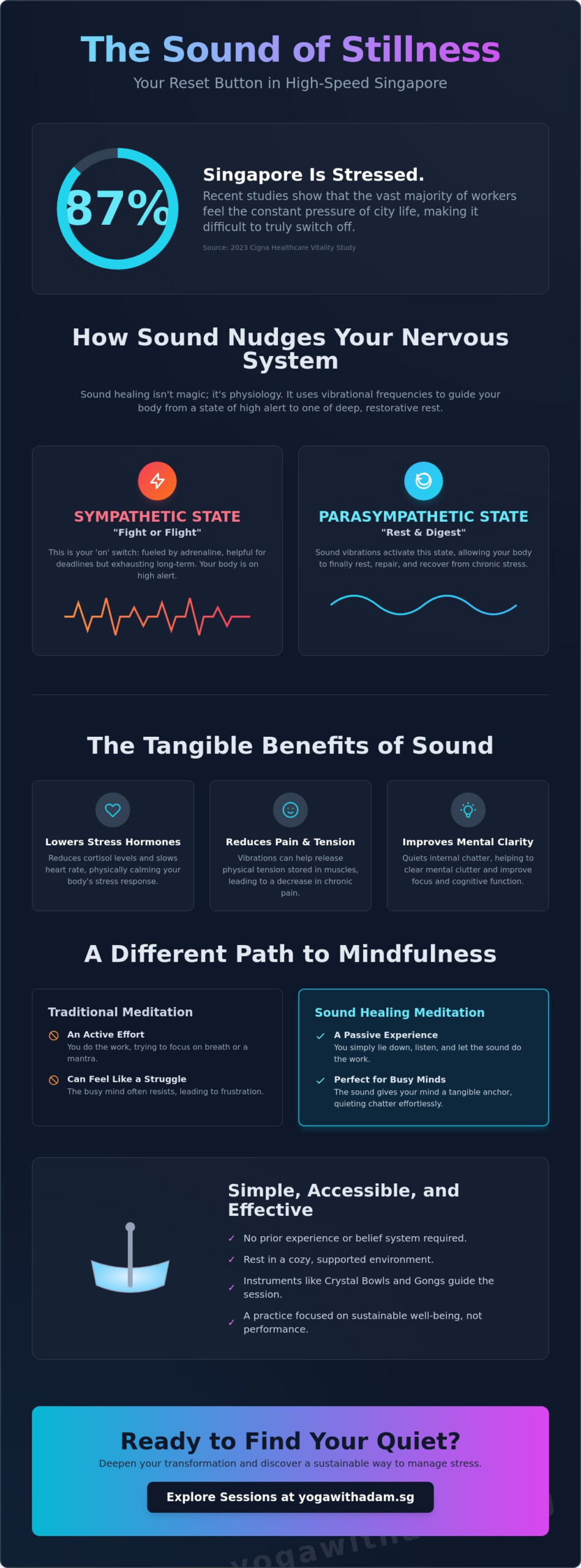
What if the most productive thing you could do for your mental health in Singapore this week was to lie down on the floor and do absolutely nothing for sixty minutes? We all know the feeling of the Singapore squeeze. It’s that constant hum of adrenaline that keeps you awake at 2 AM, even though you’ve been running since 7 AM. Recent data from the 2023 Cigna Healthcare Vitality Study shows that 87% of workers in Singapore are stressed, with many of us struggling to find a way to truly switch off.
This is exactly why sound healing meditation singapore has become such a vital tool for those of us living in this high-speed city. I want to help you understand how these resonant frequencies can physically nudge your nervous system from “fight or flight” into a state of deep, restorative rest. It’s a practice that fits perfectly into our “Yoga for Humans” philosophy because it’s simple and effective. In this guide, we’ll explore the science behind the bowls, why it works for busy minds, and how you can start using sound as a sustainable part of your self-care routine. It’s time to find some quiet in the middle of the noise.
Key Takeaways
- Understand how specific sound frequencies work to lower cortisol and regulate your nervous system, providing a sustainable way to manage stress in our fast-paced city.
- Get a clear, grounded look at what actually happens during a sound healing meditation singapore session, from the instruments we use to the cozy, supported environment you’ll rest in.
- Learn how to identify your personal goals—whether it’s deep rest or emotional release—to help you choose the right group or private experience for your needs.
- Discover why we view these practices as “Yoga for Humans,” focusing on accessible tools that support your long-term well-being rather than performative poses.
- Explore how pairing sound therapy with Kundalini Yoga or TRE® can deepen your results, helping you shake off stored tension and build a more resilient body.
What is Sound Healing Meditation? A Grounded Definition
We often think of meditation as sitting perfectly still in a silent room, trying to quiet a mind that simply won’t stop racing. Sound healing meditation takes a different path. It’s the practice of using specific frequencies and vibrations, usually from instruments like crystal singing bowls, gongs, or tuning forks, to guide your body into a state of deep, restorative relaxation. I like to call this part of our “Yoga for Humans” approach. We aren’t trying to reach an untouchable, mystical plane. We’re just helping modern people with real, tired bodies feel a bit more like themselves again.
In a city like Singapore, the pace is relentless. Whether you’re rushing through the CBD or navigating the daily commute on the MRT, your nervous system is likely on high alert. This constant buzz makes sound healing meditation singapore an essential tool for local well-being. It’s a way to hit the pause button in a high-stress environment. The best part is that you don’t need any previous meditation experience, special equipment, or specific spiritual beliefs to feel the benefits. You just need to show up, lie down, and let the sound do the heavy lifting.
How Sound Interacts with the Human Body
Our bodies are essentially fine-tuned instruments that can easily fall out of tune. Most of us spend our waking hours in a “sympathetic” nervous system state, which is our fight-or-flight mode. It’s helpful for meeting deadlines, but it’s exhausting for our long-term health. Sound vibrations help us switch into the “parasympathetic” state, where the body can finally rest, digest, and repair itself. This process is supported by Vibroacoustic therapy, which explores how audible sound vibrations can reduce physical tension and mental stress. When we use these sounds to reset a body stuck in high gear, we’re utilizing a process called entrainment. Entrainment is the process where our internal brainwaves synchronize with the external rhythms and frequencies of the sound.
Sound Healing vs. Traditional Meditation
Traditional meditation is often an active effort. You’re the one doing the work to focus on your breath or a specific mantra. For many of us, that “active” part is exactly why we struggle with it. Sound healing is a passive experience. Instead of you chasing the silence, the sound comes to you. It gives your “busy mind” a tangible focal point to latch onto, which naturally quiets the internal chatter. If you’ve ever felt like you’re “bad at meditating” because your thoughts won’t stop, sound is often the perfect entry point. It removes the pressure of performing a technique and lets you simply receive the experience in a supportive environment.
The Science and Benefits of Vibrational Therapy
Sound isn’t just something we hear with our ears; it’s a physical force that our entire body processes. When we talk about sound healing meditation singapore, we’re looking at how specific frequencies interact with our physiology. Research shows that consistent exposure to soothing sound vibrations can significantly lower heart rate and reduce cortisol levels. We often see practitioners arrive with the frantic energy of a long day in the CBD, only to find their breathing slowing down within minutes. This isn’t magic. It’s the result of sound waves interacting with the Vagus nerve, which is the main component of your parasympathetic nervous system. This nerve acts as a biological brake, telling your heart and lungs to calm down.
We view this practice as a vital part of human sustainability. In a city that rarely sleeps, we need tools that support our long term well being rather than just providing a temporary escape. Many busy professionals feel that taking an hour to lie down is wasted time. We’d argue the opposite. This kind of deep rest is actually a highly productive state. While you’re resting, your brain is busy processing information and clearing out metabolic waste. In one study on the effects of sound meditation, participants showed a marked decrease in tension and physical pain. By giving ourselves permission to pause, we’re actually upgrading our capacity to handle the demands of our daily lives.
Mental Clarity and Emotional Recovery
We all carry “silent stress” that builds up throughout the work week. It’s that low level hum of anxiety from unread emails and tight deadlines. Sound baths help clear this mental clutter, which directly improves cognitive functioning and focus. Vibrational therapy provides a unique way to support emotional regulation because it allows you to process heavy feelings without the exhausting requirement to talk it out or analyze every thought. It’s a grounded approach to mental health that feels accessible to everyone, regardless of their previous experience with meditation.
Physical Healing and Better Sleep
It’s no secret that Singaporeans are some of the most sleep deprived people in the world. This chronic lack of rest leads to physical bracing, where we subconsciously hold tension in our jaws, necks, and shoulders. During a session, these vibrations help the muscles finally let go of that grip. This physical release is a key part of holistic mental wellness. When the body isn’t stuck in a state of high alert, falling into a deep, restorative sleep becomes much easier. If you’ve been struggling to find your off switch, you might want to explore our upcoming sessions to experience this shift for yourself.
Common Instruments and What to Expect
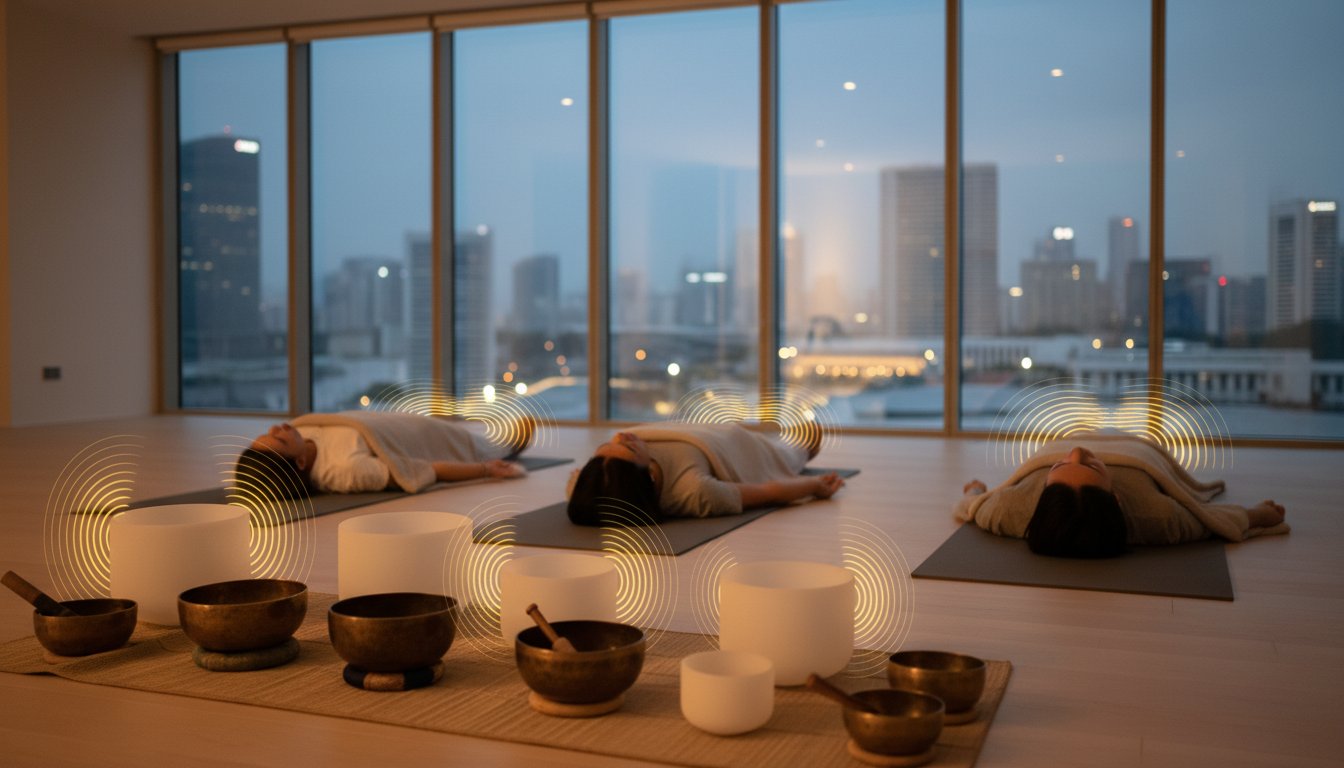
Walking into a sound healing meditation singapore session feels less like a concert and more like a prepared nest. Most studios provide a thick mat, a couple of firm bolsters, and a soft blanket. I encourage you to use every prop available. We want your physical body to feel completely supported so your mind can actually wander. You aren’t here to hold a pose; you’re here to be held by the sound.
The experience is deeply personal and changes every time you lie down. You might feel physical vibrations pulsing through your ribs, or you might see shifting colors and patterns behind your eyes. Many practitioners find themselves drifting into a “theta” state, which is that hazy border between being awake and falling asleep. If you do cross that border and start snoring, please don’t apologize. It’s a sign that your nervous system has shifted from “fight or flight” into a state of deep rest. In our space, a snore is just another layer of the soundscape.
Singing Bowls vs. Gongs: Choosing Your Frequency
Singing bowls are the foundation of most sessions. Alchemical crystal bowls, often made from 99.9% pure quartz, produce clear and high-pitched tones that feel light and ethereal. Traditional Tibetan bowls made of metal alloys offer a more grounded, harmonic resonance. Both are melodic and predictable, making them perfect for beginners who want a gentle entry point.
Gongs offer a different intensity. A gong bath doesn’t involve water; instead, you’re “washed” over by a massive wall of sound. The vibrations are complex and non-linear, which helps bypass the analytical part of your brain. If you’re someone who struggles with a loud inner critic, the gong’s power can be incredibly liberating. I also find that incorporating meditation and mantra adds a necessary human element. Using your own voice creates an internal resonance that complements the external instruments, giving you an active role in your own healing process.
The Role of the Guide
The person leading the session acts as an anchor for the room. There is a big difference between a performer who plays instruments and a facilitator who understands the nuances of human energy. A grounded guide focuses on the sequence and the silence between the notes as much as the sounds themselves. During a sound healing meditation singapore session, we monitor the room’s energy to ensure the transition from a heavy gong strike to a delicate crystal bowl is seamless and safe.
My goal is to provide a supportive container where you don’t feel pressured to achieve a specific meditative state. We prioritize your comfort and long-term well-being over aesthetic rituals. By focusing on functional relaxation, we make sure the benefits of the session follow you back out onto the busy streets of Singapore, helping you maintain that sense of steady calm long after the last bowl has stopped singing.
How to Choose the Right Sound Healing Experience in Singapore
Finding the right space for sound healing meditation singapore shouldn’t feel like another chore on your to-do list. I always tell my students to start by being honest about what they need right now. Are you looking for a bit of “me time” to escape the noise of the CBD; or are you ready to dig into some deeper emotional work? Identifying your primary goal, whether it is deep rest, emotional release, or just physical relaxation, will help you decide which path to take.
I suggest looking for a studio that feels inclusive and down-to-earth. You want a place where you can show up as you are, without feeling like you need to subscribe to a specific set of mystical beliefs. The best sessions are the ones where the teacher treats you like a human, not a project. If the vibe feels performative or overly rigid, it might not be the best environment for you to actually let go and relax.
Group Sound Baths: Community and Connection
Group sessions are a fantastic way to dip your toes into the practice. There is a unique energy that happens when a room full of people settles into stillness together. It reminds us that we aren’t alone in our stress or our desire for peace. These sessions are also quite cost-effective; most studios in Singapore charge between S$35 and S$65 for a public class. This makes it a sustainable option for a regular weekly practice. It’s about “humans” practicing together, building a sense of collective calm that stays with you long after you leave the room.
Private Healing Sessions: Tailored Transformation
Sometimes, a group setting isn’t quite enough. If you are working through specific trauma or experiencing a period of intense, high-level stress, private healing sessions offer a much more focused approach. In a one-on-one setting, I can place instruments like singing bowls directly on or very near your body. This allows the physical vibrations to penetrate deeper into your tissues. These sessions also provide the space to integrate other somatic tools, like breathwork or gentle movement, tailored specifically to how your body is feeling that day.
- Comfortable Layers: Most Singapore studios keep the air conditioning quite cold. Wear loose trousers and bring a sweatshirt or a pair of warm socks.
- A Water Bottle: Staying hydrated helps your body process the experience afterward.
- An Open Mind: You don’t need to “know” how to meditate. Just show up and listen.
- Eye Mask (Optional): While many studios provide these, bringing your own can help you feel more at home in the space.
If you’re ready to see how these vibrations can support your own well-being, I’d love to welcome you to the mat. You can view my current schedule and book a session here.
Deepen Your Transformation with Yoga with Adam
I believe that wellness shouldn’t feel like a chore or a performance. My approach at Yoga with Adam is built on the idea that these ancient tools need to work for modern bodies living in a high-pressure city like Singapore. We don’t worry about looking like a magazine cover here. Instead, I focus on how you feel when you leave the mat. By combining the resonant power of sound healing meditation singapore with the rhythmic movement of kundalini yoga, we create a practice that is both grounding and deeply restorative.
For many of my students, sound is the bridge that makes physical release possible. I often integrate sound therapy with tension & trauma releasing exercises (TRE®). This combination helps the body process stress that has been stored in the tissues for years. It’s a practical, no-nonsense way to regulate your nervous system without needing to subscribe to a specific belief system.
I also bring these somatic tools into the workplace. With 92% of Singaporeans reporting stress in recent workplace surveys, corporate wellness is no longer a luxury. I design programs for Singapore-based teams that prioritize genuine recovery and sustainable energy over quick-fix perks. We build communities that value long-term health and inclusive support.
Integrated Somatic Practices
When we combine movement, breath, and sound, we aren’t just “working out.” We’re speaking the language of the nervous system. This integrated approach leads to faster regulation because it addresses the body from multiple angles at once. My “Yoga for Humans” mission is simple: I want to make these practices accessible for your specific body, regardless of your flexibility or experience level. We focus on functional movement that supports your life outside the studio. If you want to dive deeper, I host regular workshops and retreats throughout the year that offer a more immersive experience than a standard weekly class.
Start Your Journey Today
You don’t need to be “zen” to start. You just need to show up as you are. Whether you’re looking for a group setting to find your tribe or prefer the focused attention of a private session, I provide a welcoming, no-pressure environment. We keep things light and sometimes a bit playful, because healing doesn’t always have to be heavy. Take a look at our current class schedule or reach out to book a private session. Taking that first step toward reclaiming your inner peace is the most important move you’ll make all week. I’m here to guide you through it, one breath and one sound at a time.
Your Path to a Grounded Reset
Finding a moment of real stillness in the middle of Singapore’s fast pace isn’t just a luxury; it’s a necessity for your long-term health. We’ve looked at how vibrational therapy works on a physical level and why you don’t need to be a spiritual expert to feel the effects. Using sound healing meditation singapore is a practical tool for modern life, helping you regulate your nervous system without any of the usual pretension or pressure to perform.
I’m Adam Fazlur, and I’ve spent more than 10 years as a guide, developing an approach I call Yoga for Humans. This isn’t about perfect poses; it’s about sustainable practice that fits your actual life. By integrating sound with specialized techniques like TRE® and Kundalini, I help you clear the physical and mental noise that builds up throughout the week. You’ll find a welcoming space where the focus is on your comfort and genuine connection.
Book your first grounded sound healing session with Adam today to start your transformation. I’m looking forward to meeting you on the mat and supporting your journey toward a more balanced, steady version of yourself.
Common Questions About Sound Healing
Is sound healing meditation a religious practice?
It isn’t religious at all. While sound has roots in various ancient traditions, the sound healing meditation singapore sessions I lead focus on the physical and mental impact of vibration. It’s about how sound waves interact with your nervous system to trigger a relaxation response. You don’t need to subscribe to any specific belief system to enjoy the benefits of a gong or a singing bowl; you just need an open mind.
What should I wear to a sound healing session in Singapore?
Wear your most comfortable, loose-fitting clothes that allow you to breathe easily. You’ll be lying still for about 60 to 90 minutes, and your body temperature will naturally drop as you relax. Since most Singapore studios keep the air conditioning around 22 degrees Celsius, I recommend bringing a pair of warm socks and a light sweater. Avoid belts or bulky jewelry that might feel restrictive when you’re trying to settle in.
Can I do sound healing if I have a very busy mind and can’t sit still?
You’re exactly the person who needs this the most. Most of us have minds that feel like a browser with 50 tabs open. The beauty of sound is that it gives your brain a physical anchor to focus on, making it easier to drift into a meditative state without “trying” so hard. You don’t need to be a Zen master. You just need to lie there and let the frequencies do the heavy lifting.
How often should I attend a sound bath to see results?
I suggest starting with one session every two weeks to maintain a steady baseline of calm. Research from the Journal of Evidence-Based Integrative Medicine in 2016 showed that even a single 60-minute session significantly reduces tension and fatigue. If you’re navigating a particularly stressful period at work, coming in once a week can help prevent your nervous system from hitting a state of burnout. Consistency helps your body remember how to relax.
Are there any contraindications for sound healing?
Sound healing is generally safe, but there are a few important exceptions. If you have a pacemaker, metal implants, or suffer from sound-induced epilepsy, the vibrations might be problematic. For those in their first 12 weeks of pregnancy, we usually advise waiting until the second trimester. It’s always best to check with your GP first if you have any medical concerns, as we want to ensure the practice supports your long-term well-being.
What is the difference between a sound bath and a sound healing session?
A sound bath is typically a group experience where you “bathe” in a wash of restorative sound. It’s a general relaxation tool for the community. A sound healing session often refers to a more targeted, one-on-one approach where specific instruments are placed on or near the body to address particular physical or energetic blockages. Both are excellent ways to explore sound healing meditation singapore, but the group bath is the most accessible starting point.
Do I need to bring my own yoga mat or props?
Most studios in Singapore provide mats, bolsters, and blankets, but I always suggest checking the booking page first. I personally like to bring my own small towel to cover the studio pillow for extra hygiene. If you’re someone who gets cold easily, bringing your own favorite throw blanket can make the experience feel much more cozy and personal. We want you to feel completely supported while you’re lying down.
How will I feel after my first sound healing session?
You’ll likely feel a sense of “spaceyness” or deep relaxation immediately after the session. Some people report feeling incredibly light, while others might feel a bit tired as their body processes the release of tension. I recommend drinking at least 500ml of water afterward and avoiding any high-stress activities for an hour or two. It’s a bit like a deep tissue massage for your brain, so give yourself grace to transition back.