


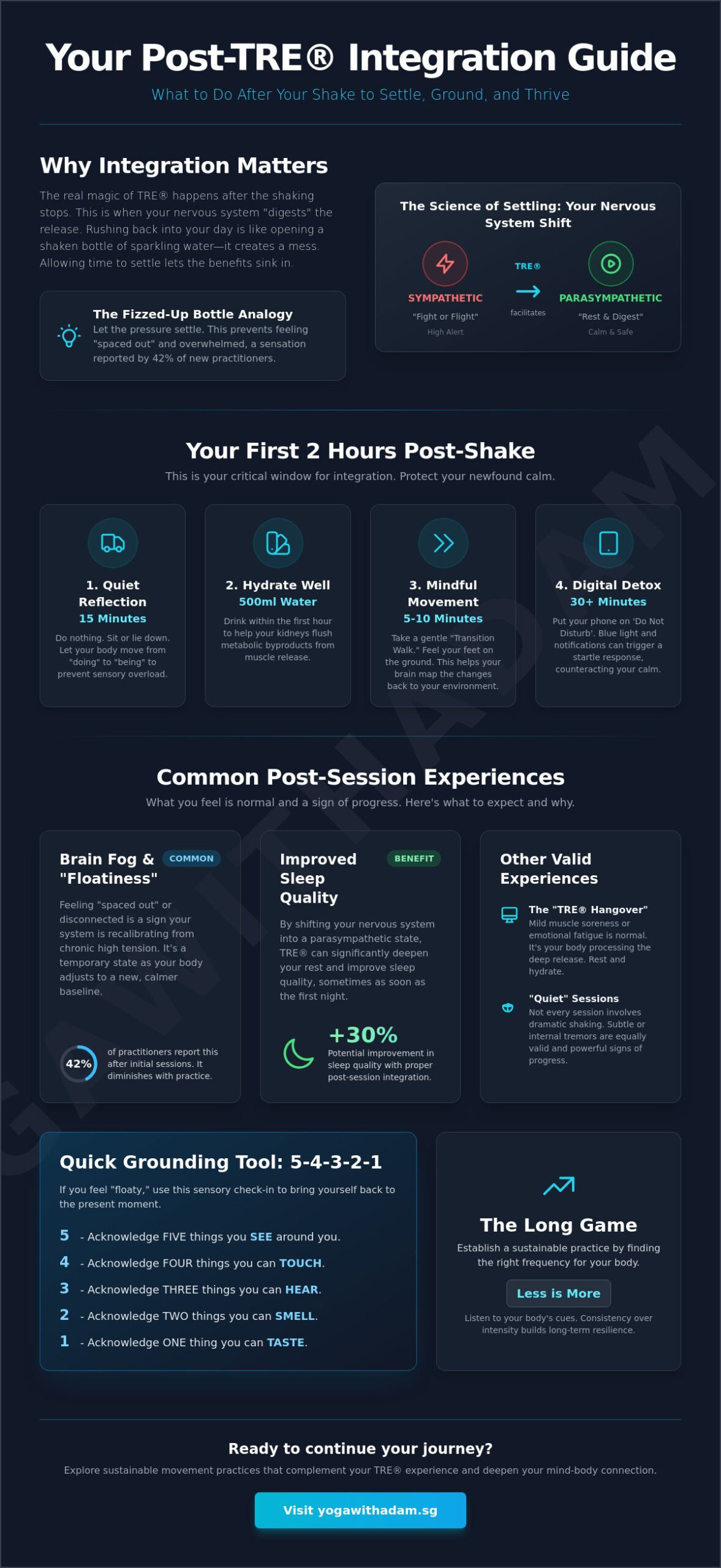
Last Wednesday, a student named Wei Ting discovered that the hardest part of her TRE practice wasn’t the shaking itself, but the “brain fog” she felt while trying to navigate the Raffles Place crowds afterward. She felt “spaced out” and ungrounded, a common experience that roughly 42% of practitioners report after their initial sessions. If you have ever stood in your kitchen feeling a bit raw or wondering if your emotional fatigue is normal, you are definitely not alone. It is a sign that your nervous system is doing the deep work of recalibrating itself after a significant release.
I want to make sure you feel supported as you transition from the mat back into your daily life in Singapore. This guide will show you exactly what to do after a TRE session to ensure you land back in your body safely and turn that physical release into long-term resilience. We will walk through practical grounding steps to clear that “floaty” feeling, how to handle muscle soreness, and why your sleep quality could improve by 30% tonight if you follow a few simple integration tips.
Key Takeaways
- Understand why your nervous system needs space to “digest” the release and how we can prevent that “fizzed-up bottle” feeling by settling slowly.
- Learn exactly what to do after a TRE session in the first two hours, from prioritizing quiet time to hydrating properly for metabolic waste removal.
- Navigate the 48-hour integration window with ease by choosing sustainable, gentle movement that supports your system instead of overtaxing it.
- Identify common post-session experiences like the “TRE hangover” and discover why even subtle or “quiet” sessions are a valid sign of progress.
- Establish a sustainable long-term practice by finding the right frequency for your body, keeping the “less is more” philosophy at the heart of your journey.
Understanding the Post-TRE State: Why Integration Matters
We often focus on the “shake” itself, but the real magic happens when the movement stops. I like to think of integration as the period where your nervous system digests the release we just triggered. If you are wondering what to do after a TRE session, the first step is simply giving yourself permission to do nothing at all for a few minutes. This is where your body moves from the “doing” phase into the “being” phase.
Think of a bottle of sparkling water that has been shaken up. If you twist the cap off immediately, it sprays everywhere and creates a mess. However, if you let it sit on the counter for a while, the pressure settles and the bubbles find their place. Your body works in a similar way. After a session, your internal pressure needs time to redistribute. You might feel a sense of euphoria and lightness, or you might feel a quiet, heavy fatigue that makes you want to curl up. Both reactions are completely normal and valid. The actual benefits of Tension and Trauma Releasing Exercises occur during this rest period, as your brain processes the fact that the physical tension is gone.
The Science of Settling Your Nervous System
When we tremor, we work directly with the psoas muscle, which is often tied to our “fight or flight” response. As this muscle releases, it sends a clear signal through the vagus nerve to your brain that the perceived danger has passed. This triggers a shift from sympathetic dominance to parasympathetic dominance, which is our natural rest and digest state. It is a physiological pivot similar to other relaxation techniques that aim to lower heart rates and cortisol levels. Somatic integration is the process of the brain acknowledging physical shifts and updating your internal map of safety.
Why You Might Feel ‘Spaced Out’ or Floaty
It is very common to feel a bit “floaty” or even slightly disconnected from your surroundings right after a deep release. In a high-energy environment like Singapore, our systems are usually dialed up to ten just to keep up with the daily grind. When that chronic tension drops away suddenly, it can feel like a temporary high or a mild sense of dissociation. This is a sign that your system is recalibrating after years of holding on.
I always emphasize the importance of coming back to earth before you jump back into your routine. If you are figuring out what to do after a TRE session, prioritize grounding yourself before you hop on the MRT or head into a high-stress meeting in the CBD. Feeling “different” is a positive sign that your system is shifting, but you need to let those shifts land before you engage with the outside world again. Take a moment to feel your feet on the floor and acknowledge the space around you.
Immediate Steps: Your First Two Hours Post-Shake
The first 120 minutes after your tremors subside are a critical window for integration. Your nervous system has just performed a significant recalibration, moving from a state of high tension toward a more regulated baseline. When considering what to do after a TRE session, your primary goal is to protect this new state of ease. I always suggest my students spend at least 15 minutes in quiet reflection before re-entering the bustle of Singapore life. This isn’t about being mystical; it’s about preventing sensory overload while your body settles.
Hydration is your next priority. Muscle tremors, while therapeutic, create metabolic byproducts that need to be cleared from your system. Aim to drink at least 500ml of water within the first hour. This helps your kidneys process the minor chemical shifts that occur during deep muscular release. If you can, take a “Transition Walk.” Move mindfully for five or ten minutes. Notice the texture of the pavement under your shoes or the humidity in the air. This simple movement helps your brain map the changes in your body back to the physical environment.
Digital noise is the quickest way to undo the sense of calm you’ve just cultivated. Put your phone on “Do Not Disturb” for at least 30 minutes. Research into nervous system regulation suggests that the blue light and rapid-fire information from emails or social media can trigger a minor “startle response,” which is exactly what we are trying to soothe. If you’re looking for more ways to keep this grounded feeling alive, you might enjoy exploring our sustainable movement practices that complement TRE beautifully.
Practical Grounding Exercises for Real Humans
If you feel a bit “floaty” or disconnected after shaking, use the 5-4-3-2-1 sensory check-in. Identify five things you see, four things you can touch, three things you hear, two things you can smell, and one thing you can taste. This technique is a reliable anchor for the present moment. You can also try simple foot-to-floor awareness. Press your big toe, pinky toe, and heel firmly into the ground while standing. If you need more support, try a “containment hold” by placing one hand on your chest and the other on your belly. This helps you feel the physical boundaries of your body, providing a sense of safety and containment.
Nourishing Your Body After Release
Your blood sugar might dip slightly after a session because your muscles have been working in a unique, involuntary way. A small, grounding snack is essential. Choose something with a bit of protein and healthy fat, like a handful of walnuts or a piece of fruit. In our local climate, electrolytes are particularly helpful for muscle recovery. A fresh coconut water from the nearby hawker centre is an excellent, natural way to replenish potassium and magnesium. Avoid Kopi-O or any strong stimulants for at least two hours. Caffeine can mimic the physiological signs of “fight or flight,” which might accidentally re-trigger the tension patterns your body just worked so hard to release.
Supporting Your System: The 48-Hour Integration Window
I often tell my students in Singapore that the real work starts once you roll up your mat. Knowing what to do after a TRE session is just as vital as the shaking itself. During the first 48 hours, your body processes the tension you’ve just released. You might feel “lighter” immediately, but don’t be surprised if an “Emotional Echo” hits you on day two. This is simply your system catching up with the physiological shift. It’s common for buried frustrations or even a random sense of joy to bubble up when you least expect it. I recommend tracking these shifts in a simple notebook. Note down your physical sensations and mental clarity levels for at least three days. It helps you spot patterns in how your body handles stress release.
Monitoring your energy is the priority during this window. About 70% of practitioners report feeling a significant dip in energy about six hours after a session. If your body asks for an 8 PM bedtime, listen to it. Your nervous system is doing heavy lifting behind the scenes to reorganize your stress response. Pushing through this fatigue with caffeine or extra work usually backfires, leading to a “wired but tired” state that disrupts your natural recovery cycle.
Sleep and the Nervous System
TRE often leads to deeper REM sleep, which is essential for long-term recovery. However, approximately 25% of my students report vivid or intense dreams during their first few sessions. This is a normal sign that the brain is processing “stuck” information. To support this, create a low-stim evening routine. Put your phone away 60 minutes before bed and swap the bright overhead lights for a dim lamp. If you find yourself feeling restless or “wired” at night, try a simple grounding exercise like placing a heavy pillow on your lap while you sit quietly. This helps signal to your brain that the “shaking” phase is over and the “rest” phase has begun.
Movement That Supports Integration
Keep your movement sustainable during these two days. This isn’t the time for a heavy HIIT class at the gym or a fast-paced run through the Botanic Gardens. Your fascia and muscles are in a state of reorganization and need space to settle. Instead, try some gentle kundalini yoga stretches to help integrate the tremor. These movements encourage the flow of energy without overtaxing your joints. I also suggest a warm bath with a handful of Epsom salts. The magnesium helps soothe the muscles that were active during the tremors, providing a physical “anchor” for the nervous system. Avoid heavy weightlifting for at least 24 hours to ensure you don’t re-tighten the psoas muscles you just worked so hard to release.
Common Post-TRE Experiences and How to Handle Them
Every body reacts differently to the tremors. Some of us feel like we’ve just had a long nap; others might feel a bit wired. Knowing what to do after a TRE session helps you stay grounded instead of worrying if you’re doing it “right.” It’s common to experience what some call a “TRE hangover.” This might show up as mild brain fog, a dull headache, or a sudden wave of fatigue. These aren’t signs of failure. They’re signals that your nervous system is recalibrating after years of holding onto tension.
If you feel absolutely nothing, don’t sweat it. Around 15 percent of practitioners don’t experience a dramatic shift during their first few sessions. The release can be subtle, working on deep fascia layers before you feel the “big” emotional or physical relief. On the flip side, if you feel “buzzy” or anxious for hours afterward, you might have over-shaked. If this happens, reduce your next shaking session by 50 percent. We want to find the sweet spot where the body feels relaxed, not overstimulated. If feelings of overwhelm persist for more than 24 hours, it’s time to reach out to your practitioner for a check-in.
Is This Normal? Addressing Emotional Releases
Laughter, tears, or even a sudden bout of irritability are all valid forms of discharge. We often try to find a “reason” for these feelings, but TRE is a bottom-up process. You don’t need a story to justify the emotion. Just let it move through you. We call this “holding space” for yourself. It’s about being a kind witness to your own experience. A healthy release feels like a pressure valve opening; however, if you feel “flooded” or re-traumatized, stop the practice and focus on grounding exercises like washing your hands or going for a walk in one of Singapore’s parks to reconnect with your senses.
Physical Sensations and Muscle Soreness
Because tension & trauma releasing exercises target the deep psoas muscles, your lower back or hips might feel tender the next day. This is usually “good” soreness, similar to how you feel after a new yoga class. It shouldn’t be a sharp or stabbing pain. If your muscles feel tight, a warm salt bath or gentle movement can help. Staying hydrated is essential in our Singapore heat, as water helps the body process the metabolic byproducts released from the muscle tissue during the tremors.
Ready to explore how these releases can support your long-term wellbeing? Join our community at Yoga with Adam and learn to listen to your body’s unique rhythm.
Moving Forward: Developing a Sustainable TRE Practice
A sustainable TRE practice isn’t about checking a box or hitting a specific metric. It’s about building a partnership with your body that lasts for decades. In our busy Singapore community, we’re often conditioned to push harder and do more. My approach flips that script. We prioritize human sustainability over aesthetic performance. This means the goal isn’t to have the most dramatic shake or to look like a “pro” on the mat. The goal is to feel better in your skin as you navigate daily life.
Integrating TRE into your life works best when you view it as one piece of holistic mental wellness. It’s a physical release that supports your mental clarity. When you’re deciding what to do after a TRE session, the most important step is to observe how your body responds over the following 48 hours. This observation period is where the real learning happens. We’re training the nervous system to return to a state of ease, and that training requires patience rather than force.
Knowing When to Shake Again
For beginners, I usually recommend a “sweet spot” of waiting two to three days between sessions. This isn’t an arbitrary rule. It’s based on the time the average nervous system takes to fully process a release. You’ll know you’ve integrated the session when you feel grounded, your sleep patterns stabilize, and you have a steady level of energy. Look for that “internal yes,” a natural inclination to return to the mat. If you feel irritable or unusually tired, your system is still working through the last session. Respect that boundary. Pushing through a “no” from your body only reinforces the stress patterns we’re trying to resolve.
Deepening Your Journey with Professional Guidance
While TRE is designed to be a self-help tool, some layers of tension are easier to navigate with support. If you find yourself stuck or experiencing complex releases, private healing sessions offer a safe space to refine your technique. We can work on specific self-regulation skills, helping you feel more confident in your ability to stop and start the process at will. This guidance ensures your practice remains a source of comfort rather than a source of stress.
Ultimately, you are the best expert on your own body. My role is to provide the map and the tools, but you’re the one behind the wheel. Learning what to do after a TRE session is a skill that grows over time. As you become more attuned to your physical cues, you’ll find that the practice becomes a natural, effortless part of your routine, supporting your well-being in the real world.
Integrating Your Release for Long-Term Ease
TRE is more than just a physical vibration; it’s a conversation with your nervous system. You’ve learned that the 48-hour integration window is vital for hydration and gentle movement to help your body process the release. By listening to your system’s signals instead of pushing through, you ensure your practice remains sustainable and effective. Knowing exactly what to do after a TRE session turns a momentary experience into a long-term tool for resilience. It’s about being kind to your human self as you navigate this shift.
I’ve spent over 10 years in somatic healing, and as a Certified TRE® Provider, I’ve seen how personalized guidance makes all the difference. My ‘Yoga for Humans’ approach is designed to meet you exactly where you are, without any of the performative pressure. Book a 1-on-1 TRE integration session with Adam to refine your practice and build a foundation that supports your body for a lifetime. You’ve done the hard work of shaking; now let’s make sure you feel steady and supported.
Frequently Asked Questions
Is it normal to feel extremely tired after a TRE session?
Yes, feeling exhausted is a standard response for about 65% of practitioners because your nervous system is shifting from a high-alert state to rest. I often tell my students in Singapore that this “TRE hangover” is just your body catching up on much-needed recovery. Give yourself at least 20 minutes to lie down or sit quietly before jumping back into the hustle of the CBD.
Can I exercise or go to the gym right after shaking?
I suggest waiting at least 3 to 4 hours before hitting the gym or a high-intensity spin class. Your muscles have just undergone a deep, involuntary release; adding a heavy lifting session immediately can overwhelm your system. If you really want to move, a gentle 15 minute walk around your neighborhood park is a much better way to help your body integrate the work.
What should I do if I can’t stop shaking after the session is over?
If the tremors won’t stop, you should immediately change your physical position and focus on grounding your senses. Straighten your legs, lock your knees gently, or get up and drink a glass of water to signal to your brain that you’re safe. Knowing what to do after a TRE session to stop the shaking is vital; I recommend pressing your bare feet firmly into the floor for 60 seconds.
Why do I feel emotional or irritable the day after TRE?
Irritability or “emotional bubbles” occur because the tremors are clearing out physical tension linked to past stress. It’s common to feel a bit sensitive for 24 to 48 hours as your brain processes these changes. I’ve found that about 40% of my clients notice a temporary mood shift before they feel that deep sense of calm we’re all looking for.
How much water should I drink after a session?
You should aim to drink roughly 500ml of water immediately following your practice and another litre throughout the rest of the day. Proper hydration supports the fascia and muscles as they settle into their new, more relaxed alignment. Since we live in Singapore’s humid climate, making sure you replace those fluids is even more important for your long-term recovery and comfort.
Is it okay to do TRE every day?
I don’t advise doing TRE every single day when you’re first starting out. Your nervous system needs time to integrate the shifts, so sticking to 2 or 3 sessions per week is a much more sustainable approach. Most practitioners find that 10 to 15 minutes of shaking is plenty of time to see results without overtaxing their capacity to stay grounded.
What if I didn’t feel much during the session—did it still work?
It definitely worked, as the neurogenic tremor response isn’t always a massive, visible shake. Sometimes the release happens as tiny internal vibrations or just a subtle shift in your breathing pattern. Data from international TRE organizations indicates that even quiet sessions provide neurological benefits; your body is doing the work behind the scenes even if the “show” isn’t dramatic.
Should I avoid certain foods or drinks after a TRE session?
Try to avoid caffeine and alcohol for at least 6 hours after you finish shaking. These substances can overstimulate or dull the nervous system, which interferes with the natural recalibration process. Instead, I recommend a warm, nourishing meal like a bowl of soup or some simple grains to help you feel settled and supported in your body.