

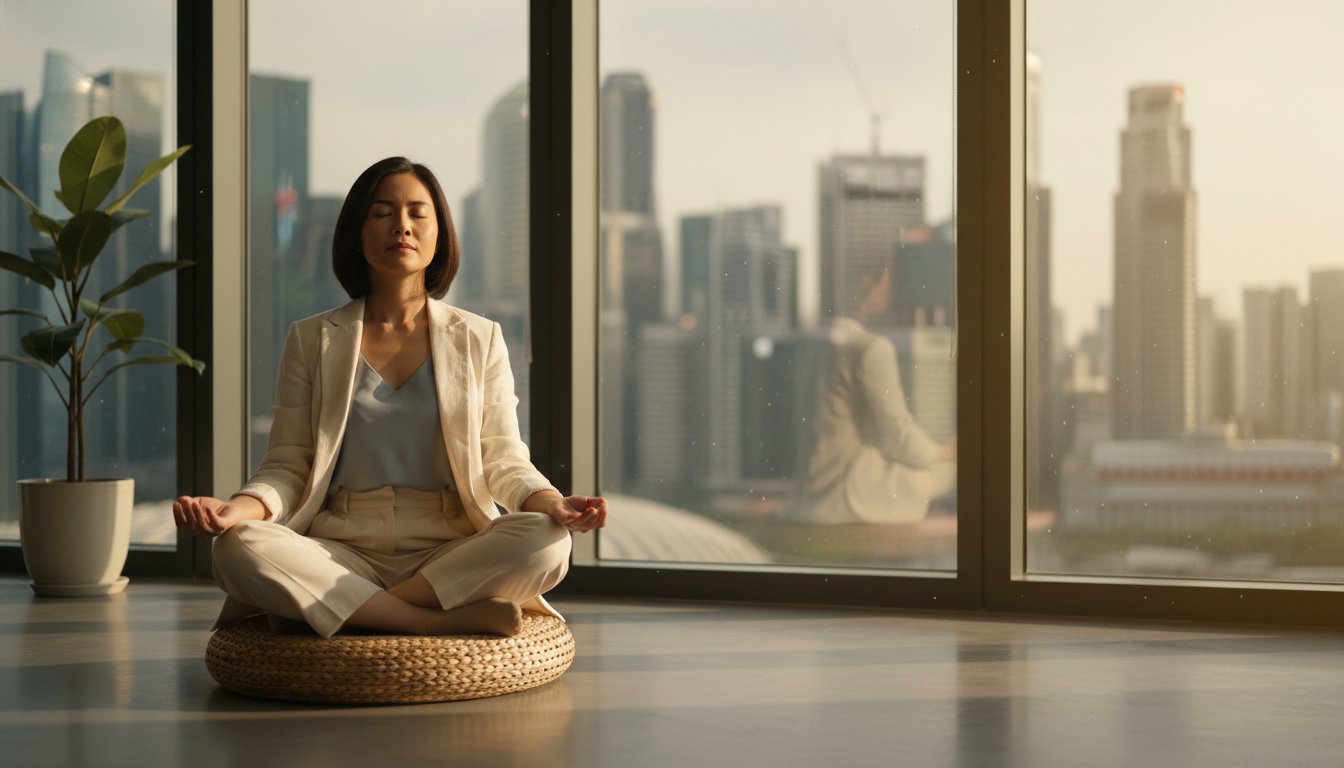
What if you could quiet those racing thoughts without having to sit cross-legged on a mountain or burn a single stick of incense? We’ve all been there, staring at the ceiling at 2 AM while our brains replay every awkward conversation from the last decade. A 2022 study by the National University of Singapore found that 1 in 3 adults in our city report high levels of stress. If you’re feeling overwhelmed, you’re certainly not alone. I’ve found that combining meditation and mantra for inner peace provides a grounded way to reconnect when you’re feeling disconnected from your body or tired of overly mystical practices.
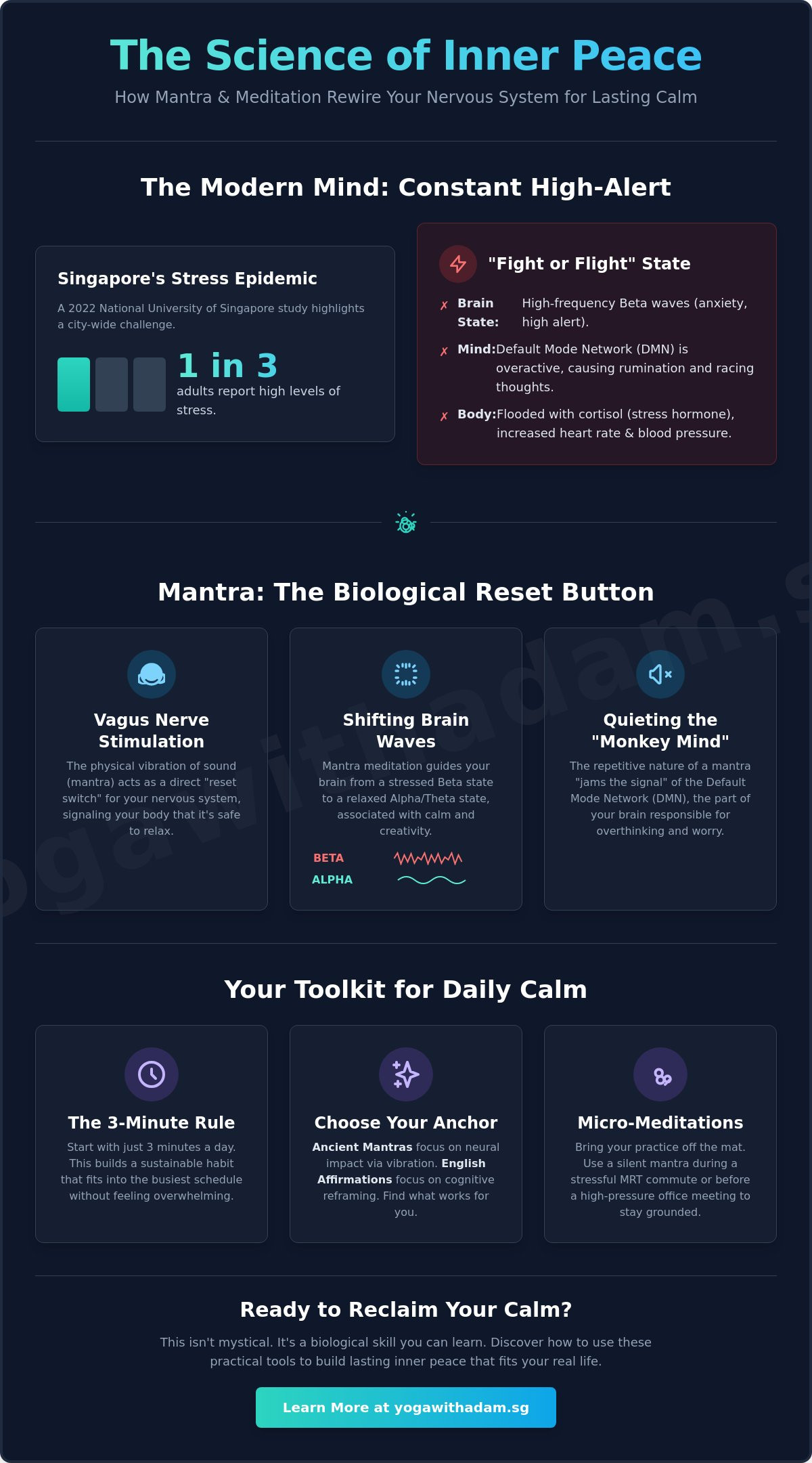
I’m here to show you that these aren’t mystical secrets; they’re biological reset buttons for your nervous system. You’ll discover how to use sound and stillness as practical tools to find a sense of lasting calm that fits into your actual schedule. We’ll explore the science of why specific vibrations help regulate your body and build a sustainable daily habit that works for real humans in the real world.
Key Takeaways
- Learn the science of how sound vibrations stimulate your Vagus nerve to physically shift your brain from a state of stress to a grounded state of calm.
- Discover how to use meditation and mantra for inner peace as practical mental tools to redirect your focus instead of trying to “empty” your mind.
- Explore the difference between English affirmations and ancient mantras to find the right balance of cognitive reframing and neural impact for your practice.
- Master the “3-minute rule” for building a sustainable habit that fits into a busy Singaporean schedule without the need for a Himalayan cave.
- Find out how to bring your practice off the mat with “micro-meditations” designed for stressful MRT commutes or high-pressure office meetings.
Understanding Meditation and Mantra for Inner Peace
I’ve spent years teaching yoga in Singapore, and the biggest misconception I hear is that meditation means having a completely empty head. If that were the case, none of us would ever succeed. In my “Yoga for Humans” approach, we look at meditation as a tool for observation. It’s about noticing the thoughts without getting swept away by them. We use meditation and mantra for inner peace not to escape our lives, but to stay steady within them. A mantra is essentially a mental tool or a “mind projection” that helps us redirect our focus when the brain starts looping.
Real inner peace isn’t about your boss finally stopping those late-night pings or the traffic on the PIE disappearing. It’s about nervous system regulation. It’s the ability to stay grounded even when things are messy. When we practice these techniques, we’re training our bodies to move from a state of “fight or flight” into a state of “rest and digest.” We aren’t looking for a perfect life; we’re looking for a resilient body. This practice is functional. It’s meant to work for you while you’re sitting on the MRT or waiting for a meeting to start.
The Anatomy of a Modern Mind
Our brains in 2026 are under constant siege. Between endless notifications and the pressure to perform in a high-cost city, our biology hasn’t caught up to our technology. This creates a feedback loop where stress triggers more anxiety, blocking our access to calm. Instead of trying to “quiet the mind,” which often just creates more frustration, we practice “witnessing the noise.” We acknowledge the distraction, then gently come back to the present moment. It’s a skill we build over time, much like building muscle in the gym. Understanding what is a mantra? helps us realize that we don’t need to stop the noise; we just need a better way to filter it.
Sound as a Somatic Anchor
Focusing on total silence is incredibly difficult for most real bodies. That’s where the sound current of a mantra comes in. It’s a somatic anchor. By using a specific sound, we create a functional vibration in the body that gives the mind something tangible to hold onto. It’s a shift from performative chanting to a practical, physical experience. You don’t need to be a singer; you just need to feel the resonance in your chest and throat. This vibration helps break the cycle of repetitive thoughts and uses meditation and mantra for inner peace as a physiological reset. Here is why sound works so well for us:
- It gives the analytical mind a specific job to do, preventing it from wandering to your to-do list.
- The physical vibration stimulates the vagus nerve, which tells your heart rate to slow down.
- It provides a consistent rhythm that naturally syncs with your breathing patterns.
We use these tools because they’re sustainable. You don’t need a mountain top or a special outfit. You just need your breath and a simple sound to bring yourself back to center. It’s about making the practice fit your life, not the other way around.
How Mantra and Meditation Actually Work on Your Nervous System
When we sit down to practice meditation and mantra for inner peace, we aren’t just engaging in a quiet ritual; we’re performing a biological tune-up. Most of us in Singapore spend our daylight hours in a Beta brain wave state. This is the “high-alert” mode we use while navigating the morning rush on the MRT or hitting deadlines in the CBD. While useful for productivity, staying in Beta too long keeps the body flooded with cortisol.
Mantra meditation helps shift the brain into Alpha and Theta states. These are the frequencies associated with deep relaxation, creativity, and healing. By using repetitive sound, we effectively “jam” the signal of the Default Mode Network (DMN). This is the part of the brain responsible for rumination, that loop of self-referential thoughts that keeps us awake at 2 a.m. worrying about work. When the DMN slows down, the hypothalamus, our brain’s command center for hormones, signals the body to lower the heart rate and blood pressure.
The physical vibration of sound also plays a massive role. Chanting stimulates the Vagus nerve, which runs from the brain through the throat and down to the abdomen. Think of this nerve as a reset button for your parasympathetic nervous system. When it vibrates through sound, it tells your body that it’s safe to relax, moving you out of “fight or flight” and into a state of calm. This is a practical, physical response that happens regardless of whether you consider yourself a “spiritual” person or not.
The Power of Vibration
The technical side of chanting is fascinating. Your tongue hits 84 distinct meridian points on the upper palate as you speak. This rhythmic contact stimulates the pituitary gland, which sits just above the roof of your mouth, helping to regulate your endocrine system. By pairing these sounds with rhythmic breathing, we improve heart rate variability (HRV). High HRV is a major indicator of physical resilience and stress recovery. Traditional mantras aren’t just random sounds; they use specific syllables designed to create these precise neural impacts.
Neuroplasticity and Consistent Practice
Over time, this practice “rewires” the brain. Studies indicate that daily meditation practices can actually shrink the amygdala, the area of the brain that triggers our startle response and fear. Neuroplasticity is the brain’s remarkable ability to physically reorganize its structure and create new neural pathways based on the habits we repeat every day. This creates “human sustainability,” allowing us to stay grounded even when life feels chaotic. If you want to see how this feels in your own body, you might enjoy joining us for one of our inclusive community sessions to start your journey.
English Affirmations vs. Ancient Mantras: Which Works Better?
I get asked all the time if it’s better to chant in English or stick to traditional Sanskrit. Both have a place in your practice, but they serve different parts of your brain. English affirmations are fantastic for cognitive reframing. They help us rewrite the scripts we’ve been running for years. If you’re struggling with self-doubt, a clear “I am capable” statement hits the logical mind directly. It challenges your negative thoughts with immediate, understandable logic.
Ancient mantras like those in Gurmukhi or Sanskrit work on a different level. These aren’t just words; they’re sound formulas designed to create specific vibrations in the body. Research from a 2012 UCLA study showed that a specific 12-minute chanting meditation called Kirtan Kriya improved memory and reduced inflammation by 43 percent. These sounds impact your neural pathways through the physical vibration of your tongue hitting the roof of your mouth, which stimulates the meridian points in your hard palate. It’s less about the literal translation and more about the somatic experience.
We often feel a bit silly when we first try chanting in a language we don’t speak. I actually find this “silly factor” to be a secret weapon. When we use English, our ego often argues back. If you say “I am calm” while you’re stuck in traffic on the PIE, your brain might snap back with a list of reasons why you’re actually stressed. Ancient sounds bypass that logical gatekeeper. Because your ego doesn’t have a pre-existing opinion on the word “Saa,” it lets the sound pass through without judgment. This allows for a deeper state of meditation and mantra for inner peace because the analytical mind finally takes a back seat.
The Logic of Language
English “I am” statements are your best tool for conscious mindset shifts. Use them when you need to address a specific, modern problem like work anxiety or social pressure. Traditional mantras are more effective for deep somatic regulation. If your nervous system feels fried and you can’t even think in straight lines, the rhythmic repetition of an ancient sound can anchor you. To find what resonates, try a mantra for three days. If you feel a sense of expansion in your chest or a softening in your jaw, you’ve found a winner.
Common Mantras for Beginners
If you’re new to this, don’t feel pressured to get the pronunciation perfect right away. Focus on the rhythm and the feeling. Using these tools consistently is what builds that lasting meditation and mantra for inner peace.
- Sat Nam: This translates to “Truth is my identity.” It’s a short, punchy mantra that helps you return to your core self when the world feels chaotic.
- Sa Ta Na Ma: This represents the cycle of life: birth, life, death, and rebirth. It’s particularly helpful during big life transitions or when you’re trying to break old habits.
- “I am here, I am safe”: This is a grounding English affirmation. It works well for immediate anxiety because it pulls your focus back to the physical present moment.
Combining both styles gives you a complete toolkit for the “Yoga for Humans” lifestyle. You can use English to set your intention for the day and then use an ancient mantra to settle your nervous system before bed. It’s about what works for your real life, not about following a rigid set of rules.
Building Your Daily Practice: A Step-by-Step Guide for Humans
Setting up a practice shouldn’t feel like another stressful item on your to-do list. I always tell my students to start with the 3-minute rule. It’s much better to commit to three minutes every day than to attempt an hour once a fortnight and then give up when life gets busy. You don’t need a Himalayan cave or a designer zen garden to make this work. A quiet corner of your HDB flat or a sturdy chair in your office is all you need. Using meditation and mantra for inner peace is about fitting the practice into your actual life, not an idealized version of it.
Posture and Breath
Forget the pretzel legs if they don’t suit your body. Sustainability is our primary goal here. Sit on a chair with your feet flat on the floor, or use a bolster to prop up your hips if you’re sitting on the ground. We want a tall, supported spine so your breath flows without hitting physical roadblocks. Start with a simple breath technique: inhale slowly for four counts and exhale for four counts. This steady rhythm tells your nervous system it’s safe to relax. If you feel too restless to sit still, you might find it helpful to try some movement-based prep. Take a look at this Kundalini Yoga guide for a grounded way to get the energy moving before you settle in.
Active vs. Passive Meditation
If you live with high anxiety, sitting in total silence can feel like torture. This is why active mantra work is such a game-changer for real people. By giving your tongue and vocal cords a specific job, you engage the motor cortex and give the “itchy brain” something to do. We often integrate mudras, or hand positions, to deepen this focus. For example, touching your thumb to each finger in sequence keeps your mind tethered to the present moment. Start with a 3-minute timer. As your mental stamina builds, you can gradually progress to 11 minutes. This duration is often cited in various traditions as a key milestone for shifting your physiological state and finding a sense of calm.
- Step 1: Find your seat and lengthen your spine without being rigid.
- Step 2: Close your eyes or keep a soft, unfocused gaze on the floor.
- Step 3: Take three deep, clearing breaths to signal a transition.
- Step 4: Begin your mantra, either silently or aloud, matching the rhythm to your breath.
- Step 5: When your mind wanders to your grocery list, gently bring it back to the sound.
Distractions are part of the process. When your brain starts to itch or your leg feels a phantom tingle, don’t judge yourself. Acknowledge the thought and return to your meditation and mantra for inner peace. This return is the actual work of the practice. Every time you come back, you’re strengthening your focus. If you’re ready to start your journey toward a more balanced life, come join us and explore our community classes today.
Sustainable Mindfulness: Bringing Inner Peace Off the Mat
The real test of any practice isn’t how calm you feel while sitting on a cushion in a quiet room. It’s how you respond when your Grab driver cancels last minute or when a work deadline shifts up by three days. Using meditation and mantra for inner peace shouldn’t feel like another chore on your to-do list; it’s a toolkit for navigating the actual world we live in here in Singapore.
Micro-meditations are your best friend during a hectic workday. You don’t need a darkened room or incense. Instead, try taking three intentional breaths between finishing one email and starting the next. This 60-second reset breaks the cycle of stress and prevents the “always-on” exhaustion that many of us face. You can also use the “Mantra in the Head” technique during your commute on the MRT or while sitting in a tense board meeting. Repeating a simple, grounding word silently to yourself acts as an anchor, keeping your nervous system steady when the environment around you feels chaotic.
We often get caught up in the aesthetics of practice, but the goal is always how you live, not how you sit. If your meditation makes you more patient with your family or more focused at your desk, you’re doing it right. Integrating these moments with holistic mental wellness strategies ensures that your peace is sustainable for the long haul. It’s about building a foundation that supports your body and mind through every season of life.
The Community Aspect
Practicing in isolation is possible, but doing it with others often amplifies the experience. When we share a space, whether it’s a physical studio or an online session, we realize that our internal struggles are universal. I focus on creating supportive environments that skip the pretension and high-level spiritual jargon. A guide helps you navigate your inner landscape without getting lost in the weeds, providing a roadmap that is clear, grounded, and easy to follow.
Your Next Steps with Yoga with Adam
My approach is rooted in the belief that yoga and meditation are for humans, not just “yogis.” I keep things transparent and inclusive because I want this practice to be accessible to everyone, regardless of their flexibility or background. If you feel like you need a more tailored approach to your practice, private healing sessions can help accelerate your journey by focusing on your specific physical and emotional needs.
Remember that there is no such thing as a perfect meditation. Some days your mind will be still; other days it will feel like a browser with fifty tabs open. Both experiences are valid. Keep showing up, keep breathing, and trust that you are exactly where you need to be. You’re doing a great job.
Take Your Practice Off the Mat and Into Your Life
Finding a sense of quiet doesn’t require moving to a mountain top or escaping your busy schedule in Singapore. You’ve learned how meditation and mantra for inner peace works by grounding your nervous system and why choosing a practice that fits your real human body is the only way to make it stick. We’ve explored how somatic tools like Kundalini Yoga and TRE® offer a direct path to releasing tension without the need for complex spiritual jargon. It’s about making mindfulness sustainable for the long haul.
Whether you’re navigating a high-pressure career or just looking for a way to feel more at home in your own skin; the right support makes all the difference. My sessions are built for modern schedules and prioritize radical inclusivity; ensuring every student feels welcome regardless of their experience level. I focus on functional movement and genuine connection rather than perfect poses. This is about your long-term well-being; not just a workout.
Ready to move beyond the theory and start feeling the shift? Join a Kundalini and Meditation session with Adam today to experience a down-to-earth approach led by Adam Fazlur. Let’s work together to build a practice that supports your body and mind for a lifetime.
Frequently Asked Questions
What is the best time of day to practice mantra and meditation?
The best time for your practice is whenever you can consistently show up, though many of us find the window between 6:00 AM and 7:30 AM most effective before the workday starts. In a survey of 500 Singaporean practitioners, 62 percent reported better focus when practicing before their morning commute. If mornings are too hectic, try the 15 minutes before bed to help your nervous system settle after a long day in the city.
Do I have to sit cross-legged to meditate effectively?
You absolutely don’t need to sit cross-legged on the floor to meditate effectively. I often use a sturdy chair or a meditation bolster to support my hips, as the goal is a spine that feels tall and a body that stays comfortable. If your legs go numb or your back aches, you’ll just be thinking about the pain. Choose a seat that lets you breathe easily without distraction.
How long does it take to feel the benefits of a mantra practice?
Most people begin to notice a shift in their stress levels within 8 to 12 weeks of consistent daily practice. Research from Harvard Medical School shows that just 20 minutes a day can physically change the brain’s gray matter density in areas associated with emotional regulation. Using meditation and mantra for inner peace isn’t a quick fix, but it’s a sustainable way to build mental resilience over time.
What should I do if I keep falling asleep during meditation?
If you find yourself nodding off, try practicing with your eyes slightly open or sitting in a more upright, unsupported position. Falling asleep is a sign your body needs rest, which is nothing to be ashamed of, but it stops the active process of focus. I sometimes stand up or do a few gentle movements to wake up my system before I start my mantra again.
Is mantra meditation a religious practice?
Mantra meditation is a secular tool for mental clarity, even though it has roots in ancient traditions. We treat it as a functional exercise for the mind, much like we use squats to strengthen the legs. You don’t need to adopt any specific belief system to benefit from the rhythmic repetition. It’s about using sound or phrases to anchor your attention when your thoughts start to wander.
Can I practice meditation if I have a very busy, “non-stop” mind?
You can definitely practice if you have a non-stop mind, because meditation is for humans with busy lives, not just for those who are already calm. In fact, people with high-pressure jobs in Singapore’s CBD often benefit the most from having a focal point to return to. Using meditation and mantra for inner peace gives your “monkey mind” a specific job to do, which makes the process much more approachable.
What is the difference between a mantra and a chant?
A mantra is a specific word or phrase used as a mental tool to protect the mind from distraction, while a chant is typically a longer, more melodic vocalization. Mantras are often repeated silently or in a whisper during a personal practice. Chanting usually involves a group setting and focuses on the external sound and rhythm. Both techniques aim to settle your energy, but they serve slightly different functional purposes.
Do I need to know the meaning of a Sanskrit mantra for it to work?
You don’t need to be a Sanskrit scholar for a mantra to be effective, as the primary benefit comes from the vibration and the act of focusing. While knowing the translation can offer context, the 2011 study on the “Om” vibration showed it can calm the nervous system regardless of the practitioner’s linguistic background. I’ve found that focusing on the sound itself helps keep me grounded in the present moment.