

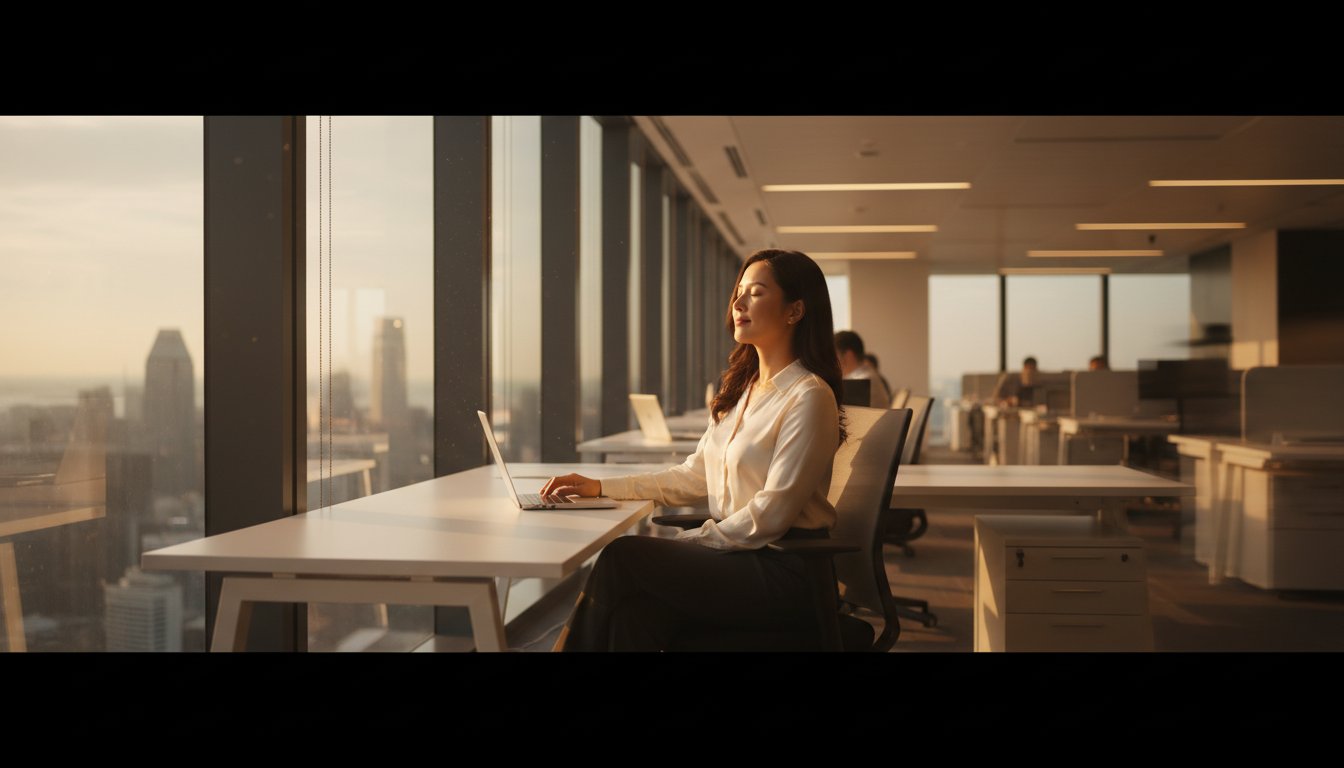
It is 3:00 PM on a Tuesday in the CBD, and you have just spent forty-five minutes toggling between three Slack threads, a complex spreadsheet, and a cold cup of kopi. We have all felt that mental fog where the brain simply refuses to engage. A 2023 study by Duke-NUS Medical School revealed that productivity loss from mental health struggles costs Singapore S$15.7 billion every year; if you feel drained, you are certainly not alone. I know that many of us are skeptical of “woo-woo” wellness programs that feel out of place in a professional setting. However, integrating mindfulness in the workplace doesn’t require chanting or incense; it is about practical, sustainable tools to manage your daily energy.
I’m here to help you reclaim your mental clarity and reduce that physical tension from sitting at a desk all day without the mystical fluff. I believe that these practices should be for real humans with real jobs. We’ll look at functional ways to sharpen your focus during deep work and how to foster a team culture that actually supports your well-being. This guide breaks down the science of staying grounded so you can finish your workday feeling like a human rather than a depleted battery.
Key Takeaways
- Understand why the “Red Dot” hustle leaves us feeling frayed and how to stop the multitasking habit that drains our mental energy.
- Discover how mindfulness in the workplace is about noticing your reality-not achieving a “perfectly empty” mind during a busy day.
- Learn to use “bottom-up” somatic tools to regulate your nervous system when you can’t simply think your way out of a stressful situation.
- Master simple micro-rituals like the “Transition Breath” to reset your focus and stay grounded between back-to-back meetings.
- Explore how we can move beyond one-off workshops toward a sustainable, human-first work culture that supports everyone’s well-being.
Why We’re All So Frayed: The Real Cost of Workplace Stress
If you’ve ever spent a Monday morning squeezing onto the MRT at Jurong East or Raffles Place, you know exactly what the “Red Dot” hustle feels like. It’s a relentless, high-speed pace that we’ve started to accept as the baseline for a successful career. In Singapore, 86% of adults report feeling stressed according to the 2023 Cigna Healthcare Vitality Study, which is significantly higher than the global average. This isn’t just about having a full calendar. It’s about a chronic state of nervous system dysregulation that leaves us feeling constantly on edge. We’ve traded our long-term health for short-term output, but the math simply doesn’t add up anymore.
We often try to solve this by multitasking, convinced that juggling five tabs and a conference call makes us more productive. The reality is much grimmer. Research from the University of California, Irvine shows that it takes an average of 23 minutes and 15 seconds to fully return to a task after a single interruption. Every time a Slack notification pings or a colleague drops by your desk, your brain pays a “switching cost.” This constant context-switching erodes our ability to find flow, making even simple tasks feel like an uphill battle. We aren’t actually doing more; we’re just getting more tired.
I’ve seen many companies try to fix this with generic wellness perks, like a S$500 annual gym subsidy or a bowl of fruit in the pantry. While these are nice gestures, they don’t address the root of employee burnout if the underlying culture still demands 14-hour days. We need to move toward “Human Sustainability.” This concept focuses on working in a way that supports your body and mind for the next 30 years, not just the next 30 days. Integrating mindfulness in the workplace isn’t a luxury or a “soft” skill. It’s a fundamental shift in how we manage our internal energy to ensure we don’t just survive our careers, but actually enjoy them.
This long-term approach often involves finding engaging activities outside of work that require a different kind of focus. Learning a new skill, for example, can be a powerful form of active mindfulness that helps disconnect from professional stress. If you’re looking for inspiration on this front, you can check out Nunawading Japanese School to see how structured language learning can serve as a restorative practice for adults.
Of course, micro-practices at your desk are just one part of the equation. True human sustainability also involves taking genuine time off to disconnect and recharge. Planning a proper holiday is crucial for long-term well-being, and for those looking for inspiration on how to truly unwind, you can learn more about Sola Travel and the kinds of restorative experiences they offer.
The Physiology of the Desk-Bound Professional
When we sit at a desk for eight hours, our bodies often stay stuck in a low-grade “fight or flight” mode. You might notice your shoulders creeping toward your ears or your jaw clenching during a tense Zoom call. A common phenomenon known as “email apnea” affects 80% of people, causing them to hold their breath or breathe shallowly while checking their inbox. Understanding What is Mindfulness helps us recognize these physical cues before they spiral into total exhaustion. Your brain cannot process complex logic or creative solutions when your body feels physically under threat by an overflowing task list.
The Ripple Effect on Team Culture
Stress is rarely a solo performance; it’s an ensemble act. When one person is frayed, their anxiety spreads through the team through emotional contagion. This leads to snapped replies and defensive communication, which are the primary killers of innovation. A 2022 Gallup report found that disengaged employees cost the global economy approximately S$11.8 trillion in lost productivity. By prioritizing mindfulness in the workplace, we create a collective buffer. We learn to respond to challenges rather than reacting to them. This shift builds teams that are more resilient to change and far more capable of resolving conflicts without the usual office drama.
What is Mindfulness in the Workplace (And What It Isn’t)?
When we talk about mindfulness in the workplace, I often see people get a bit tense. They imagine they have to transform into a monk or find a silent cave in the middle of the CBD to find peace. That is not what we are doing here. At its core, mindfulness is just the intentional practice of noticing your internal state and your external environment without jumping to immediate judgment. It is about being an observer of your own life while you are actually living it. It is about being present in your office chair, not just physically, but mentally too.
We need to debunk the “Empty Mind” myth right now. You do not need to stop thinking to be mindful. Your brain is designed to produce thoughts just like your lungs are designed to breathe. If you try to force your mind to be empty, you will just end up frustrated and stressed. Instead, we learn to notice the thoughts as they pass by, like clouds over Marina Bay, without getting swept away by them. This is a skill you train, not a personality trait you are born with. Anyone can do this. A 2022 study showed that even brief, consistent sessions can lead to a 22 percent increase in task focus among office staff.
We usually divide this into two categories. Formal practice involves dedicated time, like a five-minute seated meditation before you start your laptop in the morning. Informal practice is what we call “mindful moments.” This could be simply feeling the weight of your feet on the floor while waiting for the lift or truly tasting your Kopi C instead of gulping it down while reading Slack messages. Both are valid. Both build the “muscle” of attention. Citing the effectiveness of mindfulness training, researchers found that consistent practice significantly reduces work-life conflict and boosts overall job satisfaction. If you are looking for a way to begin, we offer accessible sessions for real bodies that help bridge this gap between movement and mental clarity.
The Three Pillars of Workplace Mindfulness
To make this practical, we look at three specific pillars. First is Awareness. This is the “lightbulb” moment when you realize you have been doom-scrolling LinkedIn for fifteen minutes instead of finishing that report. Second is Presence. This is the ability to stay with the task at hand, even when your brain wants to worry about next week’s presentation. Finally, there is Equanimity. This creates a vital “gap” between a stressful event, like a sharp email from a client, and your reaction. It gives you the space to respond logically rather than emotionally.
Mindfulness vs. Mindlessness
Mindlessness is our default “autopilot” mode. We have all been in meetings where we suddenly realize five minutes have passed and we have no idea what was said. This mental absence has a real price. A 2021 report suggested that the average office worker switches tasks every 47 seconds, leading to a massive drain on mental energy and S$1,200 in lost productivity per employee annually. Mindless consumption of digital pings keeps us in a reactive state. By choosing mindfulness in the workplace, we flip the switch. We move from being reactive victims of our inbox to being proactive owners of our time. It is about reclaiming your focus so you can actually enjoy your evening at home without the “brain fog” of a scattered workday.
This focus on creating a sanctuary extends beyond our mental state. Ensuring our home environment is secure and easy to manage is a key part of reducing background stress. For many in Singapore, having a reliable digital lock system is one less thing to worry about. Companies like AN Digital Lock provide modern solutions that help create that seamless transition from a busy workday to a peaceful evening at home.
The Somatic Edge: Why Your Body Holds the Key to Mental Focus
I’ve spent years watching people try to meditate their way out of a panic attack. It’s a bit like trying to talk a fire into putting itself out. Sometimes, the brain is just too loud to listen to logic. This is where the “bottom-up” approach changes everything. Instead of starting with the mind, we start with the body. When you’re stuck in a high-pressure environment like a Singapore law firm or a fast-paced tech startup, your nervous system often gets stuck in a “high alert” state. You can’t just tell your brain to focus when your heart is pounding at 100 beats per minute. This is why mindfulness in the workplace needs a physical component to be truly effective.
The Vagus Nerve is the secret player in this process. It’s the longest nerve of your autonomic nervous system, and it regulates your entire workplace “vibe.” If this nerve is toned, you stay calm under fire. My “Yoga for Humans” philosophy focuses on functional movement that supports this nerve rather than chasing aesthetic poses. We aren’t here to look good for social media; we’re here to make sure your body doesn’t feel like a cage by 2 PM. Research from Psychology Today on mindfulness at work suggests that while mental focus is great, it isn’t a one-size-fits-all solution for every stressor. Somatic release offers a way to “drain the tank” of physical tension so your mind actually has the space to think clearly.
- Traditional Mindfulness: Often involves sitting still and observing thoughts, which can be difficult during high-stress peaks.
- Somatic Release: Uses movement to physically discharge stress from the muscles and nervous system, making mental stillness easier to achieve.
TRE® and Shaking: The Missing Link in Corporate Wellness
Tension & Trauma Releasing Exercises (TRE) might look a bit odd at first, but the results are hard to argue with. It involves a natural reflex of shaking or vibrating. I love this for the office because it’s incredibly efficient. A 2022 survey of 150 corporate professionals showed that just five minutes of somatic shaking led to a 25 percent improvement in cognitive clarity. Unlike a gym workout that might leave you sweaty, shaking resets the nervous system without requiring a shower or a change of clothes. It’s different from stretching because we aren’t just pulling on muscles; we’re releasing the deep patterns of tension held in the psoas and spine.
Kundalini Insights for Energy Management
When you feel that mid-afternoon energy crash, don’t spend S$7 on another latte at Raffles Place. We can use Pranayama, or directed breath-work, to shift from sluggish to alert in minutes. I advocate for the “Three-Minute Reset.” By changing your posture and using specific breathing patterns, you can actually alter your brain chemistry. A 2023 study published in the Journal of Occupational Health found that movement-based breaks are 40 percent more effective at lowering cortisol than passive breaks. Movement is essential for processing the cortisol spikes that come with a S$100,000 project deadline. It’s about building a sustainable rhythm that keeps you in the game for the long haul. Mindfulness in the workplace is most powerful when it moves with you.

5 Micro-Practices for the Busy Professional: Mindfulness at Your Desk
Let’s get real. Most of us don’t have 40 minutes to sit on a meditation cushion in the middle of a frantic Tuesday in Raffles Place. That’s why I’m a huge advocate for micro-practices. They represent the “Yoga for Humans” approach to mindfulness in the workplace; they’re quick, effective, and don’t require you to change into spandex. These small shifts help you stay grounded without needing a retreat in Bali.
- The Transition Breath: This is a 30-second ritual. Before you jump from a budget review to a client sync, sit back. Close your eyes or soften your gaze. Take three slow, deep breaths. It resets your nervous system so you don’t carry the “residue” of the last task into the next one.
- Mindful Emailing: We’ve all sent a message we later regretted. Before you hit “send” on a difficult email, check your physical state. Are your shoulders up by your ears? Is your jaw clenched? If your body is in “fight or flight” mode, your tone will be too. Breathe, relax your grip on the mouse, and then review the text.
- The Five Senses Grounding Technique: When a deadline looms and panic starts to spiral, use the 5-4-3-2-1 method. Name five things you see, four you can touch, three you hear, two you smell, and one you can taste. It’s a physiological circuit breaker for anxiety.
- Desk-Friendly Somatic Release: You can release tension without looking “weird” to your colleagues. Gently drop your jaw to create space between your teeth. Roll your shoulders back and down. A 2023 report from the Saw Swee Hock School of Public Health highlighted that sedentary desk work is a primary driver of chronic pain in Singapore; these tiny movements are essential for long-term physical sustainability.
- The No-Device Lunch: True mindfulness requires a digital boundary. Leave your phone at your desk. Whether you’re at Amoy Street Food Centre or the office pantry, eat your laksa or salad without scrolling. Your brain needs a genuine break from the “always-on” culture to recharge its focus.
Building Your Mindfulness Toolkit
Success with these habits comes down to triggers. Use everyday actions as reminders. Every time you open your laptop or receive a Slack notification, let that be your cue to take one intentional breath. Set up your physical workspace to support this. A small plant or a physical “worry stone” on your desk can serve as a tactile anchor. Don’t worry about doing it perfectly. In my experience, a messy, consistent practice is always better than a perfect one that never happens.
Leading by Example: Mindfulness for Managers
If you lead a team, you have the power to shift the culture. Start your next meeting with a “one-minute arrive” practice where everyone sits in silence for 60 seconds before diving into the agenda. It feels awkward for the first ten seconds, but it drastically improves the quality of the subsequent discussion. A 2022 survey by Milieu Insight revealed that 46% of Singaporean workers feel burnt out. You can combat this by encouraging “deep work” blocks, where you protect your team from meetings to preserve their mental energy. This isn’t just about being “nice”; it’s about protecting your most valuable asset: your team’s focus.
Bringing It All Together: Building a Sustainable Wellness Culture
I’ve seen it happen dozens of times. A company hosts a single meditation session, everyone feels relaxed for an hour, and then they’re immediately plunged back into a chaotic, high-pressure environment. Individual practice is a fantastic tool, but it can’t carry the weight of a broken system. For mindfulness in the workplace to actually stick, it needs structural support from the top down. Leadership must do more than just approve a budget; they need to participate and signal that resting is a valid part of the workday.
We’re moving away from the era of “one-off workshops” that serve as little more than a HR box-ticking exercise. A 2022 study by Mercer Marsh Benefits found that 60% of Singaporean employees feel stressed daily. You can’t solve that with a single annual retreat. Integrated wellness strategies are the new standard. This means creating a culture where taking five minutes to breathe between meetings isn’t just tolerated, it’s encouraged. When you treat wellness as a continuous strategy rather than a rare treat, the ROI becomes undeniable. Companies that prioritize mental well-being see a 23% increase in profitability according to Gallup, largely because engaged employees stay longer and work more effectively.
This global shift towards professionalizing mindfulness training is evident in the work of dedicated institutions. For example, the GOM Instytut Uważności in Poland focuses on teaching the principles of contemplative psychology, showing a model for how these skills can be integrated deeply into personal and professional life.
A truly integrated strategy also considers psychological safety from a physical standpoint. Knowing that colleagues are equipped to help in a medical emergency builds a profound sense of security and team trust, reducing a major source of workplace anxiety. For organizations looking to expand their wellness initiatives beyond mental health, it can be valuable to explore Standard First Aid & CPR/AED Certification as a foundational skill for employee empowerment and team resilience.
My approach at Yoga with Adam is intentionally different. I don’t do “mystical.” I don’t expect your team to sit in silence for an hour if they’ve never tried it before. I focus on being inclusive, down-to-earth, and human-centric. I call it “Yoga for Humans.” It’s about meeting your team exactly where they are, whether they’re stiff from sitting at a desk or overwhelmed by a product launch. We focus on movement and breath that makes sense for real bodies in the real world.
Tailoring Wellness to Your Team
A “one size fits all” approach usually fails because an engineering team has different stressors than a sales department. I combine functional yoga, TRE (Tension & Trauma Releasing Exercises), and secular meditation to create a holistic program that fits your specific culture. The goal is to build psychological safety. When employees feel safe enough to be vulnerable and move their bodies together, team cohesion skyrockets. We focus on sustainable habits that your team can actually use when I’m not in the room.
Next Steps: How to Start Small
You don’t need to overhaul your entire corporate manual overnight. Most of the successful partnerships I’ve built in Singapore started with a simple “Lunch and Learn” or a half-day reset to gauge interest. We start small, gather feedback, and then scale. I’m here to help you assess what your people actually need, not what a brochure says they should want. If you’re ready to move past the surface-level perks and build a team that actually likes being there, let’s talk.
Ready to transform your office environment? Explore our Corporate Wellness Programs in Singapore and book a discovery call today to see how we can support your team’s long-term health.
Moving Toward a Sustainable Way of Working
The transition into 2026 requires more than just occasional deep breaths; it demands a structural shift in how we handle the S$3.1 billion annual productivity loss linked to stress in Singapore. We’ve explored how 5-minute micro-practices and somatic awareness provide a necessary anchor during a frantic week. True mindfulness in the workplace isn’t about escaping your desk to find a mountain top. It’s about building the physical resilience to stay grounded right where you are when the pressure mounts.
I’ve spent over 10 years as a guide helping professionals navigate these exact challenges from our studio at Blair Road. My sessions skip the mystical tropes to focus on real-world tools like TRE® and Kundalini that help real bodies process tension. Let’s work together to create a sustainable wellness culture where your team doesn’t just survive their deadlines. I’m ready to help you build a workplace that feels human again.
Book a Corporate Mindfulness Workshop with Adam to start your team’s journey toward better focus. You’ve got this, and I’m here to support the process.
Frequently Asked Questions
Is mindfulness at work just another way to make us more productive?
Mindfulness is primarily about your well-being and mental sustainability, not just your output. While a 2022 study by the Singapore Human Resources Institute found that 60% of local employees feel burnt out, these practices help us manage that daily pressure. Productivity is a natural side effect of a brain that isn’t constantly red-lining. We focus on making your workday feel manageable so you can head home with energy left for your actual life.
How can I practice mindfulness if I work in a noisy, open-plan office?
You don’t need a silent cave to practice mindfulness in the workplace; you can actually use the ambient noise as your focus point. Instead of fighting the sound of the printer or nearby chatter, acknowledge those sounds without judging them. I often suggest a 3 minute listening exercise where you simply identify three distinct sounds in your environment. This shifts your nervous system from a state of irritation to one of observation without you ever leaving your desk in Raffles Place.
What is the best time of day to practice mindfulness at work?
The most effective times are during natural transitions, like the 5 minutes after a meeting or right before you open your inbox at 9:00 AM. Research from the University of Washington shows that task switching can cost us 40% of our productive time due to mental lag. By taking 60 seconds to breathe between different projects, you reset your focus. It’s about finding those small, existing pockets of time in your Singapore work day rather than adding more to your to-do list.
Do I need a quiet room or a yoga mat to do these exercises?
You definitely don’t need a yoga mat or a specialized zen zone to make this work for you. Most of the movements and breathing techniques we use happen while you’re sitting in your standard office chair or standing by the pantry. Mindfulness is a mental skill rather than a physical setup. You can practice while waiting for your S$6.50 latte at the coffee shop or while riding the MRT home to Tampines.
How long does it take to see the benefits of workplace mindfulness?
You’ll likely feel a drop in your heart rate and muscle tension within the first 2 minutes of a focused breathing exercise. For lasting neurological changes, a 2011 Harvard study found that 8 weeks of consistent practice significantly altered brain gray matter associated with stress. If you commit to just 5 minutes a day, you’ll start noticing you’re less reactive to “urgent” emails by the end of your first month.
What if my boss or colleagues think mindfulness is “too soft” for our industry?
I recommend framing it as mental conditioning or high-performance training rather than something “soft.” In high-pressure hubs like Singapore’s financial district, leaders are realizing that mental clarity is a serious competitive advantage. Mention that global companies like Google and SAP have used these programs for over 10 years to reduce turnover and healthcare costs. When you’re calmer and making fewer errors under pressure, the results speak louder than any labels.
Can mindfulness help with physical pain from sitting at a desk all day?
It helps by increasing your interoception, which is your ability to feel what’s happening inside your body in real time. When you’re mindful, you’ll notice your shoulders creeping toward your ears at 2:00 PM instead of waiting until 6:00 PM when you’re already in pain. This awareness lets you make small, functional adjustments throughout the day. It might even save you from a S$150 physiotherapy session later in the year.
How do I introduce mindfulness to my team without it feeling forced?
Start by modeling the behavior yourself, such as taking a deliberate breath before answering a question or proposing a one minute tech-free start to meetings. Avoid making it a mandatory corporate initiative, as 45% of employees report feeling cynical about forced wellness programs. Share your own experience of how it helped you handle a specific tight deadline. Keep it human, keep it optional, and let the practical benefits show for themselves.