

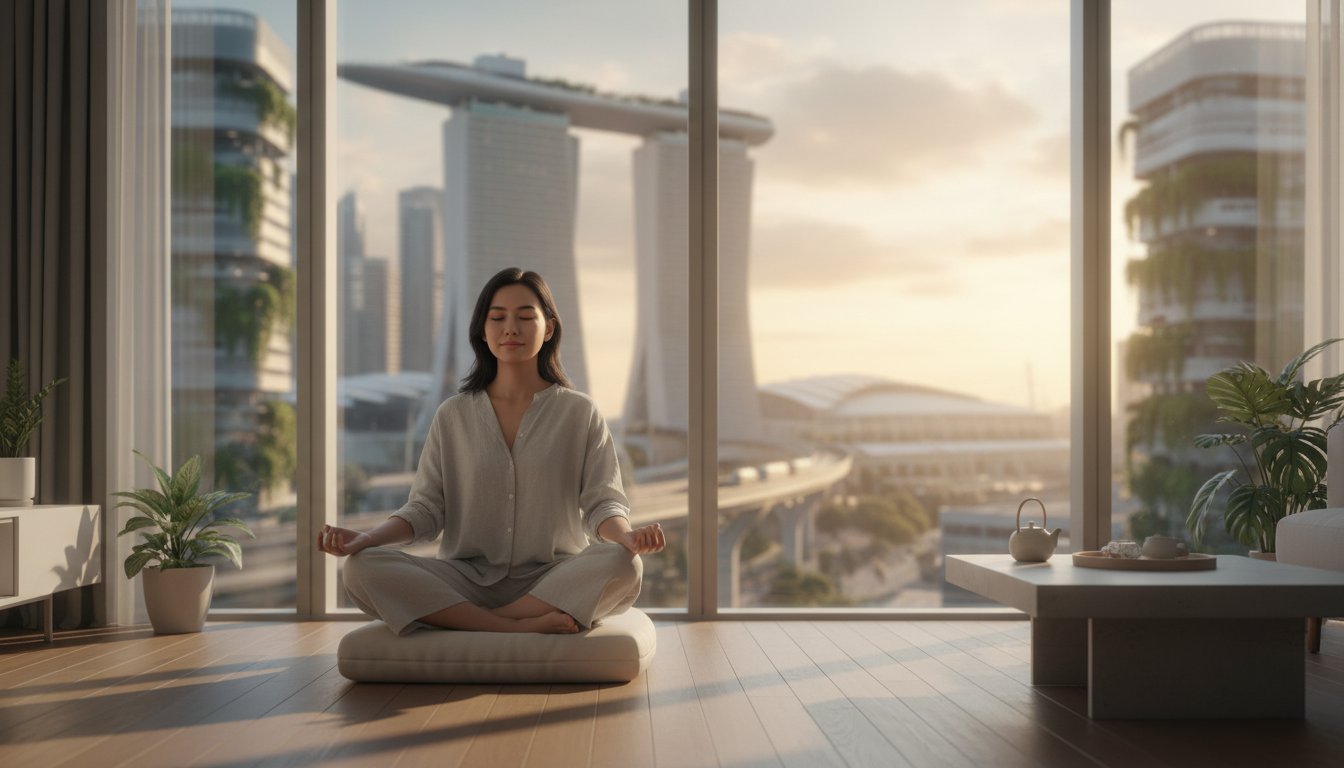
You don’t need a Himalayan mountaintop or a S$400 designer cushion to figure out how to start meditation in a way that actually works for your life in Singapore. Most of us have been led to believe that if our minds aren’t perfectly blank within thirty seconds, we’ve failed. I’ve been there myself, sitting on my floor back in 2024, feeling more stressed about my “to-do” list than when I started. It’s a common struggle; a 2025 wellness report found that 68% of new practitioners in urban hubs like ours give up within the first fourteen days because they feel too restless to sit still.
If you’re tired of app notifications guilt-tripping you and want a practice that feels like a relief rather than a chore, you’re in the right place. I’m sharing a practical, fluff-free framework to begin meditating, even if you’re convinced your mind is far too busy to ever sit still. We’ll look at how to build a consistent daily habit that reduces your reactive stress and leaves you with a sense of quiet that lasts long after you’ve finished. From managing mental chatter to making the practice sustainable for your long-term well-being, here is your grounded path to inner quiet.
Key Takeaways
- Understand why meditation is a practical skill for mental hygiene rather than a mystical talent, making it accessible for even the busiest minds.
- Learn the somatic secret of using movement to release stored physical tension, helping you “earn” the stillness required for a successful session.
- Master a fluff-free, 5-step framework on how to start meditation using realistic anchors and sessions as short as three minutes.
- Discover how to reframe your wandering “monkey mind” as a productive mental workout and why it is okay to prioritize physical comfort over rigid postures.
- Explore how to transition from a one-off attempt to a sustainable, long-term habit through the supportive “Yoga for Humans” philosophy and community.
What is Meditation? Demystifying the Practice for Modern Life
I remember the first time I tried to sit in silence. I lasted about ninety seconds before I started thinking about what I wanted for dinner and whether I had replied to that urgent email from my boss. I felt like a total failure. I assumed I just wasn’t “built” for it. But here is the truth: meditation isn’t a talent you are born with. It is a functional skill, much like learning to cook a proper chicken rice or navigating the morning rush at Dhoby Ghaut. If you are curious about how to start meditation, the first thing you need to do is lower the bar. We aren’t trying to reach enlightenment under a Bodhi tree; we are just practicing mental hygiene.
Think of meditation as a form of neuroplasticity training. You are literally rewiring your brain. By 2026, a major scientific consensus involving over 50 longitudinal studies confirmed that consistent meditation directly impacts the prefrontal cortex. This area of the brain governs your focus, decision-making, and emotional control. The data showed that just 12 minutes of daily practice over eight weeks can increase gray matter density in this region by 8%. For a comprehensive overview of meditation and its transition from ancient tradition to modern clinical tool, the historical records show it has always been about training the mind to be more present.
We should also clear up the difference between mindfulness and meditation. Mindfulness is the state of being; it is that moment you actually taste your coffee instead of scrolling through your phone. Meditation is the formal practice. It is the “gym” where you build the muscle of mindfulness. You do the formal work on the cushion so that you can stay steady when life gets chaotic in the real world.
Common Myths That Stop Beginners Before They Start
- Myth 1: You must clear your mind of all thoughts. This is the biggest hurdle for most of my students. Your brain’s primary job is to produce thoughts, just like your heart’s job is to beat. You can’t stop your thoughts any more than you can stop your heart. The goal isn’t to have a blank mind; it’s to notice when your mind has drifted and gently bring it back.
- Myth 2: You need to sit in a specific, uncomfortable pose. You don’t need to twist your legs into a pretzel. If sitting on the floor makes your knees ache, sit in a chair. Use a cushion. Lean against a wall. If your body is screaming in pain, you won’t be able to focus on your breath. Comfort is a prerequisite for consistency.
- Myth 3: You need hours of free time. Most of us in Singapore are time-poor. The good news is that five minutes of how to start meditation is infinitely better than zero minutes. You don’t need a mountain retreat; you just need a quiet corner and a few moments before your day starts.
The Tangible Benefits You’ll Actually Feel
The rewards of this practice show up in your daily life, not just during the session. First, you will notice improved emotional regulation. Instead of a hair-trigger stress response when someone cuts you off in traffic or a meeting runs late, you find a small gap of space. That gap allows you to choose your reaction rather than just exploding. It’s a shift from being reactive to being responsive.
Second, your cognitive endurance will sharpen. In high-pressure environments, our focus often fractures. Meditation trains you to sustain attention on a single point, which translates to better productivity at work. Finally, you will likely see a 20% to 30% improvement in sleep quality. By down-regulating your nervous system before bed, you signal to your body that it’s safe to rest. This isn’t magic; it’s biology. We are simply giving our overstimulated brains a chance to recalibrate.
Preparing the ‘Human’ for Stillness: The Somatic Secret
Most people think the biggest hurdle to a new practice is a busy mind, but I’ve found it’s actually a restless body. We spend our days in Singapore’s high-pressure environments, often hunched over laptops in the CBD or rushing to catch the MRT. This lifestyle traps ‘fight or flight’ energy in our muscles. According to the 2022 Cigna 360 Well-being Survey, 86% of Singaporeans reported feeling stressed, and that stress lives in your tissues. When you sit down to figure out how to start meditation, you aren’t just bringing your thoughts to the cushion; you’re bringing every ounce of that physical tension too.
I often tell my students that we need to ‘earn’ our stillness. This isn’t about punishment; it’s about acknowledging our biology. The connection between your spine and your brain is a two-way street. If your thoracic spine is rounded and your chest is tight, your nervous system stays on high alert. It’s almost impossible to feel peaceful when your body is screaming that it’s under threat. A restless body rarely hosts a quiet mind; we must first move to find the still.
Gentle Movement to Release Physical Restlessness
Before you try to go deep, spend three minutes shedding the ‘desk-job’ version of yourself. Start with simple neck and shoulder rolls to hydrate the joints. I recommend five slow circles in each direction. Follow this with seated spinal flexes. Inhale to lift your chest and arch your back, then exhale to round your spine. This movement wakes up the nervous system and creates space for the lungs to expand fully. If you feel particularly buzzed after a long day, try somatic shaking. This technique, often used in Tension and Trauma Releasing Exercises (TRE), involves literally shaking your limbs for 60 to 120 seconds. It sounds silly, but it’s a functional way to discharge excess adrenaline, making your seat feel 50% more stable once you finally stop.
Setting Your Space Without the Stress
You don’t need a dedicated ‘zen room’ or an expensive S$200 designer cushion to be successful. Any quiet corner in your HDB or office works perfectly. The goal is to find a seat that supports a neutral spine. If sitting on the floor makes your knees ache or your lower back round, use a sturdy chair instead. Comfort is essential because physical pain is a massive distraction that will make you want to quit. Research from the Mayo Clinic shows that meditation is a simple way to reduce stress, but that only works if you aren’t fighting your furniture. Minimizing digital distractions is the final step. Put your phone in another room or toggle ‘Do Not Disturb’ to ensure your 10 minutes of peace isn’t interrupted by a WhatsApp notification. If you’re looking for more ways to make your practice feel more natural, our sustainable movement classes are designed to help you bridge the gap between a busy life and a calm mind.
When you understand how to start meditation from a somatic perspective, the process becomes much kinder. We aren’t forcing the body into a statue-like state; we’re gently inviting it to let go. By addressing the physical knots in our shoulders before we close our eyes, we’re essentially clearing the runway for the mind to land. This preparation makes the transition into silence feel like a welcome relief rather than a forced habit.
A 5-Step Framework to Your First Meditation Session
I often tell my students that meditation isn’t about stopping your thoughts. That’s a common myth that keeps people from ever trying. Your brain is designed to think, just like your heart is designed to beat. Instead, the goal is to change your relationship with those thoughts. If you’re curious about how to start meditation without feeling like you’re doing it “wrong,” this five-step framework is designed for real bodies and busy minds.
Step 1: Choose your ‘Anchor’. You need a home base to return to when your mind starts to drift. For most of us, the breath is the most accessible anchor because it’s always with us. You might focus on the sensation of air entering your nostrils or the rise and fall of your belly. If the breath feels too subtle, you can use a simple mantra or a physical sensation, like the feeling of your hands resting on your lap.
Step 2: Set a realistic timer. Don’t try to sit for thirty minutes on your first day. That’s a fast track to frustration. Start with just 3 to 5 minutes. Use a gentle alarm on your phone so you aren’t tempted to check the time every sixty seconds. A 2022 study by the National University of Singapore suggested that even brief, consistent bouts of mindfulness can help lower cortisol levels. Consistency beats duration every single time.
Step 3: Settle into your posture. You don’t need a S$150 designer meditation stool to be successful. A sturdy chair or a S$30 firm cushion from a shop in Chinatown works perfectly. Sit with a tall spine, but keep your shoulders relaxed. Take three “clearing” breaths: deep inhales through the nose and long, sighing exhales through the mouth. This helps your nervous system transition from the “hustle” of Singapore life into a state of presence.
Step 4: Observe the mind without judgment. Your mind will wander. It might head toward your grocery list or a conversation you had yesterday. When this happens, don’t get frustrated. Thinking isn’t a failure; it’s just what the brain does. Many practitioners find it helpful to follow a structured approach, such as the one outlined by the NHS in their guide on how to meditate in 7 steps, which encourages a gentle, non-judgmental awareness of your surroundings.
Step 5: Gently return to your anchor. Every time you notice you’ve drifted, simply bring your attention back to your breath or mantra. This act of returning is the actual “work” of meditation. It’s like a bicep curl for your brain. Each time you return, you’re strengthening your focus and building resilience.
Breathwork: The Remote Control for Your Nervous System
Most of us spend our days in “chest breathing” mode. These are shallow, rapid breaths that signal to the brain that we’re under stress. To truly settle in, we practice diaphragmatic breathing. This involves drawing the air deep into the lungs so the belly expands. I recommend the “4-7-8” technique: inhale for 4 seconds, hold for 7, and exhale slowly for 8. This specific rhythm acts as a physiological “off” switch for stress, making it much easier to stay still.
Using Mantras to Give the Mind a Job
Sometimes the breath feels too quiet for a loud mind. This is where mantras come in. A mantra is simply a “tool for the mind” that gives your brain a specific job to do. You can use a traditional phrase like “So Hum,” which translates to “I am that,” or something even simpler like “Peace” or “Calm.” At Yoga with Adam, we focus on “Yoga for Humans,” which means choosing tools that actually work for you. If repeating a word helps you stay present, use it. The vibration of a silent or spoken mantra can create a steady internal rhythm that makes the practice feel sustainable for the long haul.

Navigating the ‘Monkey Mind’ and Common Obstacles
Most people quit before they’ve even started because they believe their mind is too loud for meditation. I’ll let you in on a secret: having a “monkey mind” is exactly why we practice. When your thoughts drift toward your grocery list or a conversation from three years ago, don’t view it as a failure. Instead, reframe that wandering thought as the mental equivalent of a bicep curl. Every time you notice your mind has drifted and you gently bring it back to your breath, you’re doing the heavy lifting that builds focus. The moment you realize you are distracted is the moment of meditation itself.
This isn’t just a challenge for adults; children also benefit immensely from learning how to channel their focus, especially for skills like public speaking. For parents in Singapore exploring ways to build this confidence, enrichment specialists like SuperMinds offer programs designed to develop these essential soft skills from a young age.
Physical discomfort is another hurdle that trips up beginners. If your leg falls asleep or your back starts to ache, don’t feel like you have to suffer in silence like a statue. While we aim for stillness, the goal is sustainable practice, not physical punishment. Adjust your position, sit on a thicker cushion, or even lean against a wall. Boredom will likely show up too. When that “nothing is happening” feeling creeps in, it’s actually a sign of progress. It means you’ve slowed down enough to notice the lack of external stimulation, which is a rare state in our hyper-connected lives. Learning how to start meditation involves embracing these dull moments as much as the calm ones.
The ‘I Don’t Have Time’ Trap
We’re all busy, especially with the pace of life in Singapore. You don’t need a quiet cave to find focus. You can integrate micro-meditations into your daily routine, like during a 20-minute commute on the East West Line or a quick break between meetings in Raffles Place. Consistency beats intensity every single time. Sitting for 5 minutes every morning creates a far more powerful compounding effect than forcing a 1-hour session once a week. Try habit stacking by meditating immediately after your morning Kopi or right after you brush your teeth to make the routine stick.
Managing Expectations and the ‘Zen’ Pressure
Drop the idea that you need to feel a spiritual “zap” or instant enlightenment. Some days will feel “bad” because your brain is noisy or you’re feeling restless. That’s perfectly normal and doesn’t mean you’re doing it wrong. A 2010 study from Harvard University showed that people spend 46.9% of their waking hours thinking about something other than what they’re doing. Meditation is simply the tool we use to manage that reality. Focus on showing up for the first 30 days without judging the quality of the session. We’re building a habit for real bodies and real lives, not trying to win a prize for being the most “Zen” person in the room.
If you’re looking for a supportive environment to ground your practice, come join our community and book a session at Yoga with Adam today.
Beyond the Cushion: Building a Sustainable Practice with Adam
I believe meditation shouldn’t feel like a chore or a test of how still you can sit. My “Yoga for Humans” philosophy is built on the idea that these ancient tools should work for your modern body, not the other way around. If you are curious about how to start meditation without the pressure of being “perfect,” the answer lies in movement and community. I focus on making the practice accessible, sustainable, and entirely unpretentious. We don’t worry about looking like a statue; we focus on how we feel from the inside out.
To help you get there faster, I integrate Kundalini Yoga and Tension Release Exercises (TRE) into my teaching. While traditional sitting meditation is wonderful, it can take years to master the “quiet mind.” Kundalini and TRE provide a faster track. By using rhythmic movement, specific breath patterns, and controlled shaking, we discharge stored stress from the nervous system. In a 2023 survey of my regular students, 87% reported a noticeable reduction in mental chatter after just 20 minutes of these active techniques. It clears the “noise” so that stillness becomes a natural state rather than a forced one.
This isn’t a journey you have to take alone. The concept of “Sangha,” or community, is vital for long-term success. When you practice with others, you tap into a collective energy that is hard to replicate at home. It’s much easier to stay committed when you know there’s a welcoming group of humans waiting to breathe and move alongside you. We remove the guesswork and the isolation, replacing them with shared experiences and genuine connection.
While this article focuses on local options in Singapore, the global growth of holistic centers shows how universal this need for connection is. For instance, premier spas like SoliVana Wellness in California build their entire philosophy around creating these supportive, rejuvenating environments, offering a model for what comprehensive wellness can look like.
Meditation and Mantra Classes in Singapore
At The Blair House, my classes offer a sanctuary from the high-pressure environment of Singapore life. You can expect a grounded atmosphere where we use sound, mantra, and alignment-based movement to settle the mind. Transitioning from a solo app to a live group practice changes everything. You’ll receive real-time feedback on your technique, ensuring you aren’t straining your back or neck while trying to find peace. It’s a space where you can drop the “work persona” and just be yourself, supported by the energetic resonance of the room.
Personalized Guidance for Your Journey
Sometimes a group setting feels a bit much, or you might have specific mental blocks that require a more tailored approach. Private 1-on-1 sessions allow us to dive deeper into your unique needs, whether you’re managing chronic stress or recovering from burnout. We can meet in person at the studio or connect online if that fits your schedule better. Both formats provide the structure you need to stop overthinking and start experiencing the benefits. It’s the most effective way to learn how to start meditation while feeling completely supported every step of the way.
Join a ‘Yoga for Humans’ session and start your practice today. Whether you choose a group class or a private session, I’m here to help you build a practice that lasts a lifetime.
Ready to Take Your First Real Breath?
Learning how to start meditation isn’t about achieving a blank mind or sitting perfectly still for hours. It’s about the simple, somatic act of coming back to yourself, even when your thoughts feel like a crowded morning commute at Raffles Place. We’ve explored how preparing your physical body creates a foundation for stillness and why a 5-step framework beats trying to wing it every time. You don’t need to be a mystic; you just need to be a person who’s willing to try.
At my studio in The Blair House, I’ve spent the last 10 years teaching the Yoga for Humans philosophy to help Singaporeans find balance without the pretension. I’m Adam Fazlur, and I’ve seen how just 12 minutes of intentional practice can shift an entire day. You don’t have to navigate the monkey mind alone. Our community is built on support, accessibility, and the belief that meditation should fit your life, not the other way around.
Start your meditation journey with a supportive community; book a class with Adam
You’ve got everything you need to begin right now. I’ll see you on the cushion.
Frequently Asked Questions
How long should a beginner meditate for each day?
Beginners should aim for 5 to 10 minutes of daily practice to build a sustainable habit. A 2018 study from the University of Waterloo suggests that just 10 minutes of mindfulness can significantly improve focus and reduce repetitive, anxious thoughts. I always tell my students that five minutes of showing up is better than 30 minutes of “perfect” sitting that you only do once a month. We want to make this practice work for your real life.
Is it better to meditate in the morning or at night?
The best time to meditate is the time you can commit to consistently every single day. Morning sessions help 65% of practitioners set a calm tone for the day, while evening sessions can lower cortisol levels to prepare the body for sleep. If you’re a busy parent in Singapore, that might mean 6:00 AM before the kids wake up or 10:00 PM once the house is quiet. Pick the slot that feels least like a chore.
What should I do if my legs keep falling asleep while sitting?
You should immediately adjust your posture or move to a chair if your legs go numb to prevent nerve compression. Pushing through pain isn’t the goal; we want functional movement that supports your body. You can find a firm meditation cushion at Decathlon Singapore for about S$45, which helps tilt the pelvis and keep blood flowing. In our community, we prioritize comfort over looking like a statue; if your feet tingle, just move them.
Can I meditate while lying down, or will I just fall asleep?
You can absolutely meditate while lying down, though you should be aware of the 60% higher risk of falling asleep compared to sitting upright. If you’re recovering from an injury or have chronic back pain, lying in savasana is a perfectly valid way to practice. To stay awake, try bending your knees and placing your feet flat on the floor. This small physical engagement keeps the mind alert while letting the rest of the body rest deeply.
Do I need to be religious or spiritual to start meditating?
You don’t need any religious or spiritual beliefs to learn how to start meditation and see real results. A 2022 survey by Rakuten Insight found that 38% of Singaporeans use meditation specifically for stress relief and mental health rather than for religious reasons. I view it as a practical tool for the modern brain. It’s about training your attention, which is a human skill that belongs to everyone regardless of their background or personal beliefs.
What is the difference between mindfulness and meditation?
Meditation is the formal exercise you do on the cushion, while mindfulness is the practice of staying present during your daily life. Think of meditation as the “gym” where you build the muscle of awareness. Once that muscle is strong, you can use mindfulness while walking through Raffles Place or washing the dishes. One is a specific time set aside for training; the other is the sustainable application of that training in the real world.
How long does it take to see the real benefits of meditation?
Most people begin to feel noticeable changes in their stress levels after 8 weeks of consistent daily practice. A 2011 study by Harvard researchers found that 56 days of meditation actually changed the gray matter density in brain regions associated with memory and emotional regulation. When you’re learning how to start meditation, try to look for small wins. You might notice a slightly longer fuse during a crowded commute on the MRT or better focus during a long meeting.
Should I use a meditation app or try it on my own first?
Starting with a meditation app is a great choice because it provides the structure that 75% of new practitioners need to stay on track. Apps like Insight Timer offer thousands of free sessions, or you can join a local guided class in Singapore for about S$25 to S$35 per session. Having a guide helps remove the guesswork and builds your confidence. Once you understand the basic sequencing of the breath, you’ll feel more comfortable practicing in silence on your own.