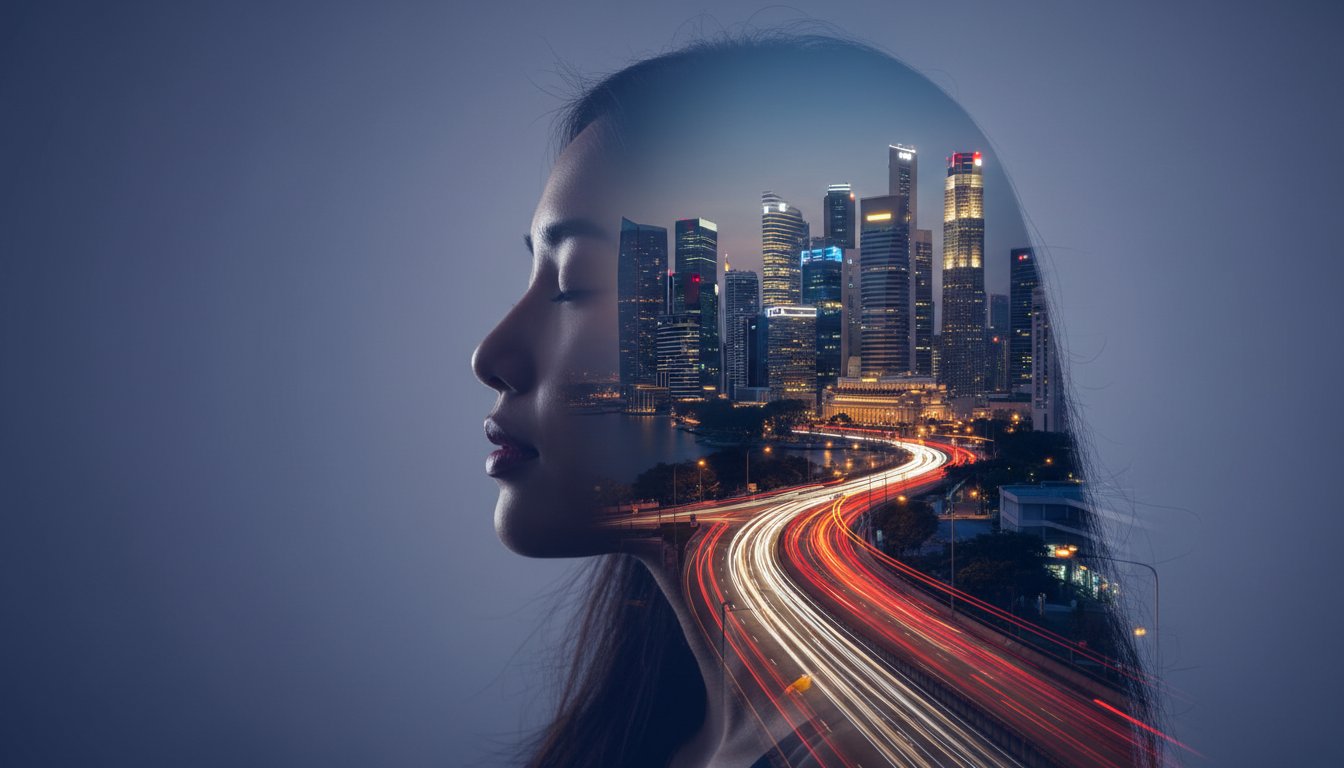
If someone tells you to “just relax” while your heart is hammering at 115 beats per minute during a morning rush at Raffles Place, you have every right to feel frustrated. We’ve all been there, trapped in that physical loop where your chest tightens and your breath feels like it’s stuck in your throat. It’s a physiological response that affects about 10% of adults in Singapore, and simply wishing it away doesn’t work. I’ve spent years learning that the right breathing exercises for anxiety aren’t about reaching a mystical state; they’re about hacking your biology to regain control.
I agree that being told to “take a deep breath” feels dismissive when you’re actually struggling to catch one. You deserve tools that respect your experience rather than ignore it. In this guide, I’ll share practical, science-backed techniques to help you regulate your nervous system and drop your heart rate within 60 seconds. We’re exploring a toolkit of “invisible” exercises you can use anywhere, from a crowded MRT carriage to a high-pressure meeting, so you can understand exactly why your body reacts this way and how to lead it back to calm.
Key Takeaways
- Understand the biological “hack” behind how your breath communicates with your Vagus nerve, and why some common advice can actually backfire during a panic moment.
- Master the “Exhale Secret” to shift your body into “Rest and Digest” mode using effective breathing exercises for anxiety that prioritize your parasympathetic nervous system.
- Get step-by-step instructions for the Physiological Sigh and Box Breathing-two practical, “Yoga for Humans” tools to drop your heart rate fast, even in high-pressure situations.
- Learn how to “micro-dose” calm by stacking 2-minute breathwork habits into your daily Singaporean routine, like waiting for the MRT or boiling the kettle.
- Explore what to do when breathing isn’t enough by discovering how somatic practices like TRE® help release tension stored deep in your psoas and fascia.
Why Breathing Exercises for Anxiety Actually Work (and Why They Sometimes Don’t)
When you’re feeling that familiar tightness in your chest or a racing heart during a busy day in Singapore, someone usually tells you to “just take a deep breath.” It sounds simple, but for many of us, that advice feels dismissive. I want to start by validating what you’re feeling right now. Anxiety isn’t just a mental loop; it’s a physiological event happening in your nervous system. Your body is stuck in a “fight or flight” response, and your brain is simply reacting to the signals it’s receiving from your organs. It isn’t “all in your head,” it’s a physical state that requires a physical solution.
The secret to shifting this state lies in your Vagus nerve. This is the longest of your 12 cranial nerves, and it acts as the primary communication highway between your brain and your heart, lungs, and gut. About 80 percent of the fibers in the Vagus nerve are sensory. This means they carry information from the body up to the brain, rather than the other way around. When you change how you breathe, you aren’t just trying to think happy thoughts; you’re sending a physical signal to your brain that the danger has passed. Using breathing exercises for anxiety is essentially a way to hack your own biology.
The Science of the Vagus Nerve
Think of your Vagus nerve as your body’s internal reset button. By engaging in slow, rhythmic patterns, we increase our “vagal tone,” which helps us recover from stress more quickly. A 2018 study published in Frontiers in Human Neuroscience found that slow breathing at a rate of roughly 6 breaths per minute significantly improves heart rate variability. Vagus Nerve Stimulation is the core mechanism of respiratory-based anxiety relief. This practice builds long-term resilience, making your nervous system more sustainable for the long haul.
Your inhales and exhales work like a seesaw. The inhale is the gas pedal, linked to the sympathetic nervous system which revs you up. The exhale is the brake, linked to the parasympathetic nervous system which slows you down. If you want to slow the car down, you have to spend more time on the brake. This is why Conscious breathing is such a powerful tool; it allows us to manually override an automatic system that has gone into overdrive.
Why ‘Just Breathe’ Can Be Bad Advice
If you’re in the middle of a panic attack, a “deep breath” often means a big, sharp inhale into the upper chest. This is called thoracic breathing. It actually signals more danger to your brain. When you over-inhale, you risk hyperventilation. This leads to a drop in carbon dioxide levels in your blood, which can cause dizziness and more heart palpitations. This is the Anxiety Paradox: trying to fix the breath with more air can actually make the panic feel 20 percent worse. We’ve all been there, and it’s a frustrating cycle to be in.
Instead of focusing on pulling air in, we need to focus on letting it out. I call this the “Exhale-First” philosophy. In a high-pressure environment like Singapore, where a 2023 Cigna Healthcare survey showed that 86 percent of adults feel stressed, we need tools that actually work without causing more distress. By emptying the lungs completely, you create space for a natural, diaphragmatic breath to follow. This approach ensures that breathing exercises for anxiety become a reliable support system rather than another source of pressure. We’re looking for progress, not perfection, in every breath we take together.
The ‘Exhale Secret’: Hacking Your Parasympathetic Nervous System
Your nervous system operates like a seesaw. On one side, you have the Sympathetic Nervous System, your “fight or flight” response. This is the mode that keeps you alert during a presentation in the CBD or when you’re rushing to catch the MRT. On the other side sits the Parasympathetic Nervous System (PNS), often called the “rest and digest” mode. In a 2022 Cigna 360 Well-being Survey, 86% of respondents in Singapore reported feeling stressed, which suggests most of us are stuck on the “fight” side of that seesaw far too often.
The fastest way to tip the scales back toward calm isn’t through positive thinking; it’s through the breath. Specifically, it’s about the exhale. When you inhale, your heart rate actually speeds up slightly. When you exhale, the Vagus nerve sends a signal to your brain to slow the heart down. This is why effective breathing exercises for anxiety often focus on the out-breath. By making the exhale longer than the inhale, you’re essentially hacking your biology to force a relaxation response.
There’s also a bit of chemistry involved. Many people believe that anxiety is caused by a lack of oxygen, but it’s often the opposite. When we’re stressed, we tend to over-breathe, which dumps too much Carbon Dioxide (CO2) from our blood. We actually need CO2 to help release oxygen from our hemoglobin into our brain and muscles. This is known as the Bohr Effect. If you don’t have enough CO2, your brain doesn’t get the oxygen it needs, making you feel lightheaded and even more anxious. Keeping your breaths “low and slow” helps maintain that crucial CO2 balance.
You can identify your current state with a simple check. Place one hand on your chest and the other on your belly. Take a normal breath. If your top hand moves first or most, you’re “chest breathing.” This shallow pattern uses the neck and shoulder muscles, which signals to your brain that you’re in a state of emergency. If your bottom hand moves, you’re using your diaphragm, the primary muscle designed for breathing. Switching from the chest to the belly can result in a 20% reduction in perceived stress levels within just a few minutes.
The 1:2 Ratio Principle
The 1:2 ratio is simple math for your nervous system. The goal is to make your exhale exactly twice as long as your inhale. This specific rhythm tricks the brain into believing the environment is safe because a body in danger never breathes this way. For example, you can inhale for a count of 3 and exhale for a count of 6. If that feels too short, try a 4-count inhale and an 8-count exhale. This technique is one of the most reliable breathing exercises for stress because it provides an immediate physical anchor for a racing mind. Incorporating these breathing exercises for anxiety into your daily commute can change the trajectory of your entire day.
Diaphragmatic Breathing: The Foundation
Your diaphragm is a large, dome-shaped muscle located at the base of your lungs. When you inhale properly, it flattens and moves downward, pushing your abdominal organs out of the way. This is why your belly should expand. To see if your diaphragm is “locked” from chronic stress, try this 30-second check: sit tall and place your hands on your lower side-ribs. Inhale deeply. If your ribs don’t move outward into your palms, your diaphragm is likely tight. Focus on breathing “low and slow” into those side-ribs rather than pulling the air up into your collarbones. At our studio, we practice these sustainable movement techniques to help students reconnect with their natural breathing mechanics, ensuring the body feels supported rather than strained.
3 Simple Breathing Techniques You Can Use Anywhere
I’ve spent years teaching yoga to people who feel like they don’t fit the typical “yoga mold.” Whether you’re squeezed onto a crowded MRT train during peak hour or prepping for a high-stakes meeting in the CBD, these tools are for you. Using breathing exercises for anxiety shouldn’t feel like a chore; it should feel like a relief. These techniques work because they target your biology, not just your mindset.
The Physiological Sigh: The Emergency Brake
This is my favorite tool for immediate relief. A 2023 study published in Cell Reports Medicine by researchers at Stanford University found that the physiological sigh is the most effective breathing pattern for improving mood and reducing resting heart rate. It’s the body’s natural way of offloading carbon dioxide. You’ve probably done this unconsciously after a long sob or a stressful day.
To do it, take a deep breath in through your nose until your lungs feel almost full. Instead of exhaling, take a second, shorter “sip” of air to fully expand the tiny air sacs in your lungs called alveoli. These sacs often collapse when we’re stressed, which limits gas exchange. By popping them open with that second inhale, you allow for a much more efficient exhale. Finish with a long, slow sigh through your mouth. Repeat this three times to feel your heart rate drop almost instantly.
Box Breathing for High-Performance Calm
You might have heard this called the Navy SEAL method. Mark Divine, a former SEAL commander, popularized this technique because it helps operators stay sharp while under extreme physical pressure. It’s not just for soldiers, though; it’s perfect for when you’re about to give a presentation or enter a difficult conversation. The secret lies in the “hold.”
- Inhale through your nose for a count of 4.
- Hold your breath for a count of 4.
- Exhale through your mouth for a count of 4.
- Hold your breath empty for a count of 4.
The breath retention phases help reset your carbon dioxide levels, which signals to your brain that you’re safe and in control. If a 4-second count feels too long, start with 2 or 3 seconds. The goal is consistency, not intensity. These breathing exercises for anxiety are about building a sustainable practice that supports your nervous system over the long term.
Straw Breathing: The Invisible Exercise
If you’re in a public space and don’t want to look like you’re practicing “yoga,” straw breathing is your best friend. It’s a subtle way to lengthen your exhale without drawing attention. Simply inhale normally through your nose. When you exhale, purse your lips as if you’re breathing out through a very thin straw. This creates back-pressure in the lungs, which naturally slows down the breath and activates the vagus nerve. It’s a gentle way to calm the “hot” anxious mind while you’re sitting at your desk or walking through a mall.
Alternate Nostril Breathing (Nadi Shodhana)
In the world of Kundalini Yoga, this is often wrapped in mystical language about energy channels. In our “Yoga for Humans” approach, we look at it as a way to balance the left and right hemispheres of the brain. It’s incredibly grounding. Use your right thumb to close your right nostril and inhale through the left. Close the left nostril with your ring finger, release the thumb, and exhale through the right. Inhale through the right, close it, and exhale through the left. This rhythmic crossing helps focus a scattered mind. It provides a cooling effect that is especially welcome in our humid Singapore weather, helping you feel centered and steady in less than two minutes.

Building a Sustainable Practice: How to Make Calm Your Default State
I often tell my students that the best practice is the one you actually do. We tend to overcomplicate things. We think we need a S$150 designer mat and a silent room to find peace. That’s not real life in Singapore. Real life is loud, fast, and usually involves a crowded commute. I advocate for the “micro-dosing” approach. Spending 120 seconds on your breath is infinitely more effective than planning a 60-minute session you never actually start. Consistency beats intensity every single time.
Think of it as training a muscle. You wouldn’t try to learn to drive in the middle of a Formula 1 race. Similarly, learning breathing exercises for anxiety is nearly impossible if you only try it during a high-stress meeting. You have to practice when you’re feeling okay. A 2023 study published in Scientific Reports found that consistent, short-duration breathwork can reduce baseline cortisol levels by up to 25 percent over a four-week period. By practicing in low-stakes moments, you’re building the neural pathways that make “calm” your body’s default setting rather than a rare luxury.
Most of us can’t find an extra hour in our day, but we all have “dead time.” This is where habit stacking becomes your best friend. Pair your breathwork with everyday Singaporean activities. Try taking five deep, conscious breaths while you’re waiting for the MRT at Raffles Place. Focus on your diaphragm while the kettle boils for your morning kopi. These tiny windows of awareness bridge the gap between “doing yoga” and living mindfully. They remind your nervous system that it’s safe even when the world around you is moving at 100 kilometers per hour.
The 2-Minute Morning Reset
Your first 10 minutes after waking up dictate your nervous system’s “set point” for the entire day. Your body naturally spikes cortisol to wake you up, a process known as the Cortisol Awakening Response. If you immediately check your work emails, you’re pouring petrol on that fire. I stay in bed for just two minutes to focus on my breath. This simple routine moves you from “alarm clock cortisol” to a state of steady focus. It’s sustainable because it requires zero equipment. You don’t need a perfect yoga studio; your mattress and a quiet moment are enough to start the day on your own terms.
Evening Wind-down for Better Sleep
Sleep quality is a major concern in our city. A 2019 survey by Philips found that 35 percent of Singaporeans don’t get enough rest, often due to racing thoughts. Anxiety at night prevents the deep, slow-wave sleep required for emotional regulation. I use the “4-7-8” technique to signal to my brain that the workday is over. Inhale for 4 seconds, hold for 7, and exhale through the mouth for 8. Evening breathwork acts as a clearing of the cache for the day’s stressors. It helps you process the day so you don’t wake up at 3:00 AM ruminating on a conversation you had at lunch.
See how we integrate these sustainable tools into every session at Yoga with Adam.
Taking the Next Step: Somatic Healing Beyond the Breath
Sometimes, even the most effective breathing exercises for anxiety feel like they’re hitting a physical wall. That’s usually because stress isn’t just in your head or your lungs; it’s physically trapped in your tissues. The psoas muscle, often called the “muscle of the soul,” is a primary storage site for the “fight or flight” response. When we’re chronically stressed, this deep core muscle stays contracted. It keeps the nervous system on high alert regardless of how deeply we inhale. Fascia, the connective tissue wrapping around our muscles, also tightens over time, creating a physical suit of armor that limits our range of motion and breath capacity.
In Singapore, where 72% of professionals report feeling the weight of burnout, these physical manifestations of stress are incredibly common. Sitting at a desk for 8 to 10 hours a day in the CBD further compresses the psoas, making it harder to access the diaphragm. While breathwork is a vital entry point, we often need to address the body’s structural holding patterns to find lasting relief. Moving beyond the breath means engaging with these somatic layers to release what’s been stored for years.
The Power of Shaking: Intro to TRE®
Breathing is a powerful tool, but sometimes the body needs to move the stress out through a physical discharge. Tension & Trauma Releasing Exercises, or TRE®, uses the body’s natural shaking mechanism to release deep muscular patterns of stress. Think of how a dog shakes after a scare; humans have that same hardwired ability, but we’ve learned to suppress it in polite society. By safely re-activating these neurogenic tremors, we can clear the tension that breath alone can’t reach. It’s a perfect partner to your breathing exercises for anxiety because it addresses the physiological “charge” left behind by stress. You can learn more about TRE sessions in Singapore to see how this somatic approach helps reset your internal thermostat.
Yoga with Adam: Finding Your Support System
Kundalini Yoga takes this a step further by using specific movements and breath patterns to move energy rather than just quiet the mind. It’s active and intentional. My philosophy is simple: we make these tools work for modern, busy lives. We don’t need you to be flexible or “spiritual.” We just need you to be human. Practicing in a community or a guided 1-on-1 setting changes the experience entirely. It provides a safe container where you can feel comfortable letting go of the performative aspects of daily life. Research suggests that 85% of practitioners find it easier to maintain a regulation practice when they have professional guidance and a supportive group environment.
I believe yoga should support your life, not become another chore on your to-do list. Private 1-on-1 sessions allow us to tailor techniques to your specific triggers, whether that’s work pressure or personal transitions. We look at functional movement that makes sense for your body today, not some idealized version of a pose. If you’re curious about how these movements feel in a relaxed, non-judgmental space, you can explore Kundalini Yoga for Beginners. Taking the leap from solo practice to a guided environment helps ensure your progress is sustainable for the long term. You don’t have to carry the weight of the world alone; sometimes, you just need a little help shaking it off.
Take Control of Your Calm Today
Finding a way through the noise of 2026 requires more than just a quick fix. You now know that the exhale secret is a biological shortcut to quiet your nervous system. By practicing these breathing exercises for anxiety for just five minutes a day, you’re building a sustainable foundation for mental clarity. Adam Fazlur has spent over 10 years refining these methods to ensure they work for real people with busy lives in Singapore. His approach at Yoga for Humans focuses on down to earth, accessible techniques like TRE® and Kundalini that prioritize your comfort over perfect poses. You deserve a practice that meets you exactly where you are today. If you’re ready to move beyond the screen and experience these shifts in person, we’d love to welcome you into our community. Join a ‘Yoga for Humans’ class and master your breath with Adam to start your journey toward a more resilient, grounded self. You’ve got the tools; now it’s just about taking that first steady breath.
Frequently Asked Questions
Can breathing exercises stop a panic attack in progress?
Yes, breathing techniques can help de-escalate a panic attack by signaling your parasympathetic nervous system to slow down. I’ve found that the physiological sigh, which involves two quick inhales followed by one long exhale, is particularly effective. A 2023 study published in Cell Reports Medicine showed that this specific pattern reduces physiological arousal faster than standard meditation, often working in under 5 minutes.
Why do I feel dizzy when I try deep breathing?
Dizziness usually happens because you’re exhaling too much carbon dioxide, which causes a temporary shift in your blood pH levels. This is common if you force the breath or breathe too quickly. If your respiratory rate exceeds 20 breaths per minute during practice, you might feel lightheaded. I suggest slowing your pace and ensuring your exhales are controlled; if you feel faint, return to your natural rhythm for 60 seconds.
How long does it take for breathing exercises to work for anxiety?
You can often feel a shift in your heart rate and muscle tension within 60 to 90 seconds of starting. For long term results, consistency is the real secret. Research from Stanford Medicine indicates that practicing breathing exercises for anxiety for just 5 minutes a day leads to significant improvements in daily mood and resting heart rate after a 28 day period. It’s about building a sustainable habit for your real life.
Is there a specific time of day that is best for breathwork?
The best time is whenever you can actually stick to it, though many of my students in Singapore find that an 8:00 AM session helps manage the stress of the morning commute. I personally like a quick 3 minute reset before lunch to break up the workday. Data shows that 90% of the benefits come from the regularity of the practice rather than the specific hour you choose to sit down.
Can I do these exercises while driving or at my desk?
You can absolutely practice while driving along the PIE or sitting in your office, provided you keep your eyes open and stay alert. Subtle techniques like box breathing, where you inhale, hold, exhale, and hold for 4 seconds each, are perfect for public spaces. These 4-4-4-4 counts allow you to maintain 100% of your external awareness while still calming your internal state during a busy day.
What is the difference between pranayama and basic breathing exercises?
Pranayama is a formal system of breath control from the yoga tradition that dates back over 2,000 years, while basic exercises are simplified tools for modern stress. In our Yoga for Humans approach, we focus on the functional movement of the diaphragm rather than complex spiritual goals. We use these breathing exercises for anxiety to help you feel grounded and steady in your body without needing to learn any intimidating jargon.
What should I do if breathing exercises make my anxiety worse?
If focusing on your breath makes you feel more anxious, stop immediately and shift your attention to a physical sensation like your feet on the floor. About 15% of people experience relaxation induced anxiety when they turn their focus inward. If this happens, try a 10 minute mindful walk or a grounding exercise instead. We want this practice to support you, so don’t force a technique that doesn’t feel right for your body today.